
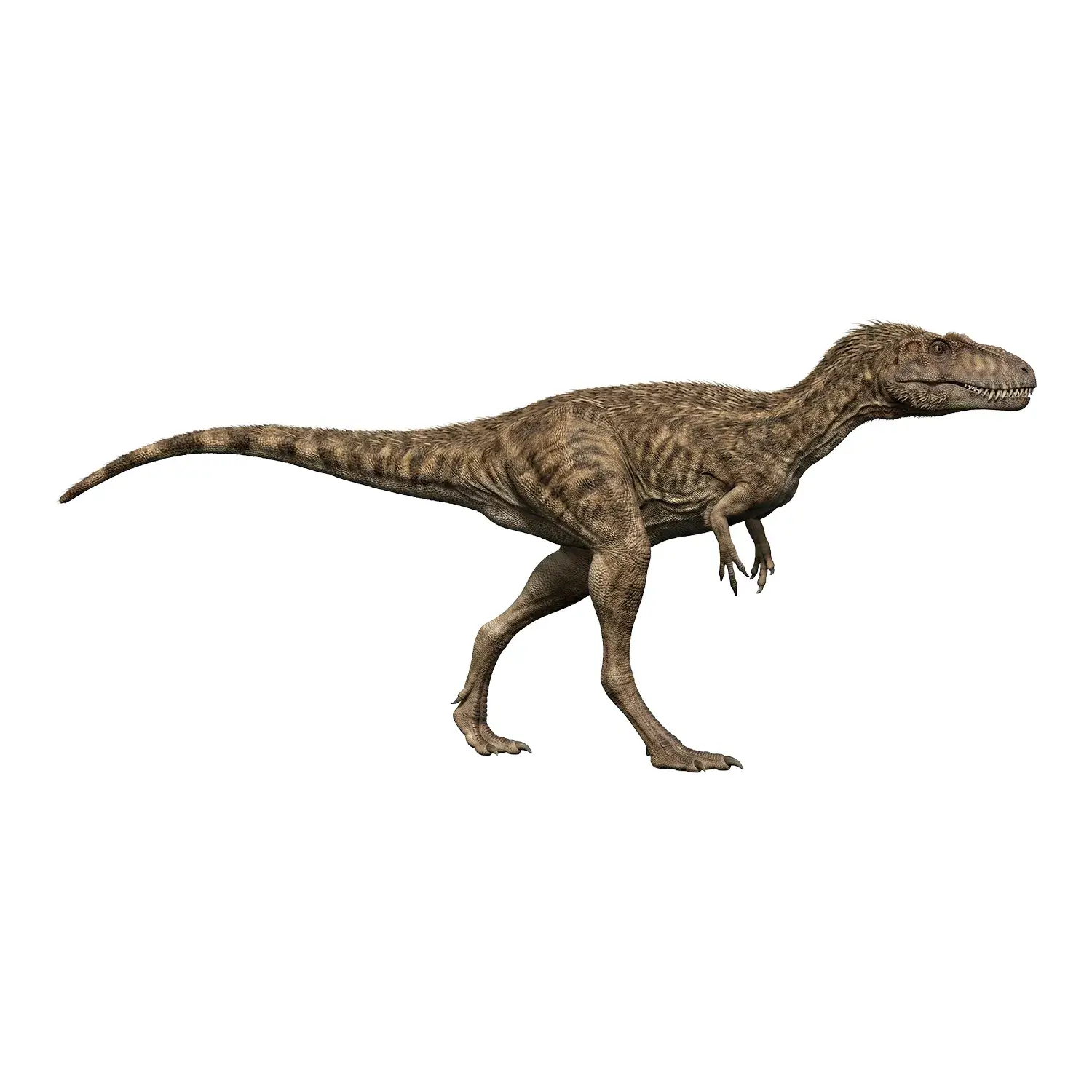
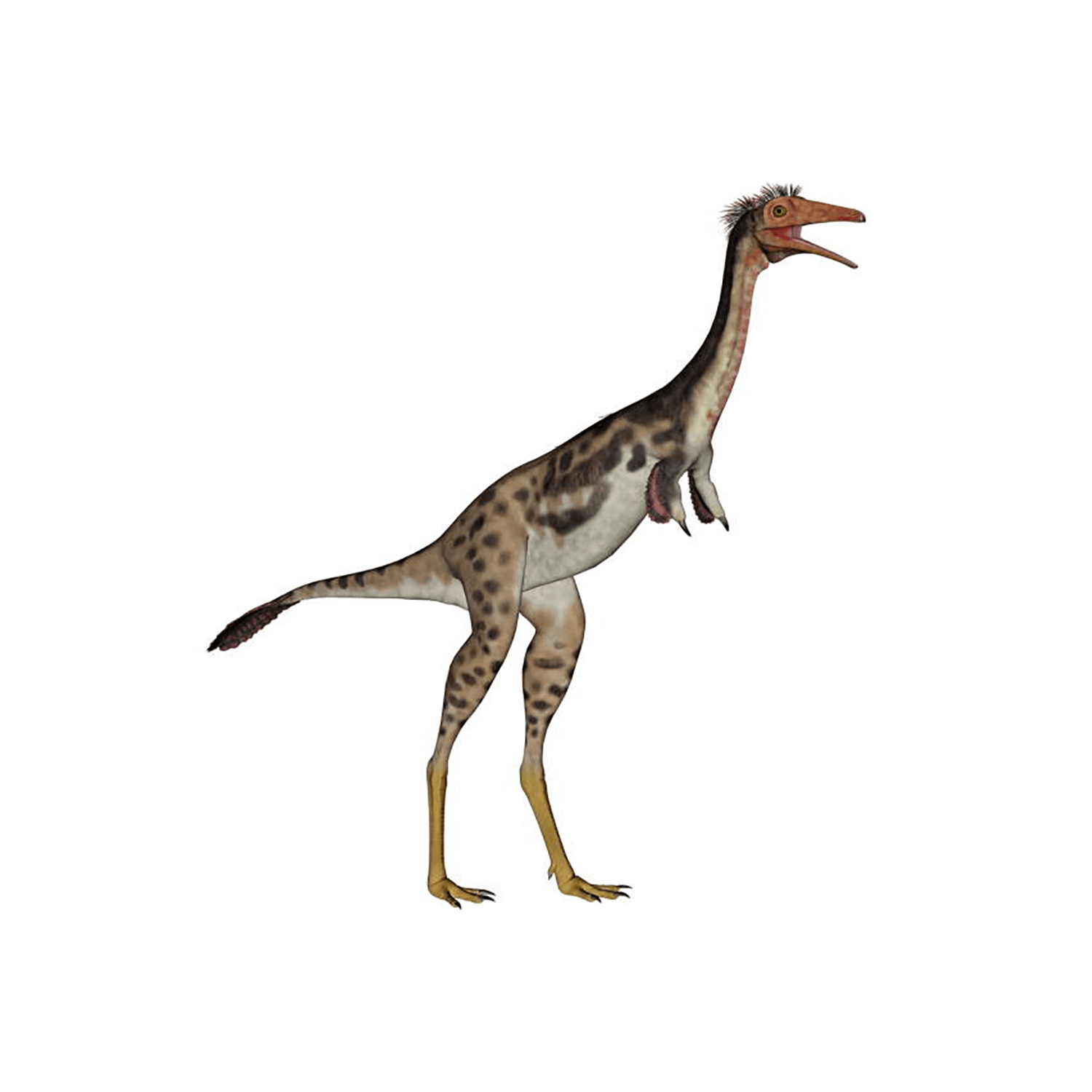
Moros
Name Origin
Derived from the "embodiment of impending doom" in Greek mythology
Family
Tyrannosauroidea
Classification
Diapsida, Saurischia, Theropoda
Habitat (Discovery Location)
United States
Period
Late Cretaceous
Length
Approximately 2 meters
Weight
Approximately 78 kg
Diet
Carnivore (Meat-eater)
 Jurassic
Park / World Featured Dinosaur
Appearance in Jurassic World: Dominion
In the film, it is set up and portrayed as a dinosaur significantly smaller than its real-life counterpart.
It appears in the movie's Prologue (a sequence depicting prehistoric times), where it is shown coexisting with the Tyrannosaurus and other species during the Cretaceous period.
A particularly memorable scene involves it approaching a sleeping Giganotosaurus. Behaving much like the relationship between a crocodile and a plover, the Moros lingers around the Giganotosaurus's mouth, pecking at food scraps and appearing to clean its teeth. It is a moment that offers a glimpse into a unique relationship between a massive predator and the tiny Moros.
Millions of years later, in the modern era, it has been resurrected by Biosyn's technology, appearing just as it did in ancient times.
In the main story, it is kept within the research facility at the "Biosyn Sanctuary," where Biosyn's headquarters are located. It is depicted inside a glass-enclosed habitat, hunting and devouring a jerboa provided as food.
You might also like... 

-
 Neovenator
- Classification
- Theropods
- Characteristics
- Carnivorous
- Era
- Cretaceous period
- Antarctopelta
- Classification
- Thyreophora
- Characteristics
- Herbivorous
- Era
- Cretaceous period
- Saurornitholestes
- Classification
- Theropods
- Characteristics
- Carnivorous
- Era
- Cretaceous period
- Maxakalisaurus
- Classification
- Sauropods
- Characteristics
- Herbivorous
- Era
- Cretaceous period
-
Sponsored Links
-
Sponsored Links







![[Latest Research] What Was the Function of Spinosaurus's Giant "Sail"? Exploring the Mysteries of Thermoregulation and Underwater Locomotion](https://dinosaurmuseum.jp/wp/wp-content/uploads/eyecatch_spinosaurus-sail-function_en-1024x512.webp)
![[Latest Discovery] A Third Type of Skin, Neither Scales Nor Feathers? Meet "Haolong dongi," a New Dinosaur Species Covered Entirely in Spikes](https://dinosaurmuseum.jp/wp/wp-content/uploads/eyecatch_dinosaur-spiky-skin-discovery_en-1024x512.webp)

Description
Moros intrepidus.
On February 21, 2019, this name sent shockwaves through the world of paleontology.
Discovered in the Cedar Mountain Formation of Utah, USA, this dinosaur is a tyrannosauroid theropod that lived in North America during the Late Cretaceous period, belonging to the same superfamily as the Tyrannosaurus.
Why is this dinosaur so important?
It is the “oldest tyrannosauroid” specimen ever found in North America, a discovery that pushes back the history of the Tyrannosaurus lineage on the continent by approximately 15 million years.
The Origin of the Name: “Impending Doom”
The scientific name “Moros intrepidus” encapsulates the singular fate borne by this small dinosaur and the grand evolutionary history that followed.
Genus Name “Moros”
Derived from the “embodiment of impending doom” in Greek mythology.
This reflects the future where their descendants (the Tyrannosaurus superfamily) would establish dominance over the North American continent, becoming a “threat (doom)” to other species.
Species Name “intrepidus”
Meaning “fearless” or “intrepid” in Latin.
It symbolizes the hypothesis that, following Moros, their lineage boldly distributed and expanded across North America.
Discovered Fossils and the 10-Year Journey
Leading up to this crucial discovery was a long struggle by paleontologists.
It began after 10 years of excavation surveys by Lindsay Zanno and her team, when, in 2013, leg bones were found protruding from a hillside.
The holotype specimen (NCSM 33392) currently consists of the following parts:
At first glance, one might dismiss it as “just another nondescript dinosaur with too few fossils to understand.”
However, these scant clues are the key to filling an important missing link that connects more basal forms like Appalachiosaurus and Dryptosaurus to the Tyrannosaurus family.
Small but Agile Hunter: Physical Characteristics
The discovered individual is estimated to be 6 to 7 years old.
Unlike the massive Tyrannosaurus we imagine, the Moros of that time possessed a very small and slender physique.
The “Arctometatarsal Condition” Specialized for Running
Its leg bones were extremely slender, with metatarsal proportions closer to ornithomimosaurs than to the large tyrannosauroids of the same period.
Of particular note is the presence of the “arctometatarsal condition,” where the third metatarsal is pinched between the second and fourth.
This structure is highly suited for running, indicating that highly cursorial tyrannosauroids had appeared in North America by the Cenomanian stage of the Late Cretaceous at the latest.
They survived the harsh world using their agile feet and developed sensory organs as weapons.
In the Shadow of the Giant Ruler “Siats”
The environment Moros inhabited was by no means a paradise for them.
Reigning at the top of the ecosystem at the time were the “Siats meekerorum,” massive carnivorous dinosaurs derived from the Allosaurus superfamily.
At the time, Moros was merely an existence that survived by scavenging the leftovers of these apex predators. To put it extremely, they might have held a status where they would be scoffed at even by the smaller Deinonychus.
In the 2019 phylogenetic analysis by Zanno and colleagues, Moros was placed near Asian taxa such as Xiongguanlong and Timurlengia, identified as a basal pantyrannosaur.
This suggests that Moros represents a biota that migrated from Asia to North America, successfully entering the continent by the end of the Early Cretaceous (Albian).
A Bridge to the Future “Tyrant”
Until changes in terrain and climate occurred and the competing Allosaurus superfamily was wiped out, they could not take the seat of the apex predator.
However, they never gave up and continued to change.
Eventually, they surpassed the descendants of the reigning Siats meekerorum and, over a long period, climbed to the top of the ecosystem, evolving into the mighty Tyrannosaurus we know so well.
While the full picture remains shrouded in mystery, Moros intrepidus is far from “nondescript”; it is a crucial existence promised a future throne.
Dinosaur fans everywhere are watching closely for future investigations and research.