Chasmosaurus


Name Origin
Opening Lizard
Family
Ceratopsidae
Classification
Diapsida, Ornithischia, Marginocephalia
Habitat (Discovery Location)
United States, Canada
Period
Approximately 76.5–75.5 million years ago (Late Cretaceous)
Length
Approximately 5 meters
Weight
Approximately 2.5–3.6 tons
Diet
Herbivore (Plant-eater)
You might also like... 

-
 Bajadasaurus
- Classification
- Sauropods
- Characteristics
- Herbivorous
- Era
- Cretaceous period
- Pycnonemosaurus
- Classification
- Theropods
- Characteristics
- Carnivorous
- Era
- Cretaceous period
- Shuvuuia
- Classification
- Theropods
- Characteristics
- Carnivorous
- Feathered
- Era
- Cretaceous period
- Aquilops
- Classification
- Marginocephalia
- Characteristics
- Herbivorous
- Era
- Cretaceous period
-
Sponsored Links
-
Sponsored Links





![[Latest Research] What Was the Function of Spinosaurus's Giant "Sail"? Exploring the Mysteries of Thermoregulation and Underwater Locomotion](https://dinosaurmuseum.jp/wp/wp-content/uploads/eyecatch_spinosaurus-sail-function_en-1024x512.webp)
![[Latest Discovery] A Third Type of Skin, Neither Scales Nor Feathers? Meet "Haolong dongi," a New Dinosaur Species Covered Entirely in Spikes](https://dinosaurmuseum.jp/wp/wp-content/uploads/eyecatch_dinosaur-spiky-skin-discovery_en-1024x512.webp)

Description
The Late Cretaceous period marked the final chapter of the dinosaur era.
During this time, the North American continent—specifically around present-day Alberta, Canada—was a paradise where a wide variety of horned dinosaurs (ceratopsians) flourished.
Among them was a dinosaur possessing an eye-catching, massive “frill.”
Its name is “Chasmosaurus.”
While it is a key dinosaur that serves as the benchmark for the Chasmosaurinae subfamily (relatives of Triceratops), its frill hid a surprising secret that might appear to be a weakness at first glance.
“Lizard with Large Openings”: Was 80% of the Frill Hollow?
Origin of the Scientific Name
The scientific name “Chasmosaurus” derives from the Greek word “chasma” (meaning large hole or opening), translating to “Opening Lizard” (or “Chasm Lizard”).
Why was it given such a name? One look at its frill—its identity—makes the reason obvious.
Huge “Holes” Occupying Most of the Surface Area
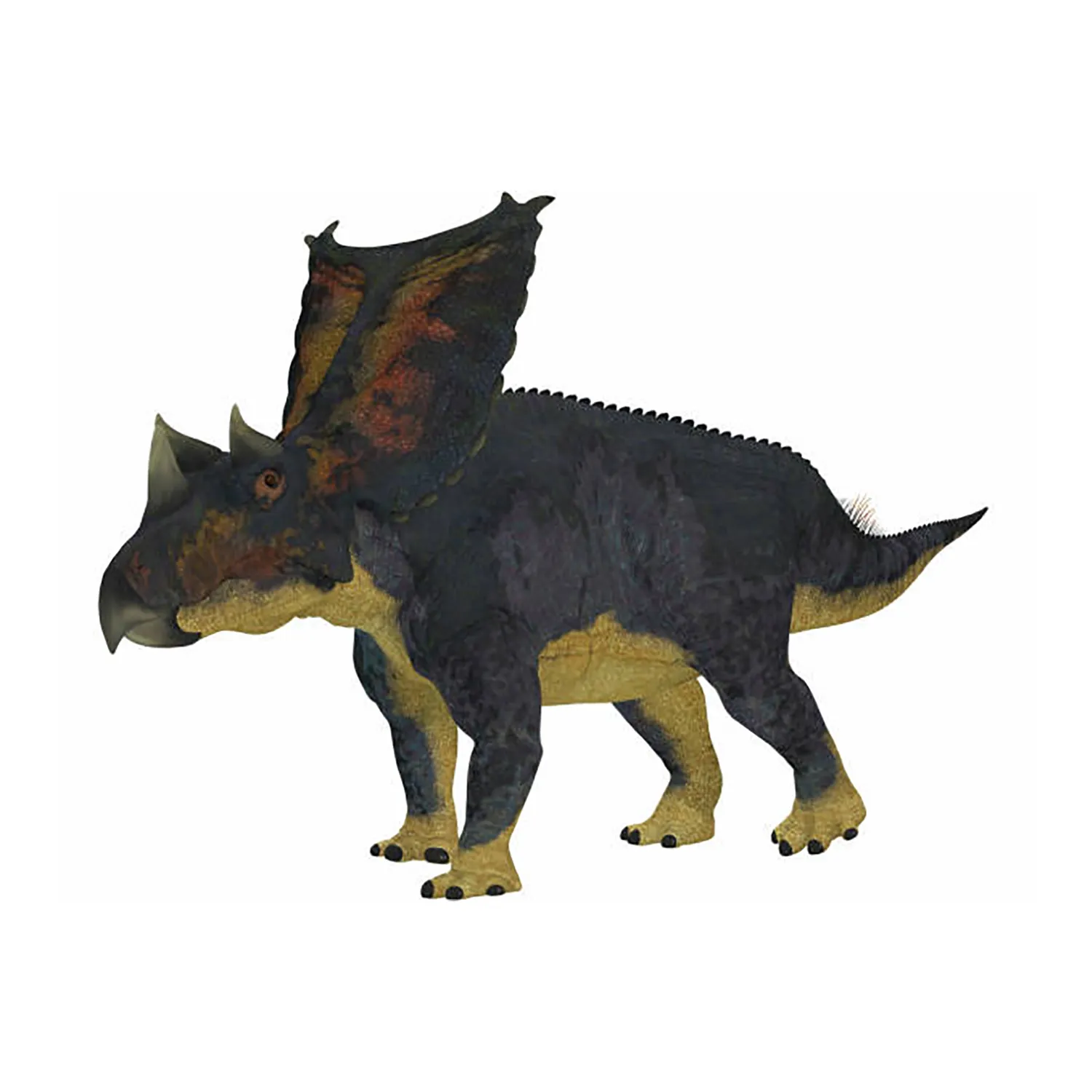
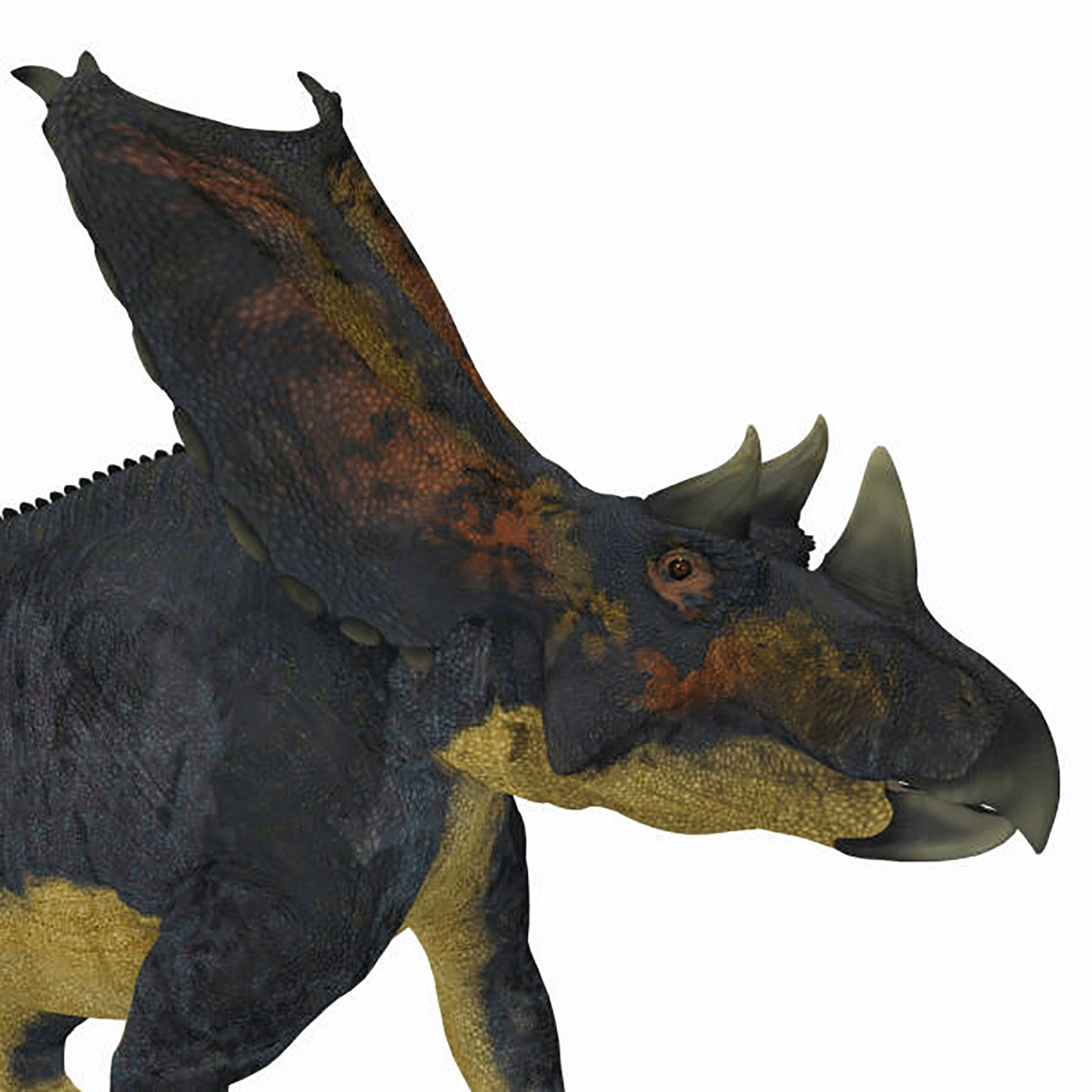
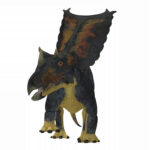
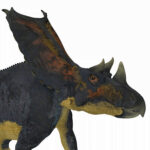
The frill of Chasmosaurus was a massive rectangle reaching over 1 meter in width and 1.5 meters in length, but it was not a “solid shield” like that of Triceratops.
There were gaping openings on the left and right sides; surprisingly, more than 80% of the surface area was hollow (consisting only of a bone frame).
80% of the frill was hollow
The Role of the Massive Frill: Weight Reduction and Display
For what purpose did this massive, hole-filled frill exist?
“Weight Reduction” is Certain
First, “weight reduction” is considered a certainty.
If the entire frill were solid thick bone, it would be too heavy to support with the neck.
By reducing the bone to the absolute limit and opening holes, it is believed they could move nimbly while maintaining a huge ornament.
*In living individuals, these holes were covered by skin and muscle.
The “Display Theory” is the Leading Candidate
Currently, the most dominant theory is that the frill was used as a “billboard (display).”
Blood vessels ran through the skin, and it is possible they flushed blood to change color to intimidate rivals or displayed vivid colors to court the opposite sex.
Defense Theory and the “Defensive Circle”
It was once thought to be a defensive shield, but a frill full of holes is too fragile for physical attacks.
However, in group battles, it may have been a different story.
When attacked by carnivorous dinosaurs, they likely formed a defensive circle like musk oxen, sheltering the children in the center.
It is believed that by facing outward and lining up their massive frills, the adults created a visual “barricade” to intimidate enemies.
The Mystery of the Horns and Herds of 1,000
Horns That Disappear with Growth?
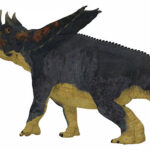
Chasmosaurus possessed three horns on its forehead and nose, but they were not as developed as those of Triceratops.
In recent years, theories such as “supraorbital horns (brow horns) being absorbed and shortened as they grew” or that the differences represent sexual dimorphism (differences between males and females) are being debated.
Bone Beds on a Scale of 1,000
In Alberta, Canada, “bone beds” containing fossils of many individuals gathered in one place have been discovered.
These are traces of entire herds being washed away by floods, suggesting that Chasmosaurus formed massive groups, sometimes reaching up to 1,000 individuals, and lived with a high degree of sociality.
Fossil “Children” That Thrilled Researchers
Chasmosaurus is one of the most thoroughly researched ceratopsians.
The reason lies in the “quality” and “quantity” of the fossils.
Skin and the Discovery of Juveniles
Many high-quality fossils exist, including “skin fossils” with scale impressions.
Furthermore, what delighted researchers was the excavation of multiple well-preserved “child fossils (juveniles).”
It is rare for the fragile bones of juveniles to remain, and this provided valuable clues for understanding changes in body shape (such as head-to-body balance) associated with growth.
Taxonomic Changes and Museums in Japan
Consolidation from 10 Species to 2
In the past, due to individual differences and growth stages, fossils were often classified as separate species, and it was said that over 10 species existed.
Currently, classification has been organized, and the following two are considered the main valid species.
Chasmosaurus belli
Has short supraorbital horns.
Chasmosaurus russelli
A primitive species with supraorbital horns.
Exhibitions in Japan
You can see reconstructed skeletons in Japanese museums, but names may change due to shifts in classification.
For example, a skeleton once labeled as “a species of Chasmosaurus” at the Fukui Prefectural Dinosaur Museum is now considered highly likely to be “Albertaceratops” or “Medusaceratops.” Information is constantly updated alongside research.