
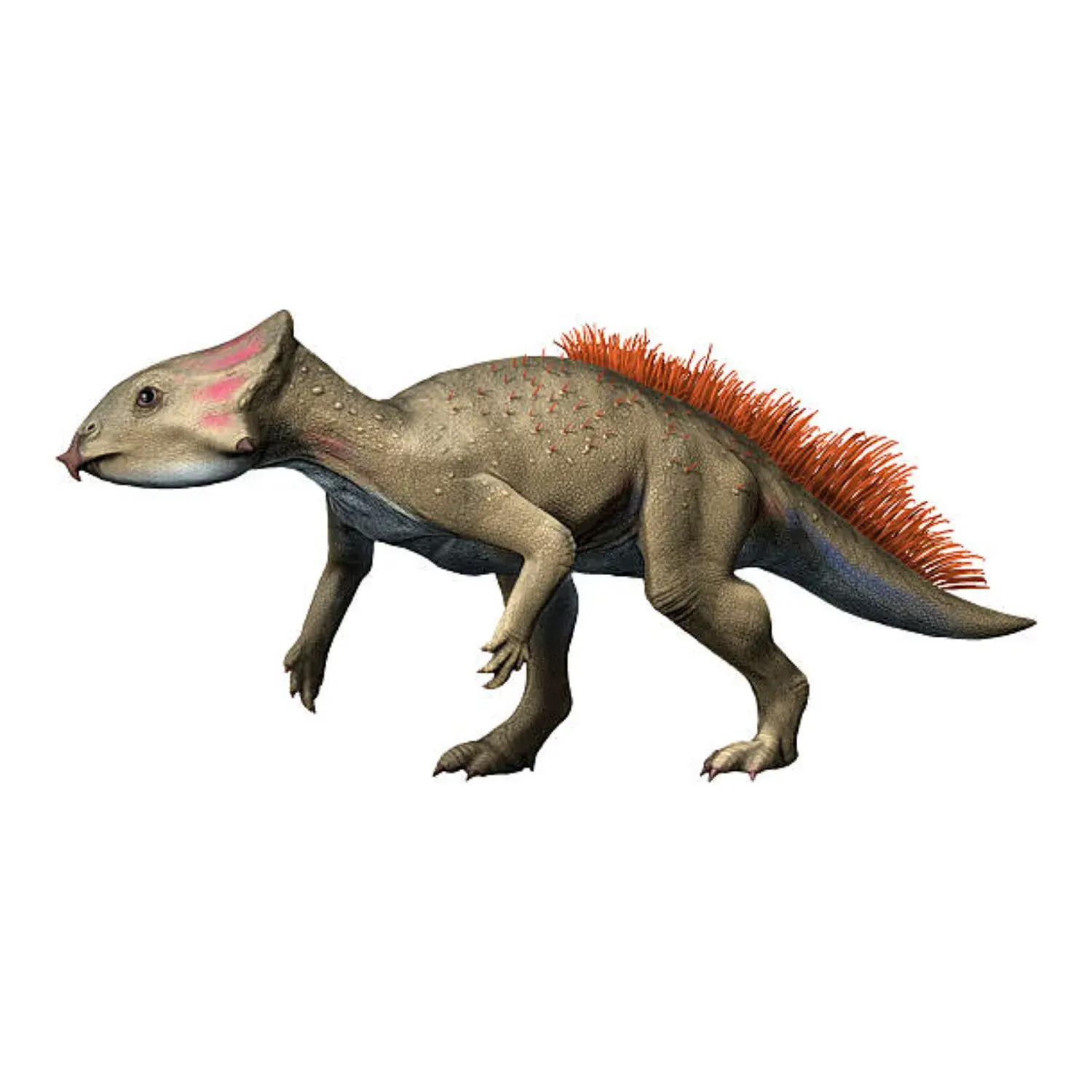
Aquilops

Name Origin
Eagle Face
Classification
Diapsida, Ornithischia, Marginocephalia
Habitat (Discovery Location)
United States
Period
Approximately 108–104 million years ago (Early Cretaceous)
Length
Approximately 60 cm
Weight
Approximately 1.5 kg
Diet
Herbivore
 Jurassic
Park / World Featured Dinosaur
Appearance in Jurassic World: Rebirth
The individual appearing in the film is a juvenile, roughly the size of a puppy. Named "Dolores," she is depicted as being incredibly attached to the character Isabella.
Her charm is one of the highlights of the film. In a moment sure to delight fans, she is shown not only sticking by Isabella's side but even hitching a ride inside her backpack to travel along with her.
Despite possessing the cuteness of a beloved pet, she also retains the sharp instincts of a wild dinosaur.
As a small dinosaur, Aquilops is characterized by extreme vigilance against predators. In the story, she is shown keenly sensing approaching large predators, playing a vital role in keeping the group safe from danger.
You might also like... 

-
 Oviraptor
- Classification
- Theropods
- Characteristics
- Omnivorous
- Feathered
- Era
- Cretaceous period
- Struthiomimus
- Classification
- Theropods
- Characteristics
- Herbivorous
- Omnivorous
- Feathered
- Era
- Cretaceous period
- Torosaurus
- Classification
- Marginocephalia
- Characteristics
- Herbivorous
- Era
- Cretaceous period
- Nothosaurus
- Classification
- Marine reptiles
- Characteristics
- Carnivorous
- Era
- Triassic period
-
Sponsored Links
-
Sponsored Links











Description
Aquilops is a ceratopsian dinosaur that lived on the North American continent during the Early Cretaceous period, approximately 108 to 104 million years ago.
With a small total length of only about 60 cm and the distinctive snout that inspired its name, this dinosaur is known as one of the oldest types of ceratopsians ever discovered in North America.
Origin of the Name and Basic Data
The scientific name Aquilops is derived from a combination of Latin and Ancient Greek.
Meaning of the Name
Latin for “Eagle” (aquila) + Ancient Greek for “Face” (ops) = “Eagle Face”
Type Species
Aquilops americanus
This specific name was chosen to commemorate the fact that it was the first “very basal neoceratopsian” discovered in the United States.
History from Discovery to Naming: Recognized as a New Species After 17 Years
The first fossil of Aquilops was discovered in 1997.
An expedition supported by National Geographic excavated a single partial skull from the Cloverly Formation (Albian stage) in Carbon County, southern Montana.
The discoverer was paleontologist Scott Madsen.
Was it Mistaken for Another Dinosaur at First?
It was not introduced to the world as “Aquilops” immediately upon discovery.
Initially, while the specimen was undergoing preparation, it was described as a different dinosaur, Zephyrosaurus.
Later, Madsen himself realized it was a new species, but it took a long time for it to be formally recognized.
Finally, in 2014—17 years after its discovery—it was named and described by Andrew Farke and colleagues, etching the name Aquilops into history.
Only 60cm Long! Physical Characteristics of the “Eagle Face”
Aquilops was a very small dinosaur.
According to estimates by paleontologist Mathew Wedel, its dimensions were as follows:
Unique Features Proposed by the Describers
As its name implies, Aquilops possessed unique facial features.
An Eagle-like Beak
This is the most defining feature of Aquilops.
The bone core of the beak curves downward, and the front possesses an arched keel with a bump.
Distinctive Dentition
The tooth row in the back of the upper jaw, when viewed from the front, is longer than the entire length of the depression seen from the side.
Pointed Antorbital Fenestra
The antorbital fenestra (the opening in front of the eye socket) is twice as long as it is tall, pointing backward and extending beneath the eye socket.
Classification and Evolution: Between Psittacosaurus and Protoceratops
Taxonomically, it is considered to have occupied a position more advanced than the famous ceratopsian Psittacosaurus, but more primitive than Protoceratops.
As a very basal neoceratopsian, it is a crucial piece of the puzzle in understanding the evolutionary process of horned dinosaurs.
Remaining Mysteries: No Frill or Body Found?
Many mysteries still surround the detailed ecology of Aquilops.
Only “Part of the Head” Has Been Found
To date, only a partial skull including the upper and lower jaws has been discovered.
Most of the back of the head and the palate are missing. Not only are the body bones—necessary to know the dinosaur’s full appearance—missing, but even the “frill,” a symbol of ceratopsians, has not been found.
The Specimen Was Likely a “Child”
Furthermore, the discovered holotype specimen itself is likely not a fully mature individual, but a “sub-adult.”
Studies comparing it with related species suggest this specimen was about 60% of the size of an adult.
In other words, the Aquilops we know is still in the growth phase, and no one yet knows what a fully grown adult looked like.
Hopes for Further Discoveries
Due to the extremely low number of specimens—and the fact that only partial sub-adult fossils have been found—the full picture of Aquilops remains unclear.
To understand the true appearance of this mysterious dinosaur with the “Eagle Face,” further fossil discoveries are essential.