
Yutyrannus
Name Origin
Feathered Tyrant (Referring to Yutyrannus)
Family
Proceratosauridae
Classification
Diapsida, Saurischia, Theropoda
Habitat (Discovery Location)
China
Period
Approximately 124.6 million years ago (Early Cretaceous)
Length
Approximately 9 meters
Weight
Approximately 1.4 tons
Diet
Carnivore (Meat-eater)
You might also like... 

-
 Teratophoneus
- Classification
- Theropods
- Characteristics
- Carnivorous
- Era
- Cretaceous period
- Sinosauropteryx
- Classification
- Theropods
- Characteristics
- Carnivorous
- Feathered
- Era
- Cretaceous period
- Dilophosaurus
- Classification
- Theropods
- Characteristics
- Carnivorous
- Era
- Jurassic period
- Anurognathus
- Classification
- Flying reptiles
- Era
- Jurassic period
-
Sponsored Links
-
Sponsored Links




![[Latest Research] What Was the Function of Spinosaurus's Giant "Sail"? Exploring the Mysteries of Thermoregulation and Underwater Locomotion](https://dinosaurmuseum.jp/wp/wp-content/uploads/eyecatch_spinosaurus-sail-function_en-1024x512.webp)
![[Latest Discovery] A Third Type of Skin, Neither Scales Nor Feathers? Meet "Haolong dongi," a New Dinosaur Species Covered Entirely in Spikes](https://dinosaurmuseum.jp/wp/wp-content/uploads/eyecatch_dinosaur-spiky-skin-discovery_en-1024x512.webp)
Description
For many years, the image of Tyrannosaurus was firmly established as a “giant reptile covered in scales.”
However, a discovery reported from China in 2012 overturned this conventional wisdom.
It is “Yutyrannus.”
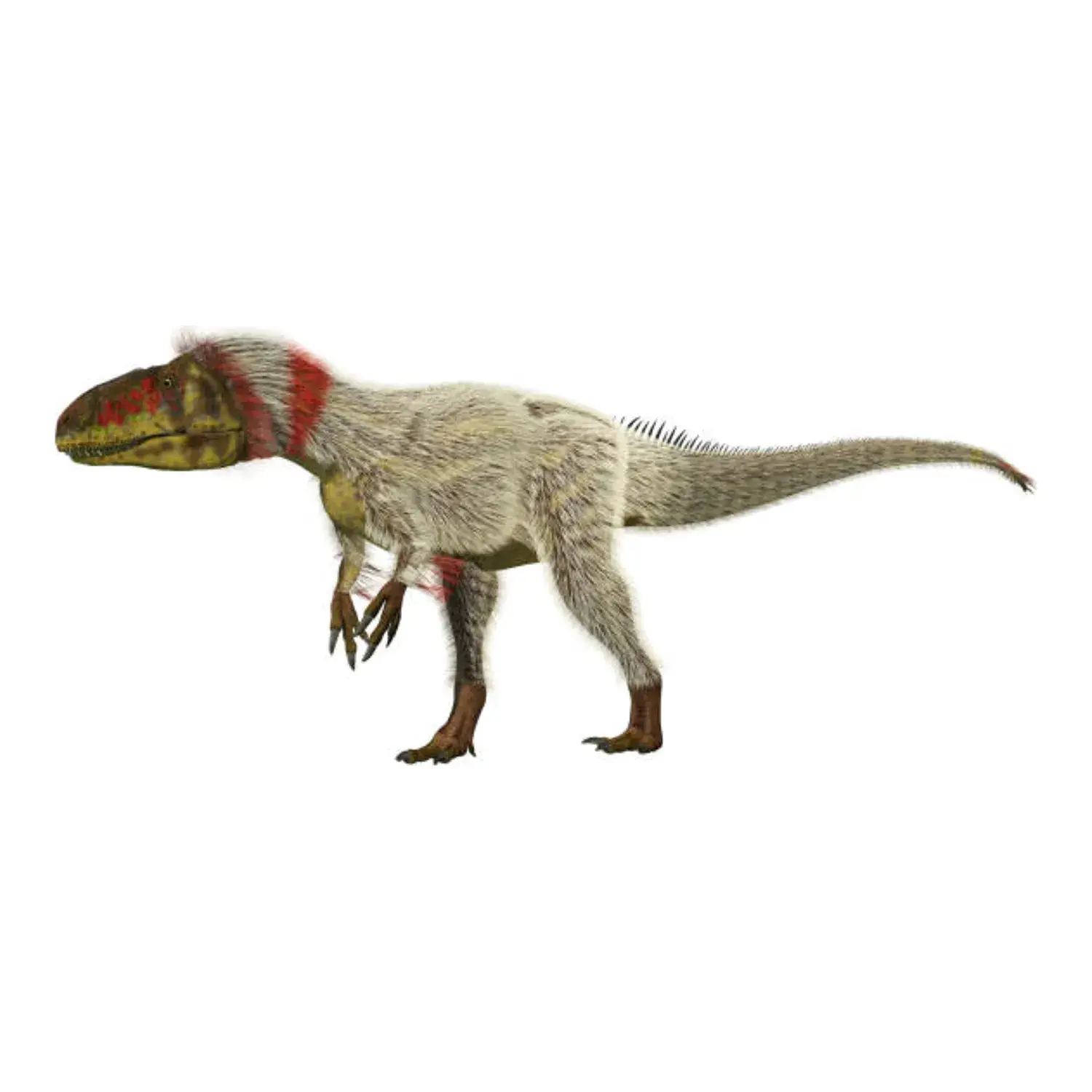
This dinosaur, which lived in the Early Cretaceous, was a giant with a total length of about 9 meters, yet its entire body was covered in feathers.
The Meaning of “Feathered Tyrant” and its Massive Size
The scientific name Yutyrannus combines the Chinese word for “feather (Yu)” and the Latin word for “tyrant (Tyrannus),” translating literally to “Feathered Tyrant.”
This name emphasizes the fact that despite being a tyrannosaur, they possessed clear “feathers.”
The Largest Hunter in the Region at the Time
Although classified as a primitive tyrannosaur (Proceratosauridae), its physique was imposing.
This made it one of the largest carnivorous dinosaurs in its habitat at the time, boasting a size comparable to Allosaurus.
Large Dinosaurs Were Fluffy Too? The Shock of the Feather Discovery
The discovery of Yutyrannus sent shockwaves through the world of paleontology.
A Miraculous Fossil Preserving Three Generations
Although crushed by geological pressure over time, the discovered fossils were in near-perfect condition with almost the entire body remaining.
Furthermore, individuals from three different growth stages—juvenile, sub-adult, and adult—were found together, making them valuable resources for understanding the growth process.
Overturning the Theory That “Large Dinosaurs Don’t Need Feathers”
Previously, it was thought that “feathers would not grow on large animals because they retain body heat too easily.” However, the fact that the 9-meter-long Yutyrannus had feathers proved that “large dinosaurs could also possess feathers.”
However, it is known that the region of China where they lived was experiencing a “cooling” period at the time.
Therefore, current reconstructions of Tyrannosaurus (which lived in warmer regions) assume an appearance adapted to its environment, rather than being fluffy all over like Yutyrannus.
Different from T. rex? Three Fingers and a Crest
Yutyrannus is a tyrannosaur, but it possesses primitive characteristics different from the evolved Tyrannosaurus.
Three Fingers
While the forelimbs of Tyrannosaurus have two fingers, Yutyrannus had three developed claws.
Crest on the Snout
It had a single crest with a wrinkled surface on its snout, resembling that of Monolophosaurus.
Short Hind Limbs
Its legs were somewhat short for a tyrannosaur.
D-Shaped Teeth
The fact that the cross-section of its front teeth is shaped like the letter “D” is proof of its shared identity as a tyrannosaur.
Apex of the Ecosystem and “Pack” Hunting
Yutyrannus lived in the “Jehol Group,” a treasure trove of feathered dinosaurs.
They reigned at the top of the ecosystem, preying on Sinosauropteryx, Microraptor, and even large herbivorous dinosaurs (such as Dongbeititan).
Since the three discovered individuals were found in the same place, it has been suggested that they may have cooperated in hunting as a family or pack.
From the condition of the fossils, it is also speculated that they were caught in a disaster, such as a landslide, during a hunt and were buried together with their prey.
The Same Dinosaur as Sinosauropteryx? A Bold Hypothesis
Finally, let’s introduce an interesting theory.
Because its features resemble those of the small feathered dinosaur “Sinosauropteryx” found in the same geological formation, some researchers propose the theory that “Yutyrannus might actually be the fully grown form (adult) of Sinosauropteryx.”
If this turns out to be true, the name “Yutyrannus” would disappear, and it would be consolidated as a “giant Sinosauropteryx.”