
Eotyrannus
Name Origin
Dawn Tyrant
Family
Tyrannosauroidea
Classification
Diapsida, Saurischia, Theropoda
Habitat (Discovery Location)
United Kingdom
Period
Approximately 130 million years ago (Early Cretaceous)
Length
Approximately 4–5 meters
Weight
Approximately 100–200 kg
Diet
Carnivore (Meat-eater)
You might also like... 

-
 Suchomimus
- Classification
- Theropods
- Characteristics
- Carnivorous
- Era
- Cretaceous period
- Huaxiagnathus
- Classification
- Theropods
- Characteristics
- Carnivorous
- Era
- Cretaceous period
- Leaellynasaura
- Classification
- Ornithopoda
- Characteristics
- Herbivorous
- Era
- Cretaceous period
- Nomingia
- Classification
- Theropods
- Characteristics
- Omnivorous
- Feathered
- Era
- Cretaceous period
-
Sponsored Links
-
Sponsored Links









![[Latest Research] What Was the Function of Spinosaurus's Giant "Sail"? Exploring the Mysteries of Thermoregulation and Underwater Locomotion](https://dinosaurmuseum.jp/wp/wp-content/uploads/eyecatch_spinosaurus-sail-function_en-1024x512.webp)
![[Latest Discovery] A Third Type of Skin, Neither Scales Nor Feathers? Meet "Haolong dongi," a New Dinosaur Species Covered Entirely in Spikes](https://dinosaurmuseum.jp/wp/wp-content/uploads/eyecatch_dinosaur-spiky-skin-discovery_en-1024x512.webp)



Description
Early Cretaceous England.
Long before the appearance of massive predators like Tyrannosaurus, a dinosaur holding the key to the evolution of what would become the “strongest carnivorous dinosaur” inhabited the ecosystem of this foggy island.
This dinosaur, called Eotyrannus, bears a name with the valiant meaning of “dawn tyrant,” and it occupies a crucial position as a missing link in the evolutionary process of the tyrannosauroids.
Discovery of the “Dawn Tyrant”: On the Isle of Wight, the Island of Dinosaurs
The Meaning of “Dawn” Hidden in Its Scientific Name
The scientific name of Eotyrannus was coined from a combination of Greek words.
This name is derived from the fact that they belong to the superfamily Tyrannosauroidea, making them one of the earliest (from the “dawn” era) members of the Tyrannosaurus lineage that would go on to rule the earth in later eras.
Discovery in 1995 and Naming
Its fossils were discovered on the “Isle of Wight” in southern England.
This location is a world-renowned treasure trove of dinosaur fossils, also known for producing the armored dinosaur Polacanthus and the carnivorous dinosaur Neovenator.
Bones discovered by a local fossil collector around 1995 sparked the research, and after detailed study, it was formally named as a new genus and species in 2001.
The Evolutionary Missing Link: Primitive “Arms” and Advanced “Teeth”
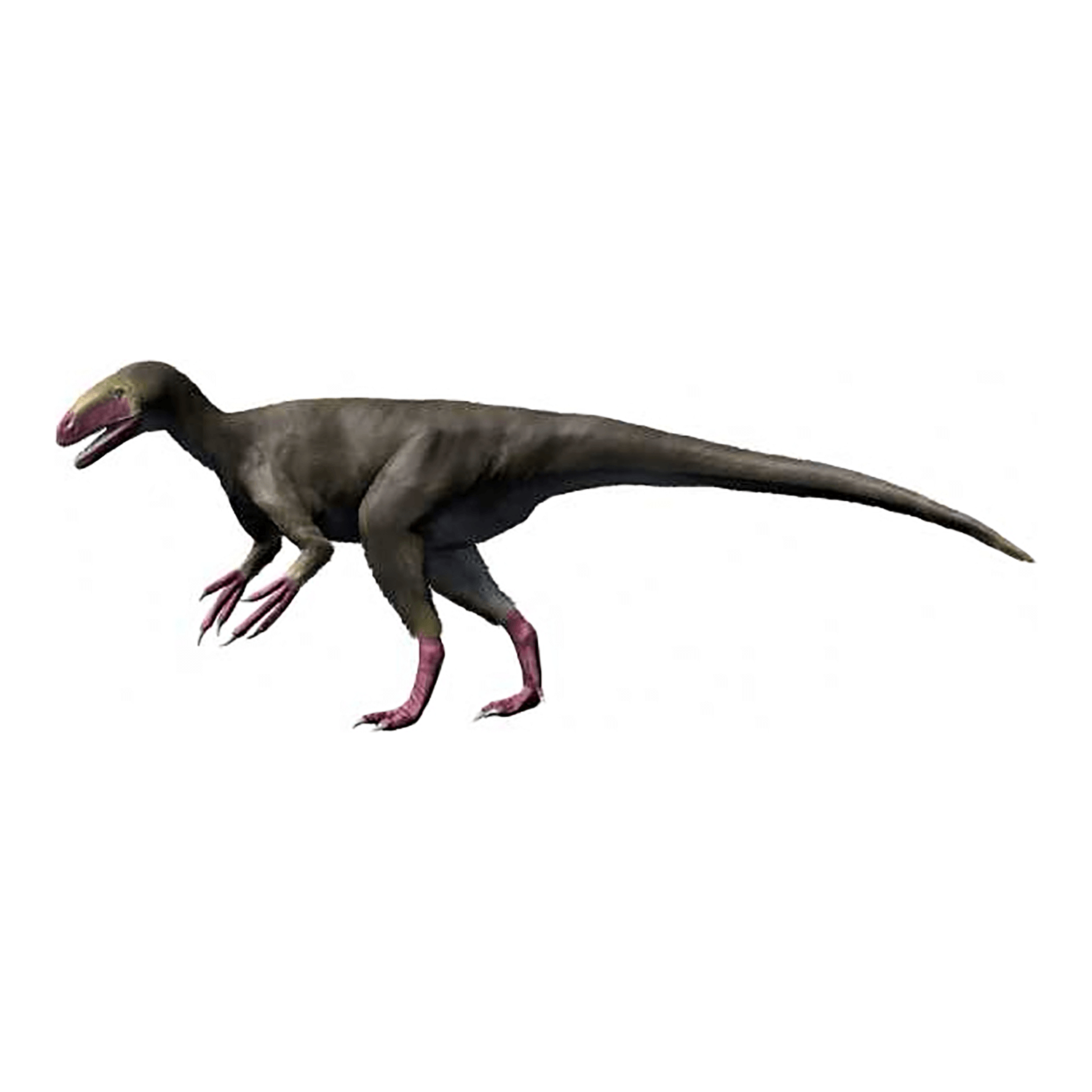
The body of Eotyrannus exhibits a puzzle-like mix of “advanced features” shared with the later Tyrannosaurus and “primitive features” inherited from its ancient ancestors.
“Long, Dexterous Arms” Retaining Ancestral Traits
What definitively sets it apart from derived tyrannosaurids are its “arms.”
While Tyrannosaurus is famous for its “short, two-fingered” forelimbs, Eotyrannus had well-developed, long forelimbs that featured “three” slender fingers.
This is a primitive ancestral trait, and it is believed they used these functional arms dexterously to grasp prey.
“D-Shaped Teeth”: A Guidepost to Tyrannosaurus
On the other hand, the decisive evidence showing they were tyrannosauroids is left in their skulls.
The cross-section of the teeth lining the front of the upper jaw was “D-shaped,” with serrations that pointed backward arranged in two rows.
This trait perfectly matches the typical characteristics seen in the later Tyrannosauridae family.
A Fleet-Footed Hunter
Additionally, their hind legs were slender, characterized specifically by long shin bones.
This indicates excellent running ability, and it is said they dashed across the land at high speeds with their sleek bodies.
*Regarding its classification, a theory suggesting it was a “megaraptoran” has been proposed in recent years, but it is currently widely accepted as an early member of the Tyrannosauroidea superfamily.
A Strategy of “Niche Partitioning” with Neovenator
Its Position as a Medium-Sized Predator
The estimated total length of Eotyrannus is 4 to 5 meters (13 to 16.4 feet).
While by no means small, the Isle of Wight at the time was home to even more massive predators.
Large predators like Neovenator and Baryonyx reigned at the top of the ecosystem, and compared to them, Eotyrannus was on the smaller side.
A Survival Strategy Utilizing Its Speed
If they fought head-on, there would be no chance of winning.
Therefore, Eotyrannus adopted a strategy to avoid direct competition with these large predators.
By utilizing their boast-worthy speed to move swiftly and preying primarily on smaller dinosaurs like Hypsilophodon, they secured a different niche (ecological standing) and survived.
A Mysterious Fossil and Its Connection to Japan (Fukui)
Poor Preservation and Remaining Mysteries
Although Eotyrannus is a highly important dinosaur, the fossils discovered so far are limited to claws, an ulna, parts of the skull, and so on, and their state of preservation is poor.
As a result, many mysteries still remain regarding the full picture of its anatomy, including its overall bodily proportions.
You Can See It at the Fukui Prefectural Dinosaur Museum!
Although it is a mysterious dinosaur discovered in the United Kingdom, you can actually see what it looked like in Japan.
A reconstructed skeleton of this Eotyrannus is on display at the “Fukui Prefectural Dinosaur Museum,” which boasts one of the largest dinosaur exhibits in the world.
Through this skeletal reconstruction based on the latest research, you can observe up close the form of what could be called the origin of Tyrannosaurus.