
Qantassaurus
Name Origin
Qantas Lizard (Named after the Australian airline)
Classification
Diapsida, Ornithischia, Ornithopoda
Habitat (Discovery Location)
Australia
Period
Early Cretaceous
Length
Approximately 2 meters
Weight
Approximately 45 kg
Diet
Herbivore (Plant-eater)
You might also like... 

-
 Imperobator
- Classification
- Theropods
- Characteristics
- Carnivorous
- Era
- Cretaceous period
- Pawpawsaurus
- Classification
- Thyreophora
- Characteristics
- Herbivorous
- Era
- Cretaceous period
- Bambiraptor
- Classification
- Theropods
- Characteristics
- Carnivorous
- Feathered
- Era
- Cretaceous period
- Atlascopcosaurus
- Classification
- Ornithopoda
- Characteristics
- Herbivorous
- Era
- Cretaceous period
-
Sponsored Links
-
Sponsored Links










![[Latest Research] What Was the Function of Spinosaurus's Giant "Sail"? Exploring the Mysteries of Thermoregulation and Underwater Locomotion](https://dinosaurmuseum.jp/wp/wp-content/uploads/eyecatch_spinosaurus-sail-function_en-1024x512.webp)
![[Latest Discovery] A Third Type of Skin, Neither Scales Nor Feathers? Meet "Haolong dongi," a New Dinosaur Species Covered Entirely in Spikes](https://dinosaurmuseum.jp/wp/wp-content/uploads/eyecatch_dinosaur-spiky-skin-discovery_en-1024x512.webp)



Description
While many dinosaur names are derived from physical characteristics or geographical locations, there exists a highly unique dinosaur that bears the name of a modern corporation—specifically, an “airline.”
That dinosaur’s name is “Qantassaurus.”
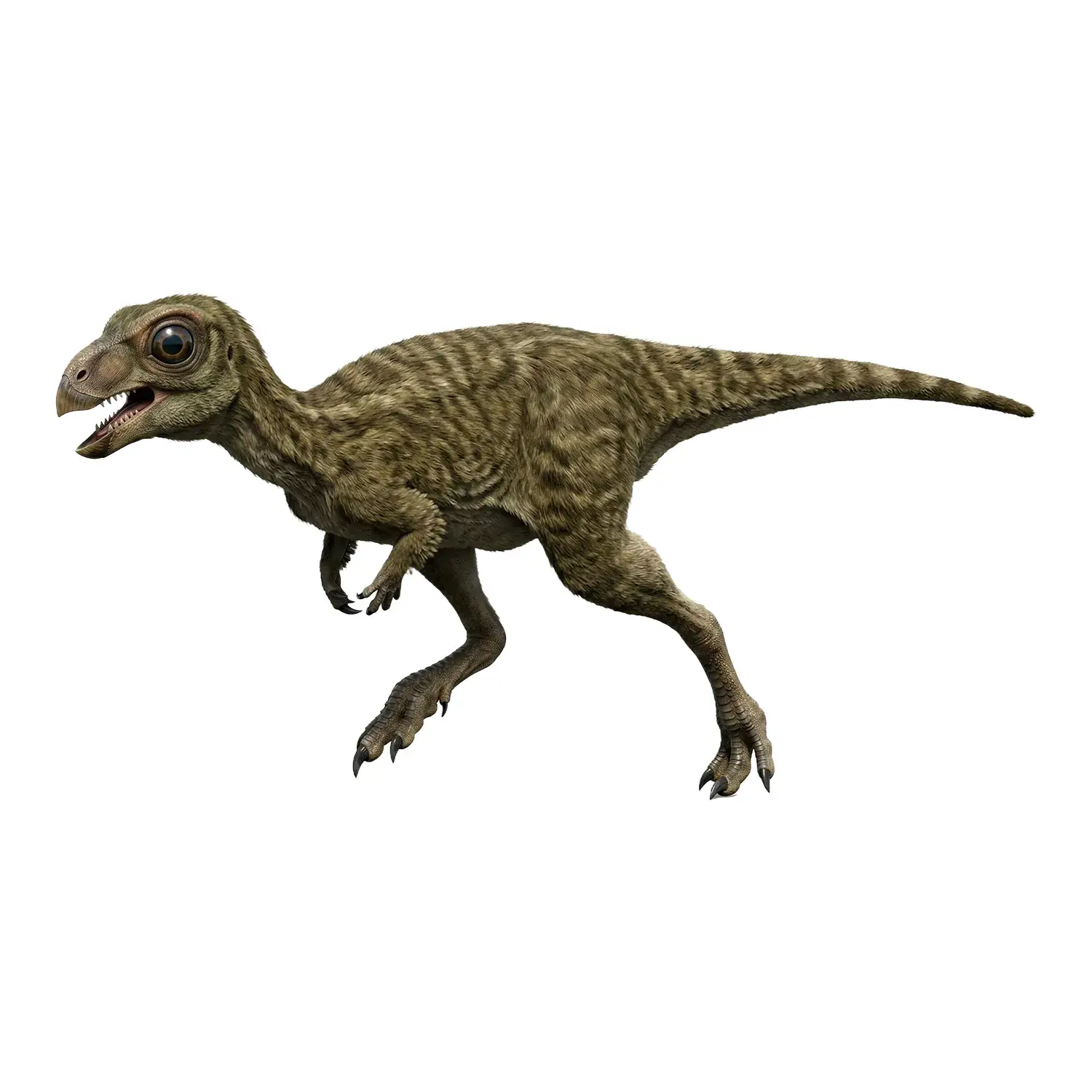
This small dinosaur, which lived in Early Cretaceous Australia, was a flightless biped.
Why was a non-flying dinosaur given the name of an airline?
And how did it survive in an environment of “freezing darkness,” so different from modern Australia?
We explain the surprising relationship with Qantas Airways and its amazing ecology adapted to the Antarctic Circle.
The Flightless “Qantas” Lizard: Returning a Favor to an Airline
Origin of the Scientific Name
The scientific name Qantassaurus literally translates to “Qantas Lizard.”
“Qantas” refers to Qantas Airways, Australia’s flag carrier.
There is a heartwarming backstory regarding the excavation project behind this seemingly strange naming.
Major Support for Fossil Transport
The fossils were discovered in 1996 by Patricia Vickers-Rich and her team.
Transporting excavated precious fossils and moving them to exhibitions around the world requires significant costs and delicate logistics.
At this time, it was Qantas Airways that provided tremendous cooperation and support for the Riches’ activities.
To repay this “kindness,” the discoverers adopted the corporate name for the scientific name when it was formally described in 1999.
Thus, a dinosaur from over 100 million years ago came to bear the name of modern wings of the sky.
The Truth Told by a Single “Jaw”
In fact, the only definitive fossil identified as Qantassaurus is the single “lower jaw bone” found at the time of discovery.
The fact that it was recognized as a new species despite the lack of a full skeleton speaks to how distinctive and unique this jawbone was.
A Swift Runner Like a Small Kangaroo
A Highly Mobile Small Dinosaur
Its reconstructed appearance is that of a dinosaur resembling a “small kangaroo” with a total length of about 1.8 meters.
Being herbivorous, their survival strategy lay in “speed.”
It is believed they sprinted while balancing with their long tails, gripping the ground with sharp claws to move around nimbly.
Distinctive “Teeth” and Classification
Unique characteristics have been revealed through research on the lower jaw, its only fossil.
The head was short and stocky, with 12 leaf-shaped teeth lining the back of the mouth.
The anatomical difference of having fewer teeth than related hypsilophodonts (which had 14 or more) indicates a unique evolution.
Currently, it is classified in the group “Elasmaria,” which developed uniquely in Australia and Antarctica.
Adaptability to Survive the Antarctic Darkness
The “Polar Night” of Gondwana
During the Early Cretaceous (about 115 million years ago), Australia was connected to Antarctica and located within the “Antarctic Circle.”
It was a harsh environment where “polar nights”—periods when the sun did not rise—continued through winter, and temperatures dropped to near freezing.
Evidence of “Warm-bloodedness” in Bones
Cold-blooded animals would hibernate, but Qantassaurus bones show no signs of halted growth (lines of arrested growth), revealing that they “continued to grow throughout the year.”
This is evidence that they possessed metabolic functions close to “endotherms (warm-blooded animals)” capable of maintaining their own body temperature without hibernating.
They harbored heat in their small bodies to fend off the cold.
Giant Eyes Seeing Through the Darkness
It is also known that their eye sockets (orbits) were extremely large and developed.
These large eyes were an evolution to capture faint light during the long winter darkness or in dim forests, suggesting they could be active even in the dark, much like nocturnal animals.