
Is the “Roar” a Myth? The Latest Science on What Tyrannosaurus Really Sounded Like

An iconic scene from the movie “Jurassic Park.”
The deafening “Roar!” of a giant Tyrannosaurus echoing alongside the rumbling of the earth.
For many people, that terrifying yet cool cry is the very image of a dinosaur.
But what if that roar was nothing more than “human imagination,” far removed from scientific fact?
Thanks to recent paleontological research, the mystery of how dinosaurs actually sounded and communicated is gradually being unraveled.
In this article, we will explain in detail the approaches used to uncover the true nature of “sounds” that do not fossilize, a world-first discovery originating from Japan, and the “real sounds of dinosaurs” derived from the latest science.
Why Don’t We Know What Dinosaurs Sounded Like?
As a basic premise, there are no audio recordings of dinosaur “voices.”
So, why can’t we reconstruct their cries from fossils?
Vocal Organs “Do Not Fossilize”
The organs responsible for producing sound (vocal cords, lungs, the syrinx in birds, etc.) are all made of “soft tissues” like muscle and cartilage.
Unlike hard bones and teeth, these decompose quickly after death, making it extremely rare for them to remain as fossils.
Because the mechanics of their vocalizations cannot be directly confirmed, filmmakers have synthesized the cries of various animals—such as lions, tigers, elephants, and crocodiles—to create a highly impactful, “imaginary roar.”
Three Approaches by Scientists
In the absence of direct evidence, scientists deduce ancient sounds from the following indirect clues:
- Comparative studies with modern living relatives (birds and crocodilians)
- Structural analysis of the skull and inner ear (using CT scans, etc.)
- Analysis of rarely discovered fossils from around the vocal organs
Hints About Vocalizations Provided by Relatives (Birds and Crocodilians)
The most important hints for deducing dinosaur voices come from their closest phylogenetic relatives: “birds” and “crocodilians.”
Hints from Birds: A Duck-Like Sound?
Birds are direct descendants that evolved from small theropods.
Birds do not have vocal cords; they sing using a “syrinx” located deep within the trachea.
In 2016, a syrinx was discovered for the first time in the world in a fossil of a dinosaur close to the ancestors of birds from the Late Cretaceous, found in Antarctica.
Among small theropods and feathered dinosaurs, there may have been species that chirped with sharp voices like modern birds, or produced simple sounds like the “quack” or “honk” of a duck or goose.
Hints from Crocodilians: Did Tyrannosaurus Use “Closed-Mouth Vocalization”?
Crocodilians do not roar with their mouths wide open; instead, they use “closed-mouth vocalization,” emitting a low rumble from deep within their throats with their mouths closed.
By vibrating their body cavities, they produce an intimidating, deep bass sound that carries over long distances.
In recent years, the hypothesis that large carnivorous dinosaurs like Tyrannosaurus also used this “closed-mouth vocalization” has garnered attention.
Rather than roaring “Roar!” with their mouths open, it is possible they vibrated their entire bodies with their mouths closed, emitting a low, heavy, rumbling growl that seemed to crawl along the ground.
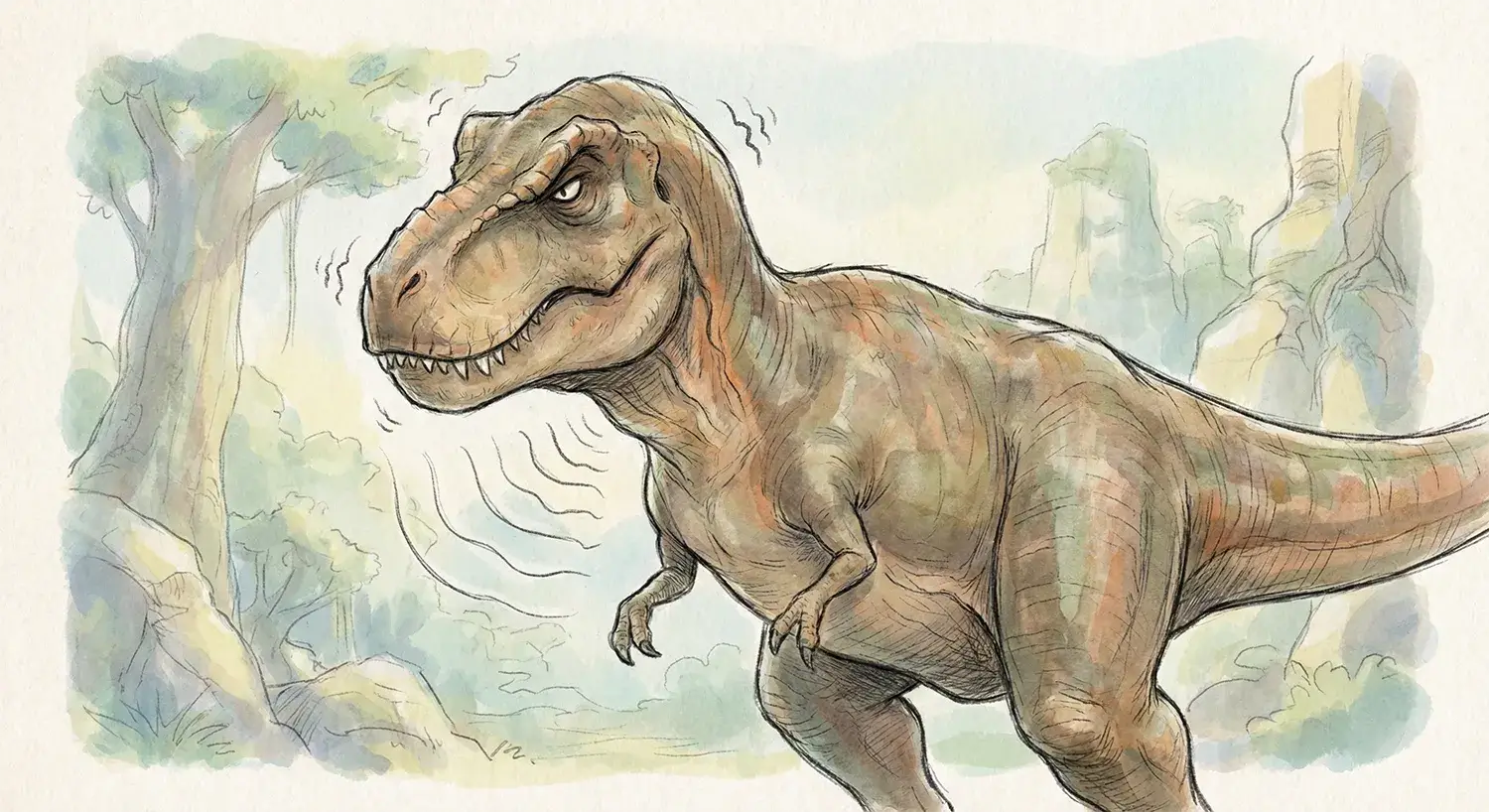
Vibrating their entire bodies with their mouths closed, emitting a rumbling growl.
The Mechanisms of “Sound” and Hearing Told by Bones
Important information regarding “sound” can also be read from the dinosaur fossils themselves.
A Natural Trombone: Parasaurolophus
The Late Cretaceous herbivorous dinosaur Parasaurolophus possessed a giant “crest” extending far back from its head.
As a result of CT scans, it was found that the interior was a complex tubular structure where air made a U-turn as it passed through.
This is the same principle as a wind instrument like a trombone; it is speculated that by blowing breath into it, they resonated a “low, echoing sound like a trumpet or a foghorn.”
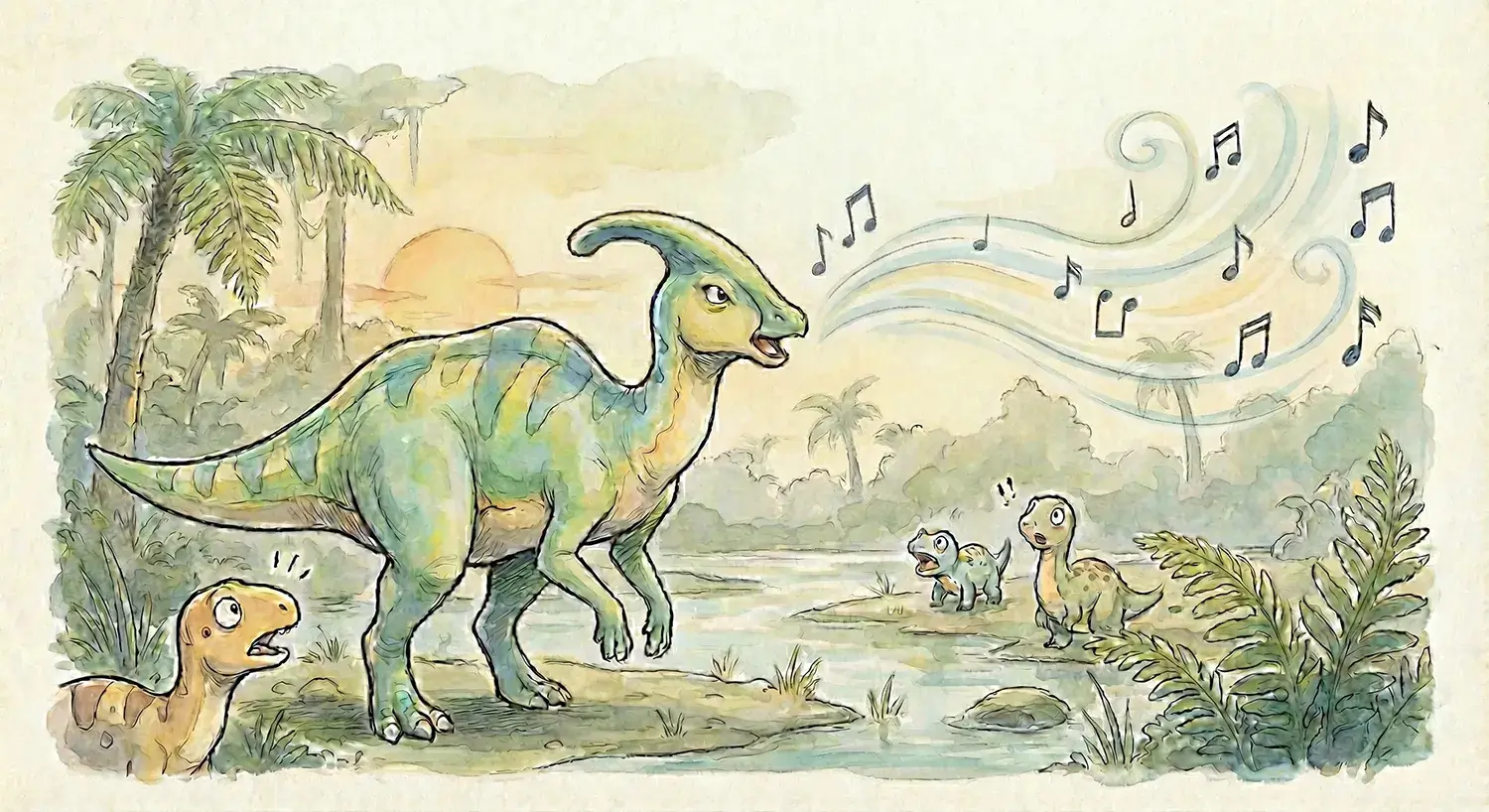
Resonated a “low, echoing sound like a trumpet or a foghorn”
Tyrannosaurus’s “Hearing” Revealed by the Inner Ear
Animals evolve ears so that they can best hear “the voices emitted by their own species.”
As a result of analyzing the inner ear of Tyrannosaurus, it was found that they were remarkably adept at hearing “very low-frequency sounds (infrasound)” rather than high-pitched ranges.
This supports the hypothesis that they emitted ultra-low-frequency growls (closed-mouth vocalization) and communicated by sensing them as vibrations in the air or ground.
A World First! A Major Discovery of a “Dinosaur Throat Fossil” Originating from Japan
Until now, it was thought that vocal organs do not remain in fossils, but in recent years, a Japanese research team has broken through that barrier.
The “Throat Bones” of the Armored Dinosaur Pinacosaurus
A research group led by Curator Junki Yoshida of the Fukushima Museum discovered the world’s first “throat bones (larynx)” of a dinosaur from a fossil of the armored dinosaur “Pinacosaurus” dating back about 80 million years, which was excavated in Mongolia in 2005.
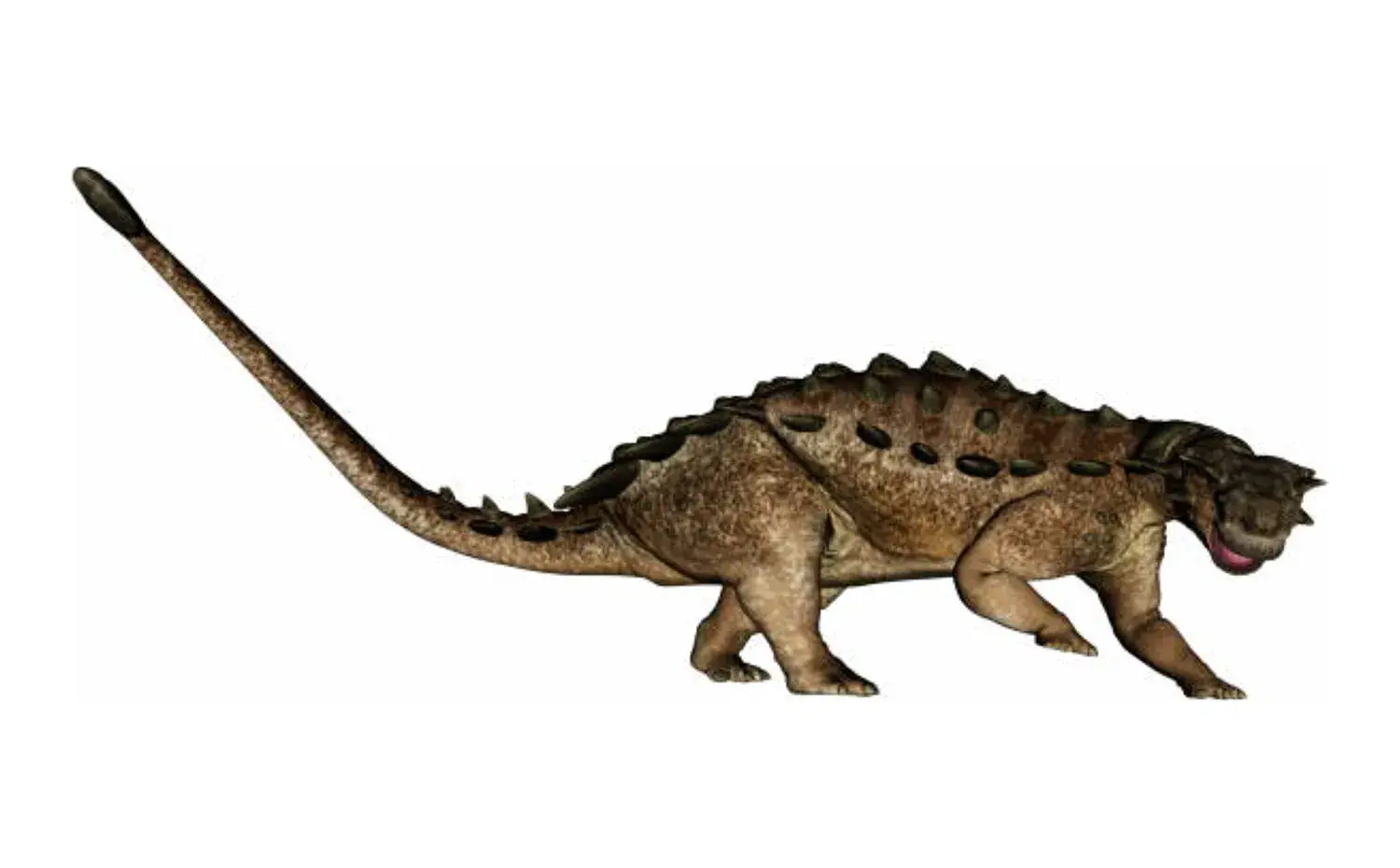
Pinacosaurus
It is a miraculous and major discovery that the throat structure, which is rich in cartilage components, was preserved.
The Possibility of Producing Complex Vocalizations
As a result of the analysis, it was found that the throat of Pinacosaurus had a structure capable of active movement, such as opening and closing, and similarities with modern birds were also found.
It was shown that rather than simply hissing and exhaling breath, they may have been able to deftly control their throat muscles to emit “complex vocalizations” like birds.
While it will take time to recreate their specific cries, this marks an extremely important “first step” in unraveling the evolution of dinosaur vocalizations.
The Real Soundscape of the Dinosaur Age
Synthesizing the latest research results, the Cretaceous forests were likely not a world where giant monsters roared wildly like in the movies.
Small Dinosaurs
Communicating with sharp bird-like chirps or duck-like sounds.
Parasaurolophus
Resonating their crests to call out to their herd with sounds like trumpeting foghorns.
Tyrannosaurus
Keeping their mouths closed while emitting intimidating, ultra-low-frequency rumbling growls that reverberate in the pit of the stomach.
While different from the “Roar!” seen in movies, a Tyrannosaurus producing an unidentifiable, deep bass sound vibrating through the ground from the depths of a quiet forest evokes a far more visceral, biological terror.
Precisely because we don’t know the exact answer, the scientific process of logically deriving sounds from fossils is full of romance and wonder.
The next time you see a dinosaur, please try to imagine, “What kind of voice did it have?”

![[New Paleontology Theory] Prehistoric Armored Dinosaurs, Ankylosaurids, May Have Dug for Self-Defense](https://dinosaurmuseum.jp/wp/wp-content/uploads/eyecatch_ankylosauridae-digging-defense-research_en-1024x512.webp)
![[Latest Discovery] A Third Type of Skin, Neither Scales Nor Feathers? Meet "Haolong dongi," a New Dinosaur Species Covered Entirely in Spikes](https://dinosaurmuseum.jp/wp/wp-content/uploads/eyecatch_dinosaur-spiky-skin-discovery_en-1024x512.webp)










![[Latest Research] What Was the Function of Spinosaurus's Giant "Sail"? Exploring the Mysteries of Thermoregulation and Underwater Locomotion](https://dinosaurmuseum.jp/wp/wp-content/uploads/eyecatch_spinosaurus-sail-function_en-1024x512.webp)