Protoceratops


Name Origin
First Horned Face
Family
Protoceratopsidae
Classification
Diapsida, Ornithischia, Marginocephalia
Habitat (Discovery Location)
China, Mongolia
Period
Approximately 83–70 million years ago (Late Cretaceous)
Length
Approximately 1.8–2.5 meters
Weight
Approximately 230 kg
Diet
Herbivore
You might also like... 

-
 Gargoyleosaurus
- Classification
- Thyreophora
- Characteristics
- Herbivorous
- Era
- Jurassic period
- Irritator
- Classification
- Theropods
- Characteristics
- Carnivorous
- Era
- Cretaceous period
- Metriacanthosaurus
- Classification
- Theropods
- Characteristics
- Carnivorous
- Era
- Jurassic period
- Jianchangosaurus
- Classification
- Theropods
- Characteristics
- Herbivorous
- Feathered
- Era
- Cretaceous period
-
Sponsored Links
-
Sponsored Links




![[Latest Research] What Was the Function of Spinosaurus's Giant "Sail"? Exploring the Mysteries of Thermoregulation and Underwater Locomotion](https://dinosaurmuseum.jp/wp/wp-content/uploads/eyecatch_spinosaurus-sail-function_en-1024x512.webp)
![[Latest Discovery] A Third Type of Skin, Neither Scales Nor Feathers? Meet "Haolong dongi," a New Dinosaur Species Covered Entirely in Spikes](https://dinosaurmuseum.jp/wp/wp-content/uploads/eyecatch_dinosaur-spiky-skin-discovery_en-1024x512.webp)
Description
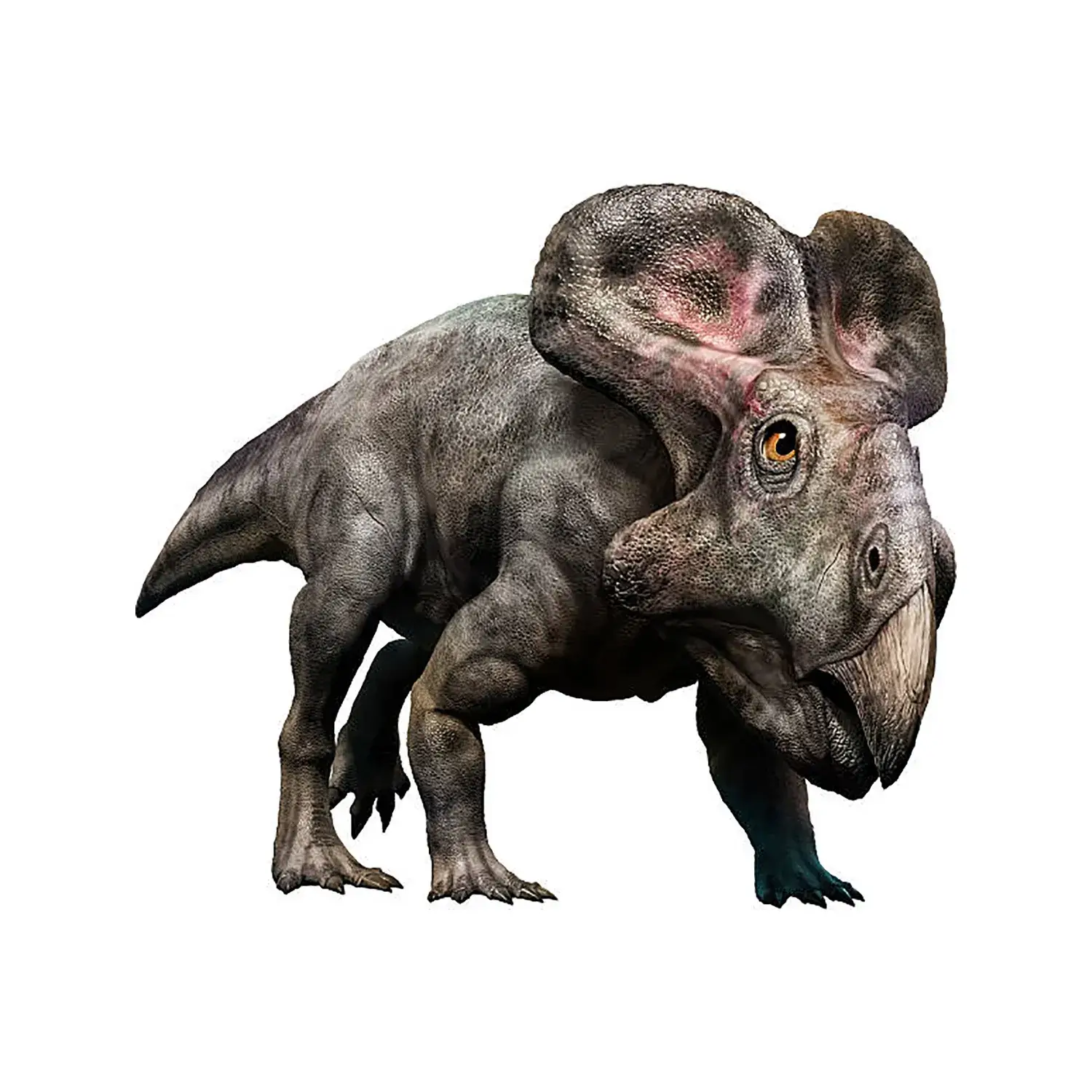
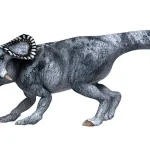
When we think of “ceratopsians,” represented by Triceratops, we imagine massive horns. However, the ancestors of these dinosaurs survived in the desert with small bodies that lacked horns.
This is “Protoceratops.”
Thriving in Late Cretaceous Mongolia, this dinosaur is often called the “Sheep of the Cretaceous” due to its abundance. It has provided numerous discoveries that are extremely important in the history of paleontological research.
The “Sheep of the Cretaceous” Filling the Desert: A Hornless Ceratopsian
Fossils of Protoceratops were discovered in the Gobi Desert in the 1920s by an expedition team from the American Museum of Natural History led by Roy Chapman Andrews.
Origin of the Name and Size
The scientific name means “First Horned Face,” but in reality, it does not have prominent horns.
This is because they belong to a “primitive group” from before the evolution into dinosaurs like Triceratops.
They were about 1.8 to 2.5 meters in length and stood about 60 cm tall.
Their size was similar to that of a modern sheep.
Overwhelming Number of Fossils
More than several hundred fossils, ranging from eggs to adults, have been discovered in places like the Gobi Desert. Because of this prosperity, they are affectionately referred to as the “Sheep of the Cretaceous.”
Parrot-like “Beak” and a Mysterious “Tail”
Their greatest characteristic is a large head developed in place of horns.
Powerful Beak
They used a sharp beak, like that of a parrot, to pluck plants and then sliced them up like “scissors” with their back teeth.
Role of the Frill
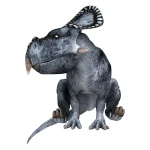
The frill at the back of the head was very thin. Rather than for defense, it functioned as an attachment point for muscles or as a display to make the body appear larger.
Paddle-shaped Tail
In recent years, a “semi-aquatic theory” has been proposed, suggesting they swam near the water’s edge like capybaras, based on the fact that their tails were flat vertically.
Legendary Death Match! The “Fighting Dinosaurs” with Velociraptor
One cannot discuss Protoceratops without mentioning one of the most famous fossils in the world: the “Fighting Dinosaurs.”
Discovered in 1971, this fossil preserves a Protoceratops and a carnivorous dinosaur, “Velociraptor,” locked in combat.
Time Stopped by a Sandstorm
The Velociraptor has its foot claw thrust into the throat of the prey, while the Protoceratops has clamped its jaws firmly onto the opponent’s arm.
It is believed that in the middle of this death match where neither would yield, they were buried alive by a sudden landslide caused by a sandstorm.
This shows that while they were generally docile, they also had a side as fighters that would bite back at natural enemies when cornered.
False Charge of the Egg Thief and “Soft Eggs”
Another dinosaur, “Oviraptor,” was found in a place once thought to be a Protoceratops nest, leading to it being given the dishonorable name of “Egg Thief.”
However, subsequent research revealed that those eggs actually belonged to Oviraptor.
Oviraptor was not a thief, but a parent protecting its own eggs.
So, where were the real Protoceratops eggs? Actually, we now know that their eggs had “soft shells” like those of lizards.
Because they were difficult to preserve as fossils, their discovery was delayed, but soft-shelled egg fossils were finally confirmed in 2020, solving a long-standing mystery.
The True Identity of the Mythical “Griffin”?
Finally, let me introduce a romantic hypothesis.
The “Griffin” is a legendary creature with the beak of an eagle and the body of a lion.
There is a theory that the true identity of this creature was actually Protoceratops fossils.
It is possible that when ancient travelers witnessed weathered skeletons in the Gobi Desert, they mistook the “beak and four-legged beast body,” along with the frill bone, for “wings.”
Although there is no proof, their distinctive appearance may have stimulated the imagination of ancient people and become the model for myths.