
Euskelosaurus
Name Origin
Primitive Leg Lizard
Family
Plateosauridae
Classification
Diapsida, Saurischia, Sauropodomorpha
Habitat (Discovery Location)
South Africa, Zimbabwe, Lesotho
Period
Late Triassic
Length
Approximately 9 meters
Diet
Herbivore
You might also like... 

-
 Triceratops
- Classification
- Marginocephalia
- Characteristics
- Herbivorous
- Era
- Cretaceous period
- Sinoceratops
- Classification
- Marginocephalia
- Characteristics
- Herbivorous
- Era
- Cretaceous period
- Velociraptor
- Classification
- Theropods
- Characteristics
- Carnivorous
- Era
- Cretaceous period
- Saurornitholestes
- Classification
- Theropods
- Characteristics
- Carnivorous
- Era
- Cretaceous period
-
Sponsored Links
-
Sponsored Links




![[Latest Research] What Was the Function of Spinosaurus's Giant "Sail"? Exploring the Mysteries of Thermoregulation and Underwater Locomotion](https://dinosaurmuseum.jp/wp/wp-content/uploads/eyecatch_spinosaurus-sail-function_en-1024x512.webp)
![[Latest Discovery] A Third Type of Skin, Neither Scales Nor Feathers? Meet "Haolong dongi," a New Dinosaur Species Covered Entirely in Spikes](https://dinosaurmuseum.jp/wp/wp-content/uploads/eyecatch_dinosaur-spiky-skin-discovery_en-1024x512.webp)
Description
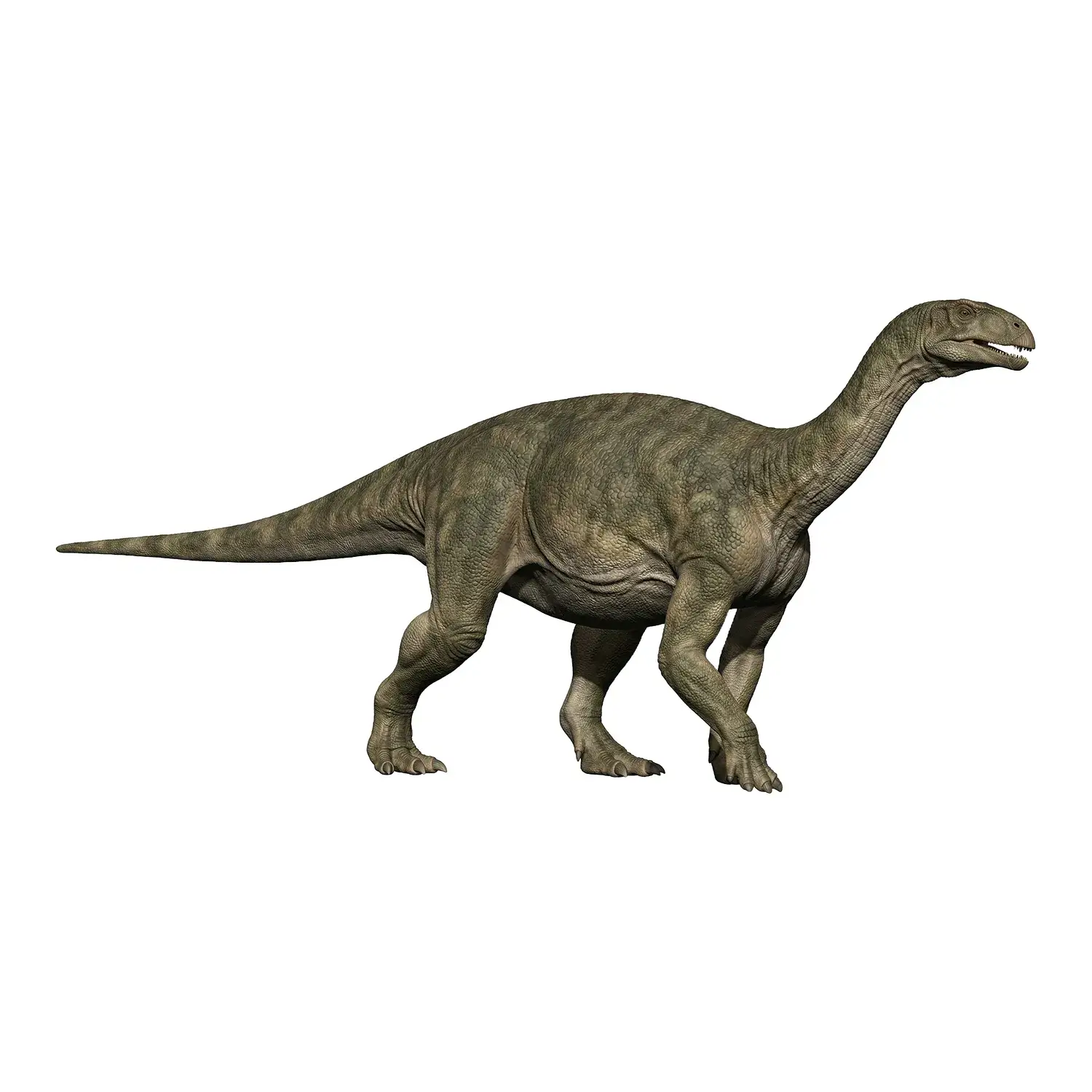
Euskelosaurus is one of the largest prosauropods that lived in South Africa during the Late Triassic period.
It belongs to a lineage closely related to Plateosaurus, the first large herbivorous dinosaur, and inhabited the supercontinent “Pangea,” formed when all continents were united.
An “Old Timer” with a History Longer than Tyrannosaurus
The 1863 Discovery and the Bizarre Scarcity of Fossils
The discovery of this dinosaur dates back to 1863, approximately 200 years ago.
This predates the discovery of the famous Tyrannosaurus (1892), making it a historic figure—effectively a “veteran”—in the field of paleontology.
However, despite this long history, the number of excavated bones remains strangely low to this day, consisting only of limb bones and vertebrae.
Name Recognition in Japan: Countable on Two Hands?
An old discovery, yet few fossils.
Perhaps because of this, it is said to be a very obscure dinosaur that most people in Japan—perhaps only a handful, to be extreme—would not know.
It is a niche existence known only to true enthusiasts.
From Carnivory to Herbivory: Dietary Transition and Evolution
Characteristics as an Intermediate Dinosaur
Prosauropods, the group to which Euskelosaurus belongs, are believed to represent an “intermediate” stage where dinosaurs transitioned from meat-eating to plant-eating.
In fact, the teeth of Euskelosaurus were shaped to handle both animal and plant matter efficiently.
A Body Too Large for Hunting
While the shape of their teeth suggested potential omnivory, their bodies were likely too large to actively attack and hunt prey.
Therefore, it appears they lived primarily on a diet of plants.
“Curved Femur” to Support Large Digestive Organs
A distinct physical characteristic is that the femur (thigh bone) curves outward from the torso.
This is hypothesized to be due to reasons specific to herbivores.
Because plants take longer to digest than meat, a longer intestinal tract is required.
The curvature of the femur may be an evolutionary adaptation of the skeleton to accommodate the massive digestive system needed to process and absorb plant matter within the abdomen.