
Selmasaurus
Name Origin
Selma lizard (Lizard of Selma)
Family
Mosasauridae
Classification
Reptilia, Diapsida, Squamata
Habitat (Discovery Location)
United States, Japan
Period
Late Cretaceous
Length
Approximately 3 to 5 meters
Diet
Piscivore (Fish-eater)
You might also like... 

-
 Majungasaurus
- Classification
- Theropods
- Characteristics
- Carnivorous
- Era
- Cretaceous period
- Albertosaurus
- Classification
- Theropods
- Characteristics
- Carnivorous
- Era
- Cretaceous period
- Kryptops
- Classification
- Theropods
- Characteristics
- Carnivorous
- Era
- Cretaceous period
- Pyroraptor
- Classification
- Theropods
- Characteristics
- Carnivorous
- Era
- Cretaceous period
-
Sponsored Links
-
Sponsored Links











![[Latest Research] What Was the Function of Spinosaurus's Giant "Sail"? Exploring the Mysteries of Thermoregulation and Underwater Locomotion](https://dinosaurmuseum.jp/wp/wp-content/uploads/eyecatch_spinosaurus-sail-function_en-1024x512.webp)
![[Latest Discovery] A Third Type of Skin, Neither Scales Nor Feathers? Meet "Haolong dongi," a New Dinosaur Species Covered Entirely in Spikes](https://dinosaurmuseum.jp/wp/wp-content/uploads/eyecatch_dinosaur-spiky-skin-discovery_en-1024x512.webp)

Description
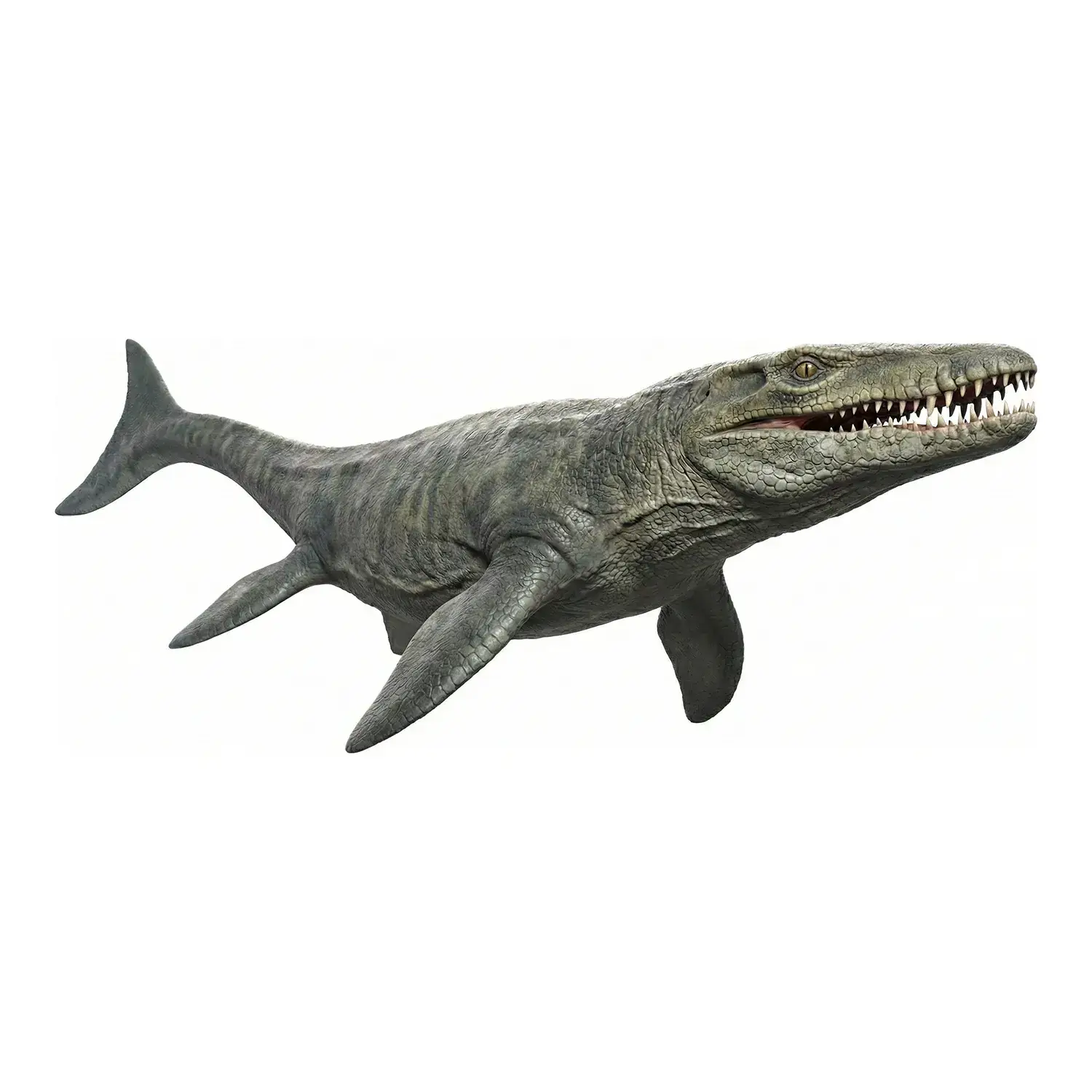
Selmasaurus is a genus of extinct marine reptile (subfamily Plioplatecarpinae of the family Mosasauridae) that inhabited the seas during the Cretaceous period.
While fossils had previously been yielded from Alabama and Kansas in the United States, in recent years, a discovery was reported from Kagoshima Prefecture in Japan, across the Pacific Ocean, drawing significant attention.
What is Selmasaurus? Basic Information and Physical Characteristics
Currently, two species of Selmasaurus are known: “Selmasaurus russelli” (S. russelli) and “Selmasaurus johnsoni” (S. johnsoni).
A Small Predator with Few Teeth
With a total length of 3 to 5 meters, it was a small predator among the Mosasauridae.
Additionally, it had a relatively small number of teeth for a mosasaur, and when first discovered, it was considered the “genus with the fewest teeth.”
Unique Anatomical Features of the Skull
Classified in the subfamily Plioplatecarpinae, Selmasaurus possesses unique characteristics in its skull.
Based on the research by Polcyn and Everhart (2008), the following features have been proposed to distinguish it from other genera.
Structure Around the Stapes (Quadrate bone)
The suprastapedial process projects to roughly half the height of the quadrate and contacts, but does not fuse with, a peg-like infrastapedial process.
Shape of the Parietal
The medially crushed semi-rectangular parietal diverges anteriorly and converges posteriorly to form “parasagittal crests” that bifurcate at the terminus.
Bone Articulation
The posteroventral median process of the parietal makes a long, narrow contact with the supraoccipital.
Supratemporal and Parietal Bones
The anteromedial process of the supratemporal is crushed against the parietal ramus, extending its entire length.
History of Fossil Discovery and Research: Excavation Drama in the United States
Research on Selmasaurus began in the United States in the 1970s.
Description of S. russelli and Identification of the Stratum
The name Selmasaurus was first described in geologist Samuel Wayne Shannon’s master’s thesis in 1975, but it remained an unofficial name (nomen nudum) for a long time.
Later, it was officially described by Wright in 1988.
The type specimen is housed at the Geological Survey of Alabama (later transferred to the Alabama Museum of Natural History) and includes an incomplete but well-preserved skull, cervical vertebrae, and other bones.
The specific name “russelli” was named in honor of paleontologist Dale Russell.
Although the exact stratum was unknown at the time of discovery, Caitlin R. Kiernan extracted microplankton from the matrix in 1998, revealing that it originated from the lower Campanian deposits of the Mooreville Chalk Formation in the Selma Group.
In this fauna, this specimen was an extremely rare element, comprising only 0.3% of the assemblage.
Discovery of the New Species S. johnsoni
In 1996, an extremely well-preserved skull and postcranial skeleton were discovered by Steve Johnson and others in the Niobrara Formation (Santonian or Campanian) in western Kansas.
Housed at the Sternberg Museum of Natural History, this fossil was identified as a new species, “Selmasaurus johnsoni,” in 2008 after more than 10 years of research.
This discovery deepened the understanding of Selmasaurus’s anatomical information and greatly expanded its geographical and temporal habitat range.
A Major Discovery in Japan (Kagoshima Prefecture)! Updating the Spatiotemporal Distribution
Although Selmasaurus was thought to be endemic to North America, there was a dramatic discovery across the Pacific in Japan.
In July 2022, a quadrate bone of Selmasaurus was discovered from the Upper Cretaceous system distributed on Shimokoshiki Island in Satsumasendai City, Kagoshima Prefecture.
This fossil was announced to the general media by Dr. Takuya Konishi in July 2025.
The reasons this discovery is extremely important are the following two points:
As a result, the data on the spatiotemporal distribution of the genus Selmasaurus has been significantly updated.
Classification and Close Relatives of Selmasaurus
Wright and Shannon classified Selmasaurus into the “Plioplatecarpinae” subfamily of Mosasauridae based on the morphology of the circulatory system passing through the basicranium.
This group includes genera such as Platecarpus, Plioplatecarpus, and Ectenosaurus.
While Selmasaurus may be most closely related to Ectenosaurus, there is a clear difference in that its skull is “far shorter and more robust” than that of Ectenosaurus.
It is expected that the discovery of new specimens in the future will further deepen our understanding of Selmasaurus.