
Mosasaurus
Name Origin
Lizard from the Meuse River
Family
Mosasauridae
Classification
Reptilia, Squamata, Lepidosauria
Habitat (Discovery Location)
Netherlands, United States, Japan
Period
79 to 65 million years ago (Late Cretaceous)
Length
Approximately 12 to 13 meters
Weight
Approximately 10 to 40 tons
Diet
Piscivore (Fish-eater)
 Jurassic
Park / World Featured Dinosaur
Appearance in Jurassic World
The Mosasaurus made its series debut as a star attraction for the park. It boasts the largest size of any carnivore in the facility and is considered the largest carnivore in the entire franchise. It has 88 teeth.
The scene in the movie's trailer, where it spectacularly leaps from the water to grab a Great White Shark, left a powerful impression on audiences.
It normally inhabes the "Lagoon," a giant pool in the center of the park, where a spectacular feeding show (an attraction where it leaps to eat a Great White Shark) is held, much like a dolphin show.
Although only one Mosasaurus appears in the film, the park's lore states that three were housed in the facility. According to the keepers, the largest female individual has a "shy and bashful" personality. It is said that she often refuses to surface unless it is feeding time, and sometimes won't even show her face. Thanks to her internal implant, she never attacks the audience, suggesting she is somewhat acclimated to humans.
Her origin story dates back to August 25, 2000, when InGen scientists discovered traceable DNA fragments from a Mosasaurus specimen. The chief scientist, Dr. Wu, believed that if DNA could be extracted from sources other than mosquitoes trapped in amber, it might be possible to recreate aquatic life. After extensive research, he finally succeeded in bringing the Mosasaurus back to life.
The resulting individual was unveiled at Jurassic World and received rave reviews from the park's owner, Mr. Masrani. The Mosasaurus lived peacefully in the park's pool until the "incident" occurred.
In the film, besides the shark feeding show, she also stunned audiences when she dynamically devoured a Pteranodon that had accidentally flown over the Lagoon during the chaos, along with Zara Young, who was trapped in the Pteranodon's grasp.
Then, during the film's climax, as the Tyrannosaurus (Rexy) and the Velociraptor (Blue) were engaged in a life-or-death battle with the Indominus rex, the Mosasaurus suddenly leaped from the Lagoon and clamped down on the Indominus's neck. She dragged it underwater, killing it, thus playing an indirect but decisive role in Blue's victory and serving as the film's grand finale.Appearance in Jurassic World: Fallen Kingdom
Continuing from the previous film, the Mosasaurus once again captivated audiences with its overwhelming size and presence.
Six months after the park's collapse, with the threat of a volcanic eruption looming, it is revealed that the Mosasaurus is still alive and well in the Lagoon (the ruins of the facility).
Early in the story, henchmen working for Eli Mills use a mini-sub to retrieve the bones of the Indominus rex from the bottom of the Lagoon. The Mosasaurus silently sneaks up behind them, skillfully attacking the sub and devouring the crew.
At the same time, Jack, a mercenary on the island, finds himself being chased by a starving Tyrannosaurus. He clings to a ladder dangling from a helicopter and appears to have barely escaped the T-Rex. However, the moment he shouts in relief, the Mosasaurus leaps from the water with its massive jaws open, snatching Jack out of the mid-air and vanishing back into the depths. It was a shocking scene reminiscent of the park's classic feeding show—a signature Mosasaurus moment.
During this attack, Jack drops the gate control tablet, breaking it. This causes the facility's gates, which connect the Lagoon to the open ocean, to fail to close completely, leaving them partially open.
This allows the Mosasaurus to swim out of the Lagoon and into the open sea. As a result, it manages to escape the island early, avoiding the tragedy of the volcanic eruption that later devastates Isla Nublar.
After fleeing the island, it plays no part in the destruction of its home or the major incidents at the Lockwood Estate on the U.S. mainland.
The Mosasaurus reappears in the film's final sequence. Its massive shadow is seen inside a giant wave at a beach crowded with surfers, closing in on a surfer who has fallen off his board.
Just like in the previous film, its overall screen time was limited, but it demonstrated an overwhelming presence, "stealing the show" in key moments and delivering fear and excitement to the audience.Appearance in Jurassic World: Dominion
Boasting popularity as one of the series' top favorites, the Mosasaurus—the Ruler of the Seas—has ventured into the open ocean following the collapse of the park, confronting humanity as an even greater threat.
Liberated from the confines of the park, she no longer swims in a restricted tank but roams the vast open ocean. Having feasted on an abundance of marine life in the wild, it has been confirmed that she has grown even massive than she was during her captivity. She now reigns supreme over the marine ecosystem as an unstoppable apex predator.
Her most memorable appearance in the film occurs off the coast of the Bering Sea.
In this scene, she attacks a crab fishing boat operating in stormy waters, displaying overwhelming power as she attempts to snatch the crab pots—giant crane and all. Beyond this incident, she is depicted appearing in waters around the globe, posing a serious threat to shipping vessels and maritime activities.
According to information from the official promotional website "Dinotracker," her range is astonishingly vast. Not confined to any specific region, sightings have been reported across the Pacific Ocean, indicating that the world's oceans have effectively become her territory.Appearance in Jurassic World: Rebirth
The defining characteristic of the Mosasaurus in this film is its staggering size.
・Length: 30.5m (100feet)
・Weight: Over 18tons
The official length of "100feet (over 30m)" makes it the largest creature to appear in the entire series to date. It is even more massive than the individual that appeared in the fourth through sixth films (the "JW individual"), yet it possesses terrifying physical capabilities, with a swimming speed said to rival that of a killer whale.
Visually, it has undergone a significant overhaul.
Body Color
It features distinct tiger shark-like stripes on its back.
Texture
The texture of its belly and skin resembles that of a whale, making its design closer to a realistic marine mammal compared to the individuals in previous films.
Age Rings
Countless scars and barnacles cover its body, highlighting the "rings" of its long life and the raw power inherent in its massive frame.
In the story, it appears as one of the three key "sea" dinosaurs (strictly speaking, marine reptiles) that are crucial to the medicine. Surprisingly, it has established a mutualistic relationship with a pack of Spinosaurus in the waters surrounding the island, and is depicted hunting prey jointly with them.
In the film, it attacks the "Mariposa" and the "Essex" as they attempt to approach the island. Its underwater charge, driven by its immense bulk, is devastating; it demonstrated enough destructive power to disable the engines of a small military patrol vessel upon impact.
According to the lore, InGen tracked this individual with a unique tag before the company went bankrupt, but it reportedly escaped their control (by the time of the film, the data is owned by Parker Genics).
There is a scene where this individual is displayed as "M142" on the monitor of the Essex. However, since the Essex itself is displayed as "M275," readers should note that this is merely a radar identification code, and the interpretation that "InGen named this individual M142" is incorrect.
According to the sound team, the roar of the Mosasaurus in this film incorporates elements of whale songs and metallic sounds. This blend expresses the mysterious and imposing resonance unique to a giant creature.
After the movie's release, a visual material from the film's world showing "a Mosasaurus carcass and local people" was released, causing a major stir among fans. Fears were raised that "the individual from the previous films (the JW individual) might have died," but this was addressed by official staff with a clarification that "the carcass photographed is not the JW individual."
With this, the theory that the previous individual had died was officially debunked for the time being. The carcass is considered to be a different individual, distinct from both the one in this film and the JW individual.
You might also like... 

-
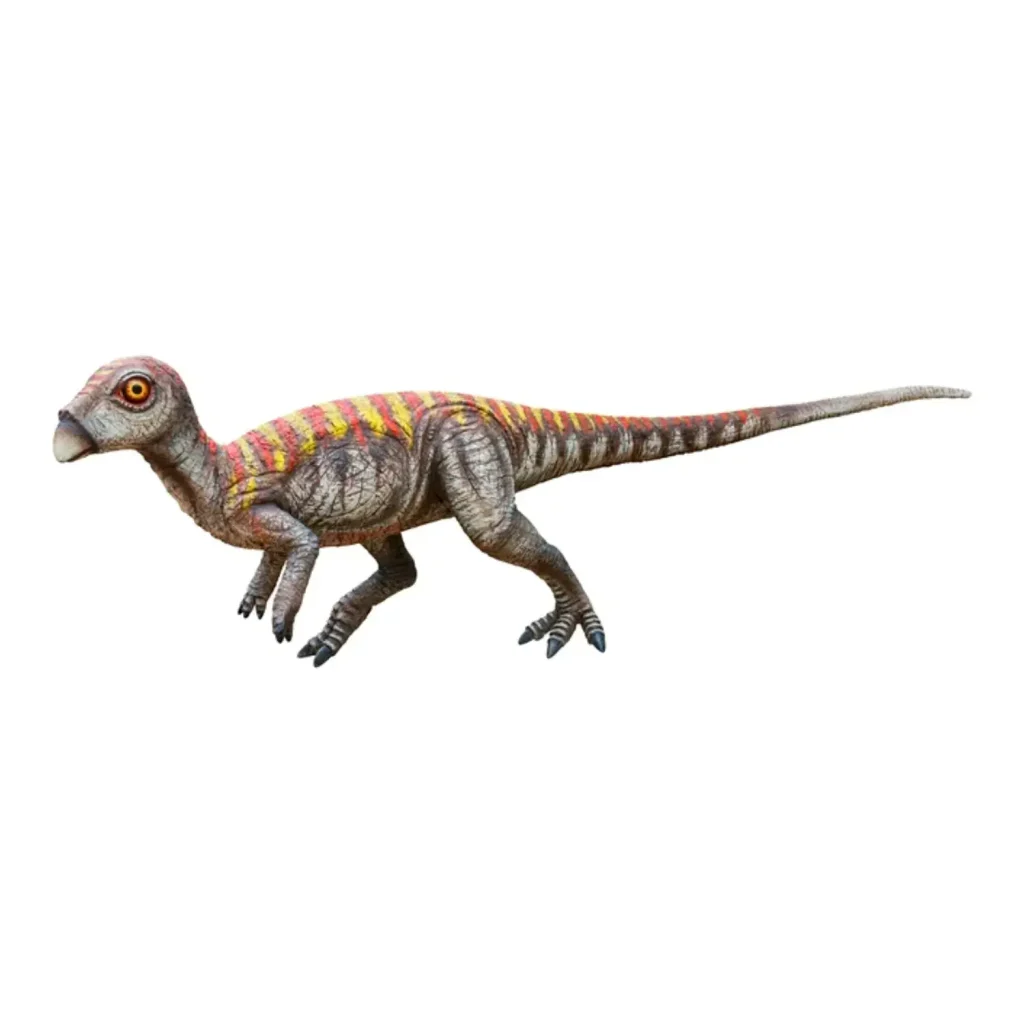
 Pachycephalosaurus
- Classification
- Marginocephalia
- Characteristics
- Herbivorous
- Era
- Cretaceous period
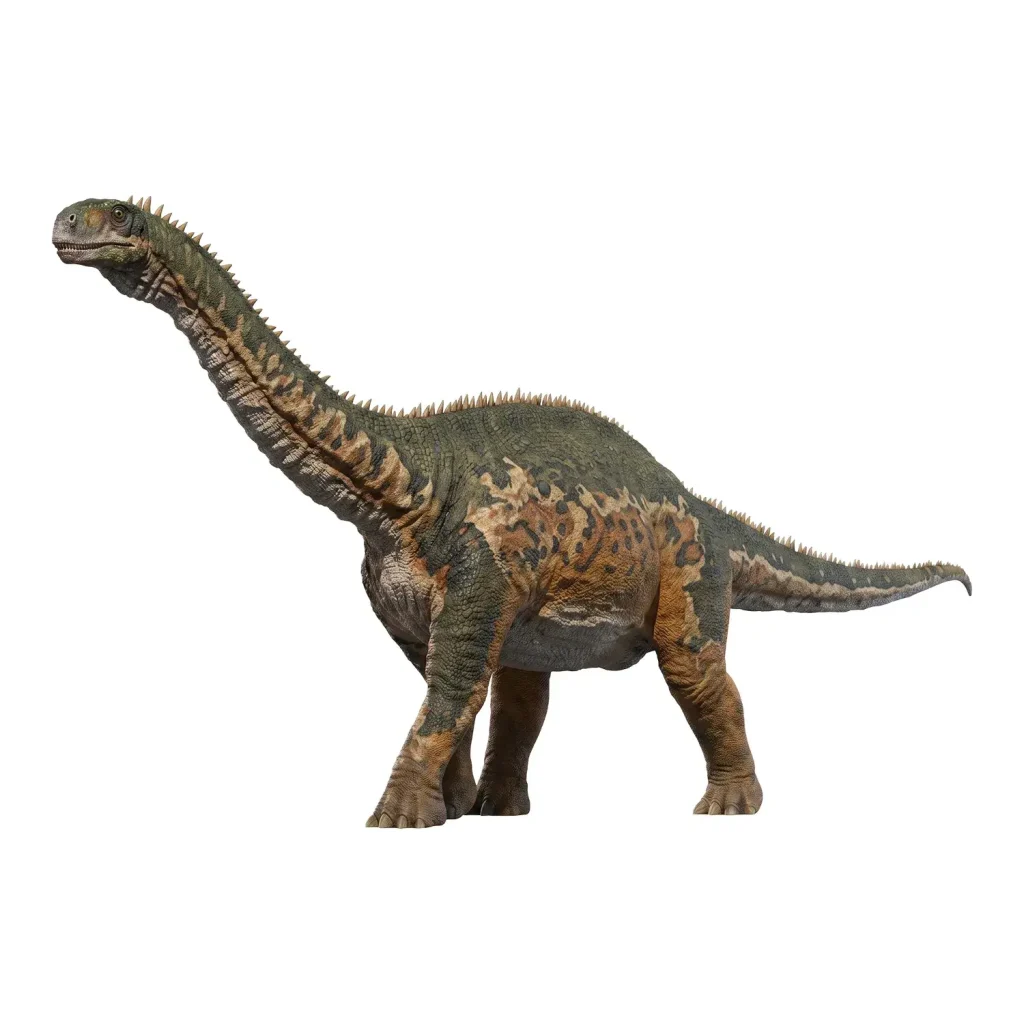
- Isanosaurus
- Classification
- Sauropods
- Characteristics
- Herbivorous
- Era
- Triassic period
- Leaellynasaura
- Classification
- Ornithopoda
- Characteristics
- Herbivorous
- Era
- Cretaceous period
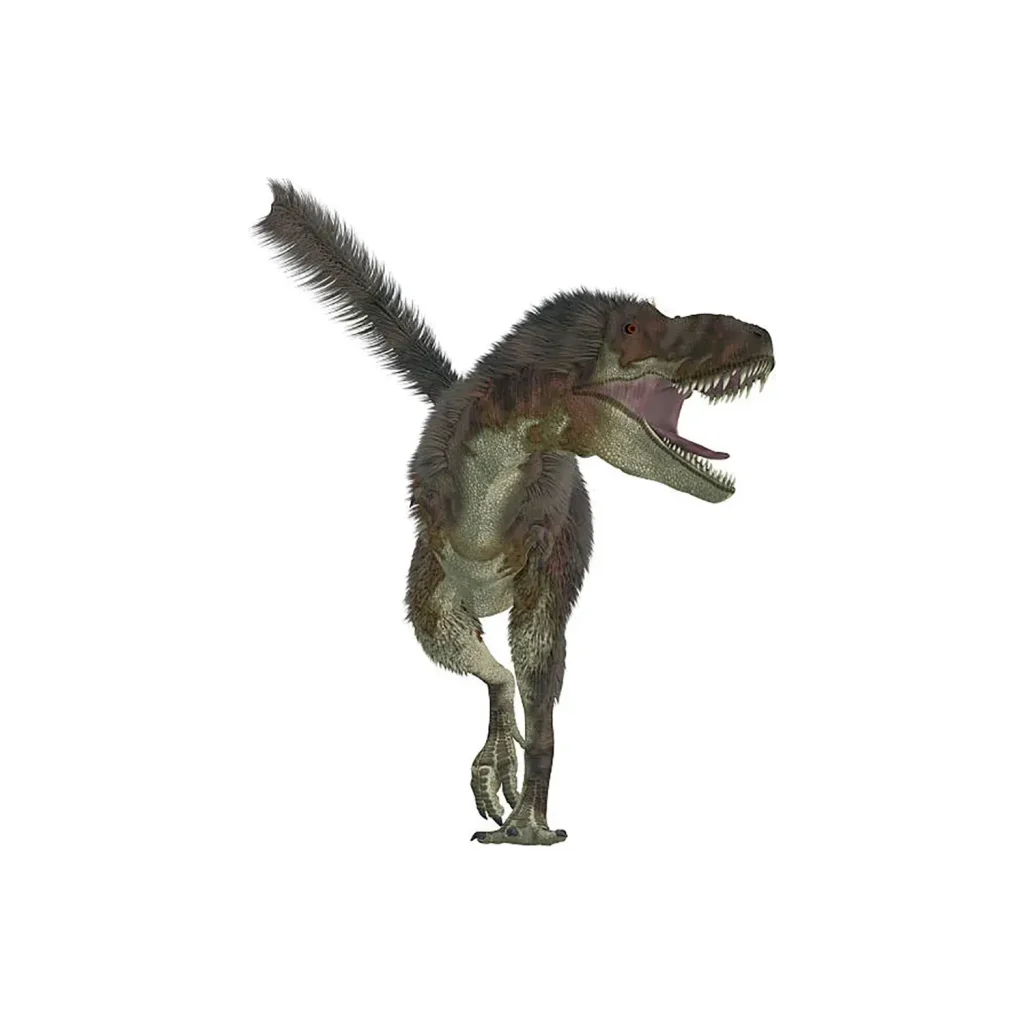
- Daspletosaurus
- Classification
- Theropods
- Characteristics
- Carnivorous
- Era
- Cretaceous period
-
Sponsored Links
-
Sponsored Links




![[Latest Research] What Was the Function of Spinosaurus's Giant "Sail"? Exploring the Mysteries of Thermoregulation and Underwater Locomotion](https://dinosaurmuseum.jp/wp/wp-content/uploads/eyecatch_spinosaurus-sail-function_en-1024x512.webp)
![[Latest Discovery] A Third Type of Skin, Neither Scales Nor Feathers? Meet "Haolong dongi," a New Dinosaur Species Covered Entirely in Spikes](https://dinosaurmuseum.jp/wp/wp-content/uploads/eyecatch_dinosaur-spiky-skin-discovery_en-1024x512.webp)
Description
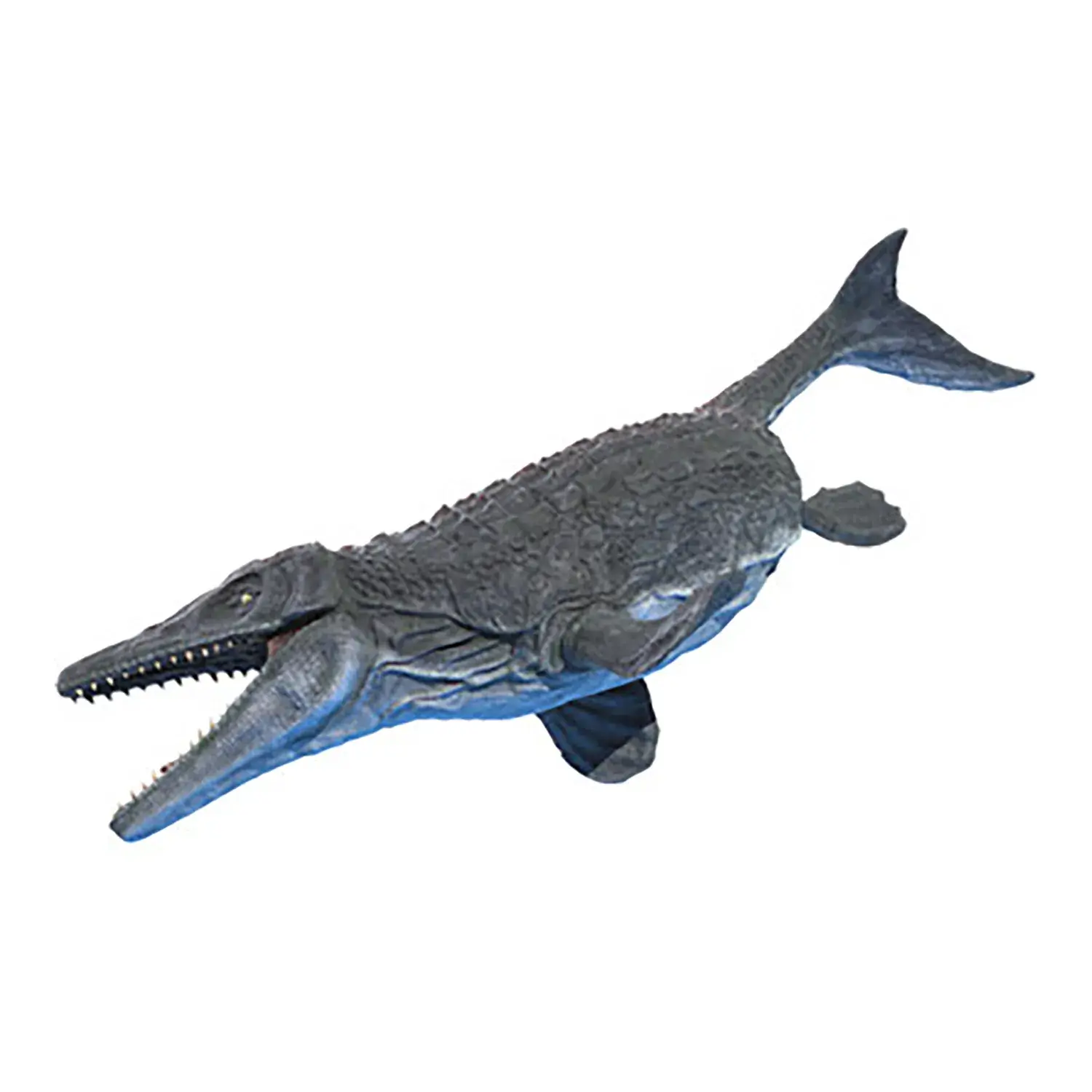
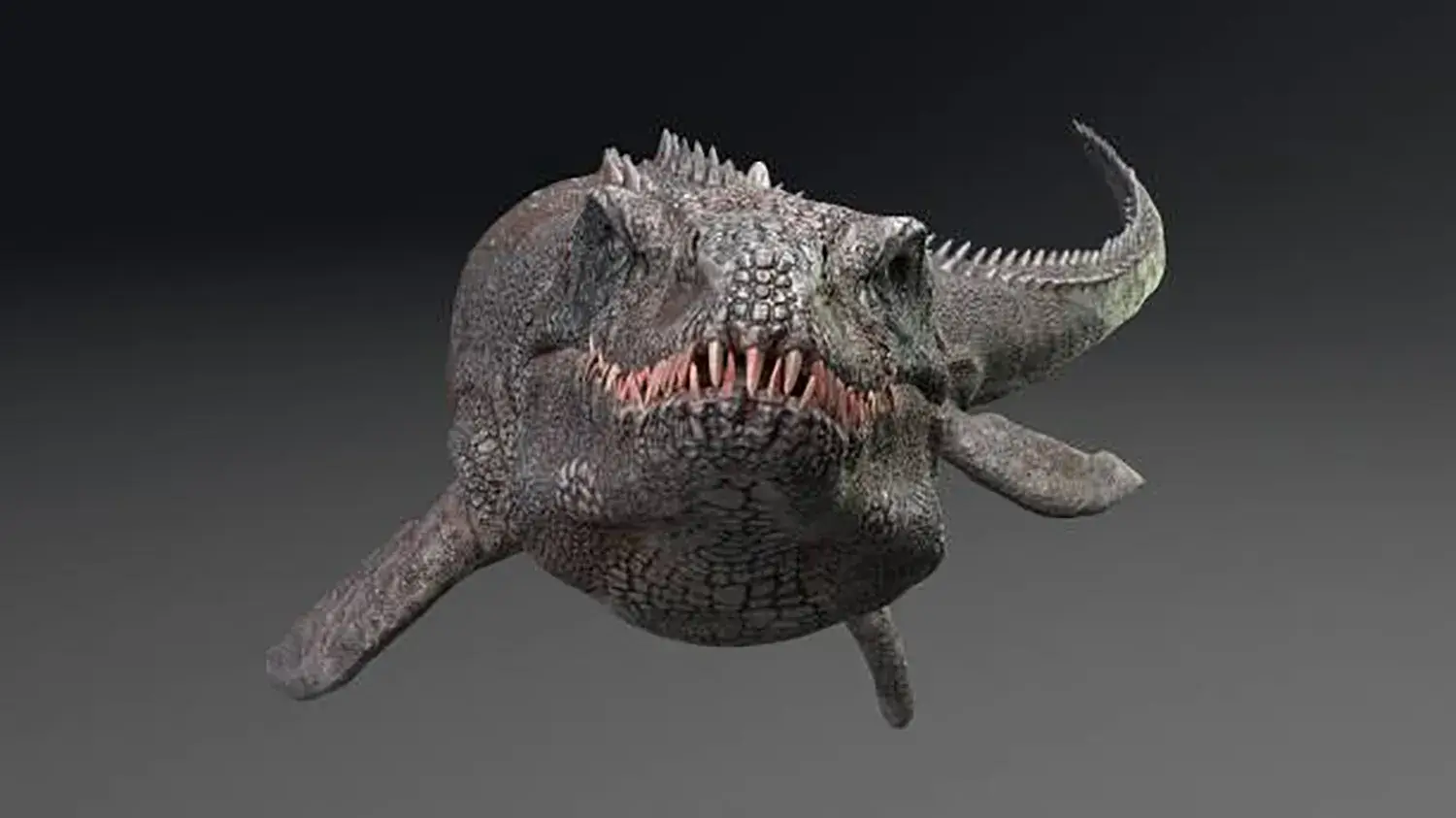
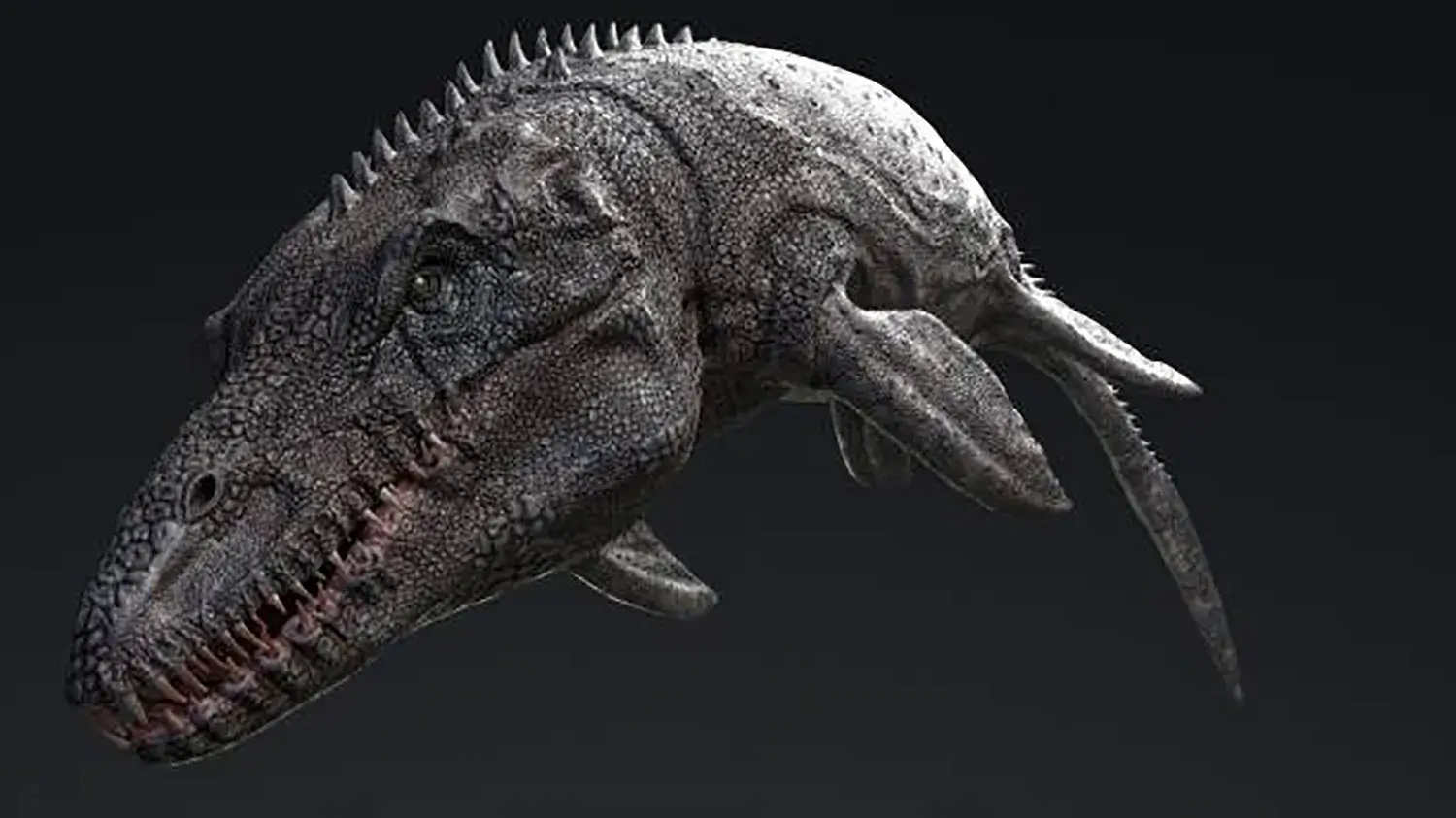
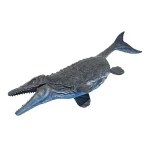
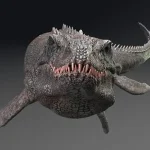
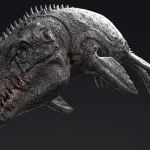
Mosasaurus was a giant marine reptile that reigned over the seas during the Late Cretaceous period.
A giant marine reptile that reigned over the seas during the Late Cretaceous period
Its name is derived from the location where its fossils were first discovered, meaning “lizard of the Meuse River.”
Although sometimes treated as a dinosaur in the media, strictly speaking, it is a type of giant monitor lizard that returned to the sea, not a dinosaur.
Physical Characteristics of a Ferocious Hunter
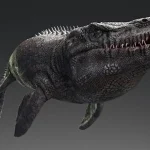
Mosasaurus reached lengths of 12 to 13 meters, making it one of the largest creatures living in the oceans of its time.
Along with Tylosaurus, which belongs to the same Mosasauridae family, they were the absolute rulers who dominated the Cretaceous seas.
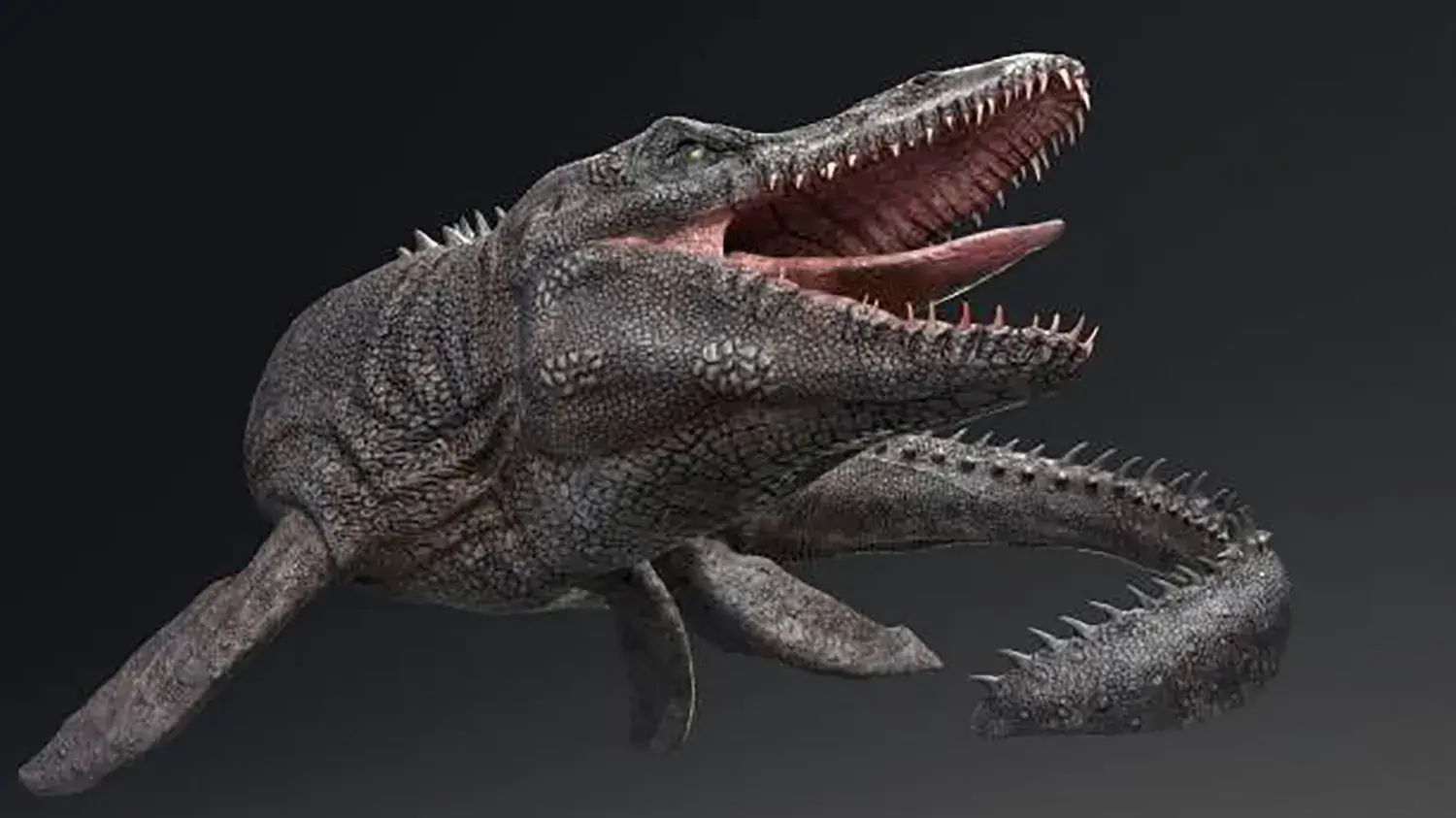
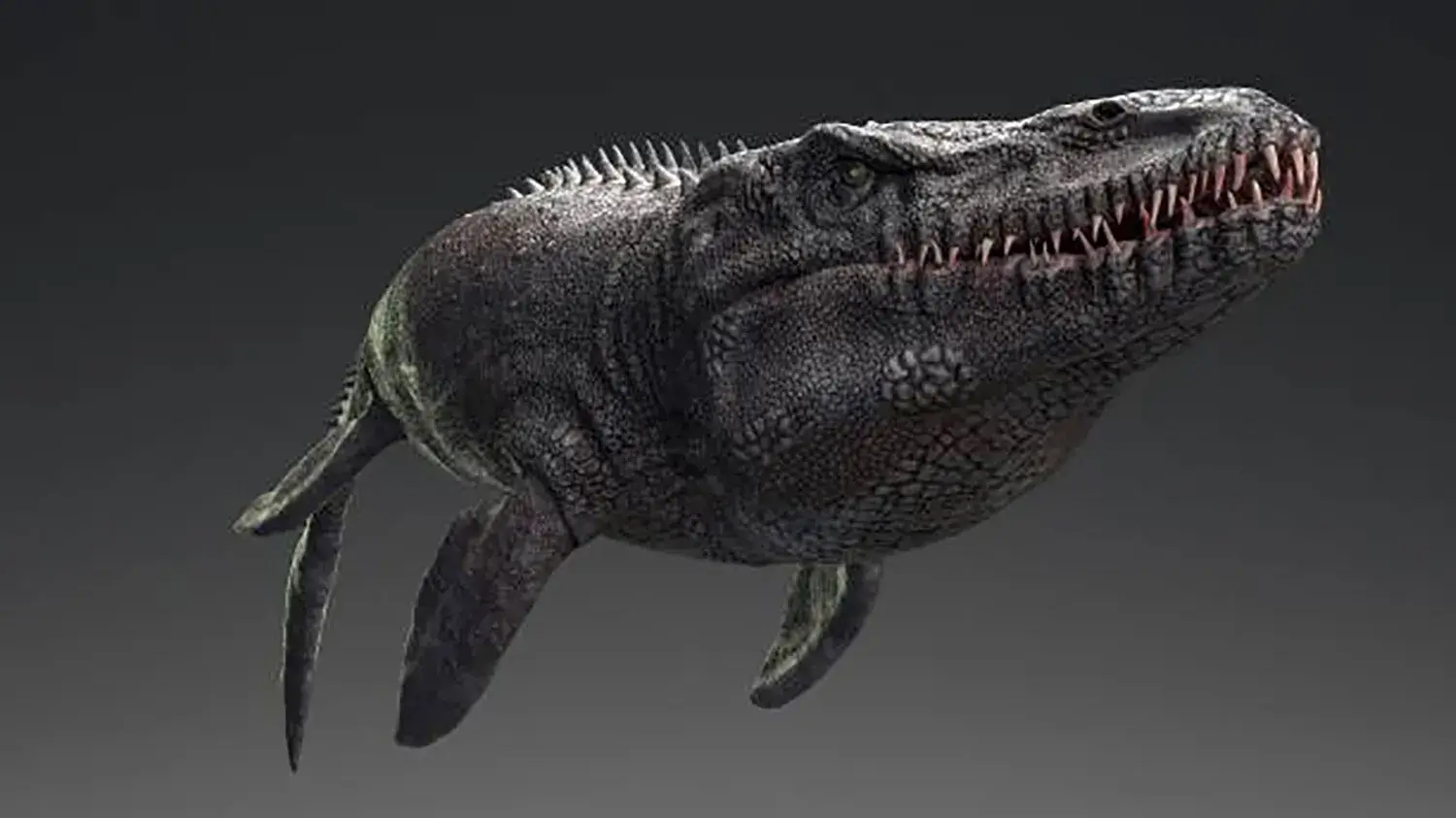
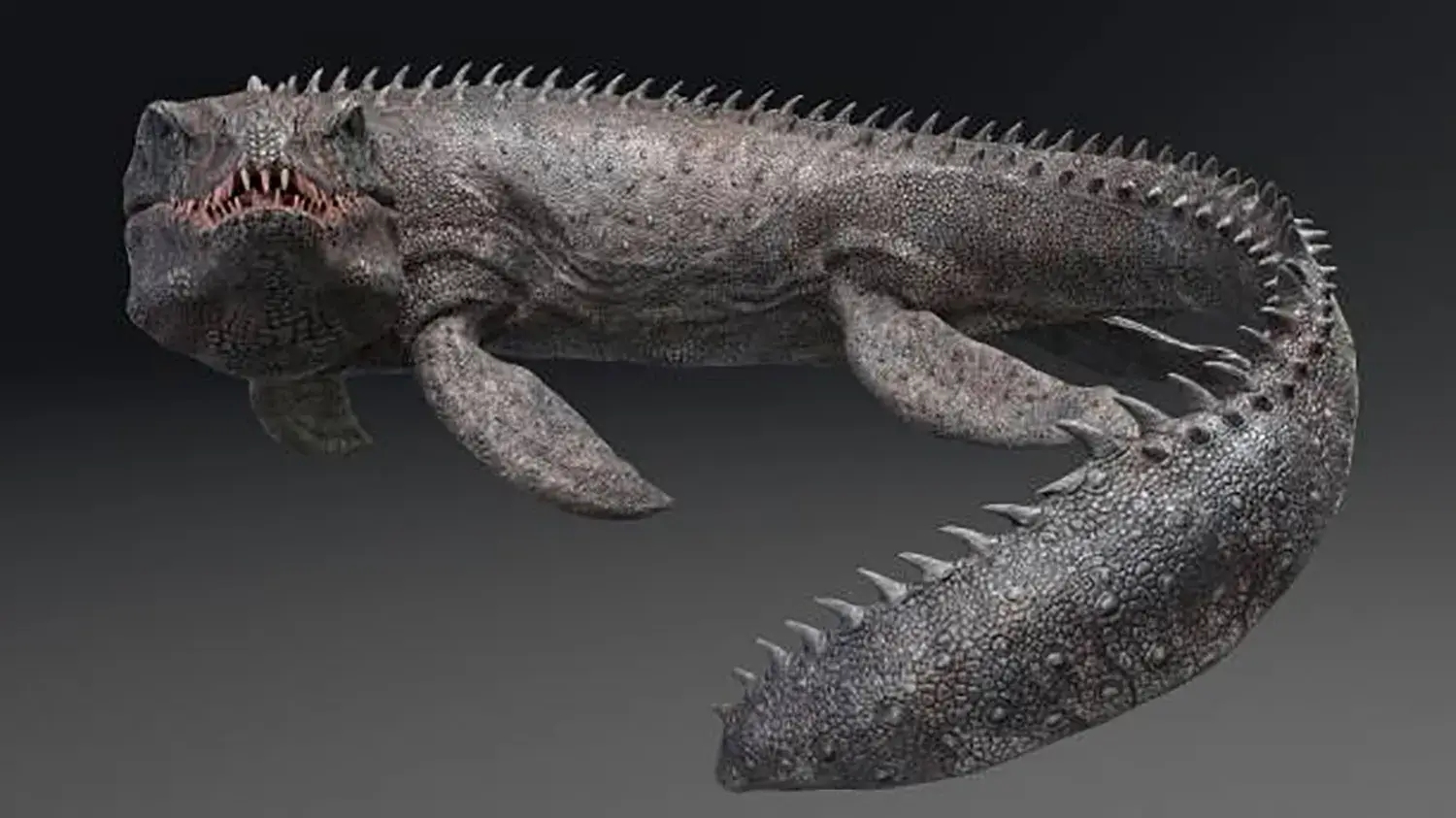
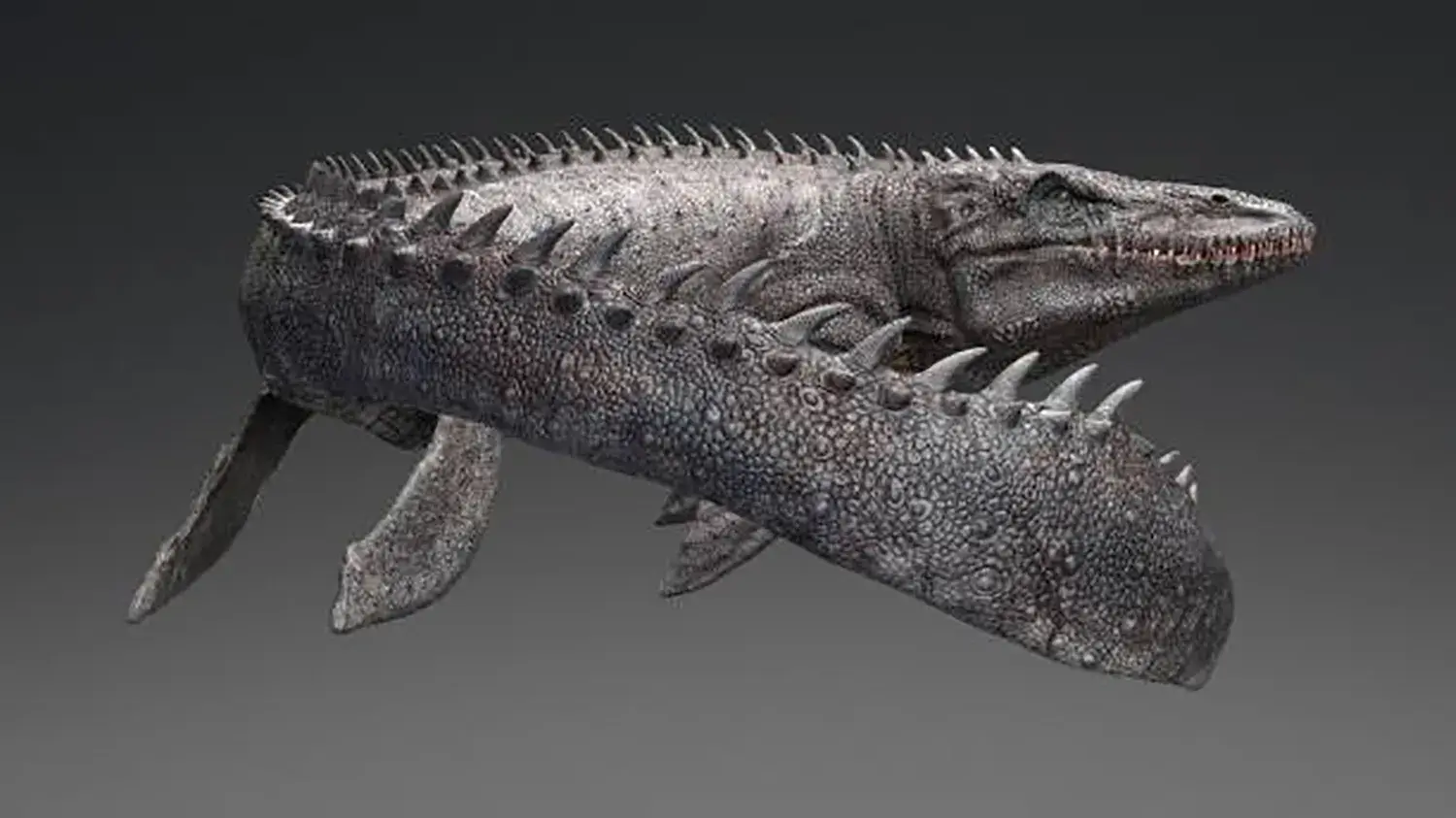
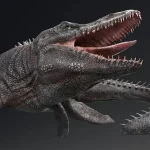
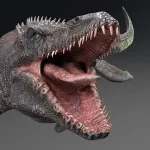
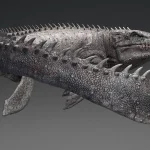
It had a cylindrical body, a head that tapered toward the snout, and sharp teeth equipped for tearing apart its prey.
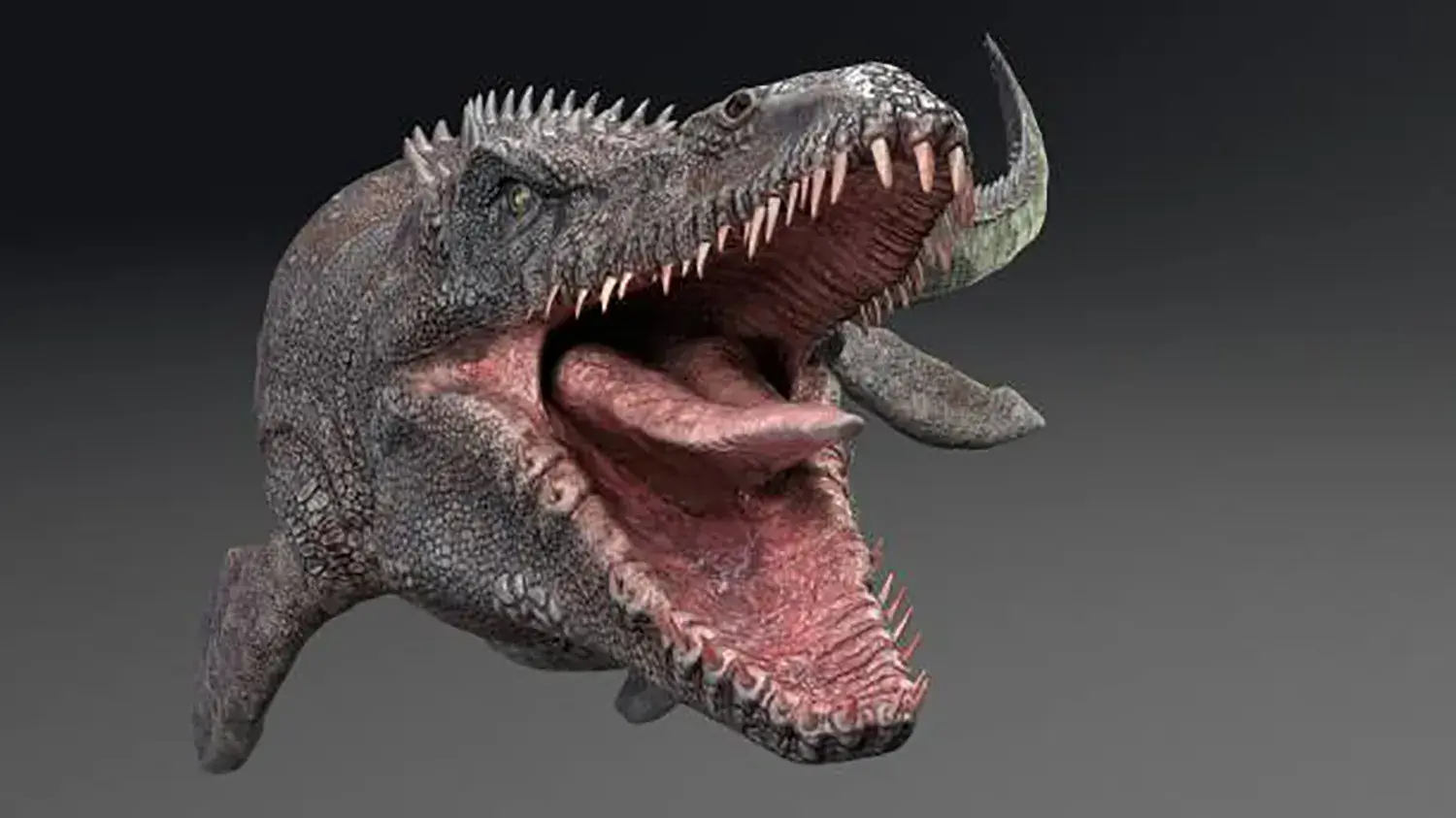
Equipped with sharp teeth for tearing apart its prey
Its backward-curving teeth were designed to prevent prey from escaping once caught.
It is believed to have preyed on anything it laid eyes on, including fish, ammonites, and even other marine reptiles.
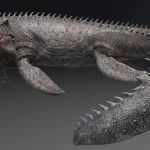
It was once thought to have a tail like a terrestrial lizard, but recent research has revealed that it possessed a tail fin similar to that of a shark or dolphin.
Its front and hind legs transformed into flippers, and it likely swam at high speeds by undulating its body from side to side.
An Aggressive Nature and a Bizarre History of Discovery
Many bite marks likely left by other creatures remain on its fossils.
This suggests that Mosasaurus did not just unilaterally prey on others, but engaged in fierce territorial disputes and battles with other creatures, including its own kind.
Mosasaurus was first discovered quite early, around 1764, and its fossils were once looted as spoils of war, earning it the nickname “Monster of Maastricht.”
Later, in 1822, it was officially recognized as an ancient reptile.
Its portrayal as a ferocious hunter in the movie “Jurassic World” garnered massive popularity due to its intense presence. Furthermore, multiple fossils have been discovered in Japan, and research is ongoing.
A ferocious hunter
Discoveries in Japan and Its Diversity
Mosasaurus fossils are found abundantly around the world, with discovery cases in Japan as well.
Because there are over 20 species within the Mosasauridae family, it is common in the paleontological community to specify exactly which species is being discussed when talking about Mosasaurs.
Its overwhelming strength and mystery-filled ecology continue to fascinate many people today.