Anurognathus
Name Origin
Tailless Jaw
Family
Anurognathidae
Classification
Diapsida, Pterosauria
Habitat (Discovery Location)
Germany
Period
Late Jurassic
Length
Approximately 0.5m (Wingspan)
Weight
Approximately 40g
Diet
Insectivore
 Jurassic
Park / World Featured Dinosaur
Appearance in Jurassic World: Rebirth
The design of the Anurognathus featured in this title differs significantly from characteristics established by recent paleontological theories.
Body Surface
Lacking the filaments (feathers or pycnofibers) generally expected, it features green, scaly skin.
Tail
While real Anurognathus are characterized by short tails, the individuals in the film are depicted with long tails.
Facial Features
The overall design resembles that of a frog.
Why was this design chosen? In interviews, the director and production team have commented that "feathered dinosaurs look like giant chickens and aren't scary at all." It is believed that this policy of prioritizing "scariness" heavily influenced the design of the Anurognathus as well.
The specifications of the individuals appearing in the film are very small, as follows:
・Wingspan: 0.5m (20inches)
・Weight: 0.4kg
Its ecology is similar to that of a bat; essentially, it exists merely as background wildlife flying around the island. It is portrayed as a harmless ambient creature, not aggressive toward humans.
Although it has no flashy action scenes, it played one important role in the progression of the story.
In the film, they inadvertently alerted Duncan and his team, who were exploring the ruins, to the existence of a hidden passage. Their movement within the dimly lit ruins allowed the group to discover the path forward.
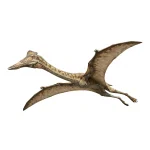
You might also like... 

-
 Apatosaurus
- Classification
- Sauropods
- Characteristics
- Herbivorous
- Era
- Jurassic period
- Cryolophosaurus
- Classification
- Theropods
- Characteristics
- Carnivorous
- Feathered
- Era
- Jurassic period
- Ophthalmosaurus
- Classification
- Marine reptiles
- Characteristics
- Carnivorous
- Era
- Jurassic period
- Europasaurus
- Classification
- Sauropods
- Characteristics
- Herbivorous
- Era
- Jurassic period
-
Sponsored Links
-
Sponsored Links



![[Latest Research] What Was the Function of Spinosaurus's Giant "Sail"? Exploring the Mysteries of Thermoregulation and Underwater Locomotion](https://dinosaurmuseum.jp/wp/wp-content/uploads/eyecatch_spinosaurus-sail-function_en-1024x512.webp)
![[Latest Discovery] A Third Type of Skin, Neither Scales Nor Feathers? Meet "Haolong dongi," a New Dinosaur Species Covered Entirely in Spikes](https://dinosaurmuseum.jp/wp/wp-content/uploads/eyecatch_dinosaur-spiky-skin-discovery_en-1024x512.webp)

Description
Late Jurassic Germany.
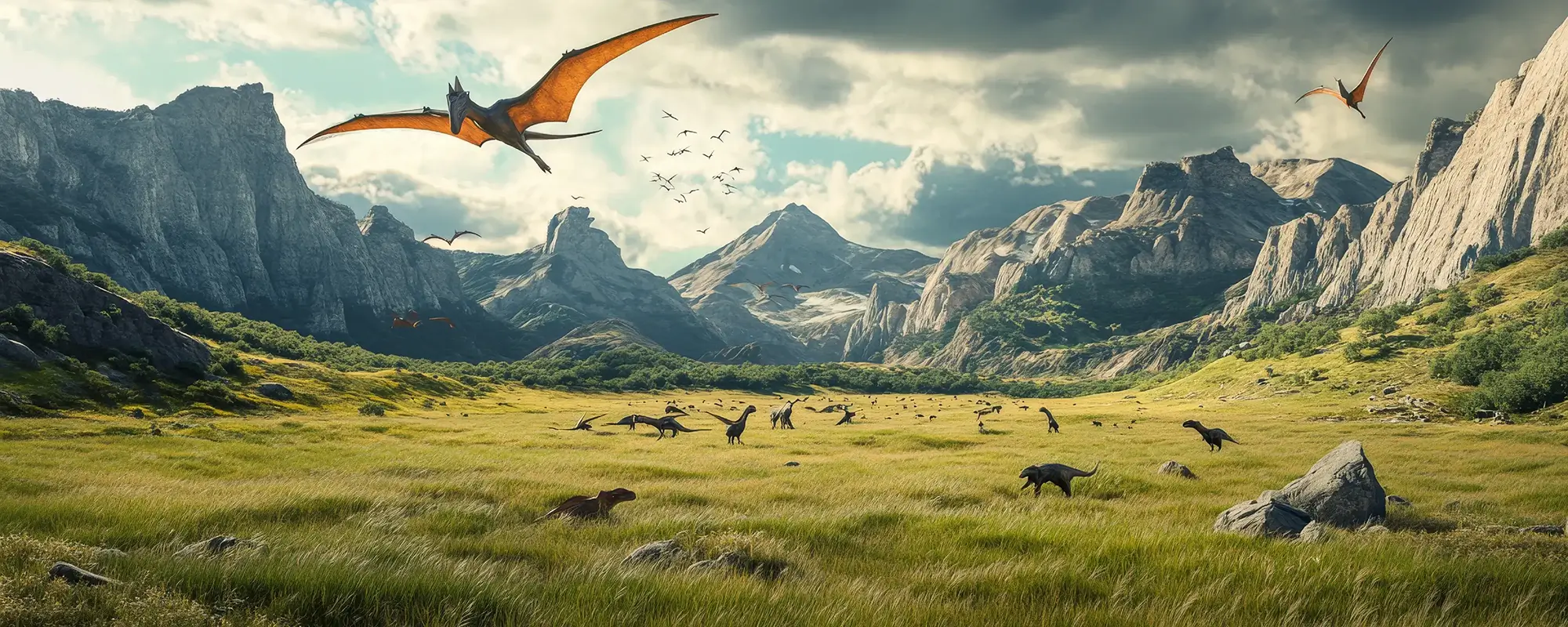
In the skies of this era, also famous for being the home of Archaeopteryx, a bizarre, tiny pterosaur reminiscent of a modern bat flitted about.
Its name was Anurognathus.
Discovered in Solnhofen, one of Germany’s premier fossil sites, this pterosaur possessed fascinating features that highlight its unique evolutionary journey.
Discovery and Name Origin: “Jaw Without a Tail”
Well-Preserved Fossils and a Connection to Japan
The fossils of Anurognathus were discovered in the same geological strata as Archaeopteryx.
What is particularly noteworthy is the excellent condition of the discovered fossils.
Despite being an extremely small creature, it was preserved in such pristine condition that there were more than enough features to identify the species.
Interestingly, although the discoverer was a German scholar, he is said to have had deep ties to Japan.
Meaning of the Name
The genus name Anurognathus directly describes its physical characteristics, meaning “jaw without a tail.”
True to its name, its most prominent features were its “short tail” and “unique head,” which were unseen in other pterosaurs of its lineage at the time.
A Taxonomic Paradox: An Advanced Tail and Primitive Wrists
The taxonomic placement of Anurognathus is highly unique, possessing a combination of features that hint at a transitional phase in evolution.
A “Short Tail” Despite Being a Rhamphorhynchoid?
Taxonomically, they are classified under the “rhamphorhynchoids.”
This group, which also includes Dimorphodon—familiar from the Jurassic Park film series—is typically characterized by having a “long tail” with a “diamond-shaped vane” at the end.
However, despite belonging to this group, the tail of Anurognathus is exceptionally short.
The characteristics of its tail resembled the tailbones seen in modern birds or the advanced pterosaurs (pterodactyloids) that appeared much later, such as Pteranodon.
Wrists Remained “Primitive”
At first glance, it looks like an advanced pterosaur, but it had not entirely evolved past its roots.
Their bodies still firmly retained features typical of early pterosaurs like the rhamphorhynchoids, such as short carpal (wrist) bones.
In other words, as a representative pterosaur of the family Anurognathidae, Anurognathus was a peculiar creature where primitive and seemingly advanced features coexisted.
Bat-Like Appearance and Physical Characteristics
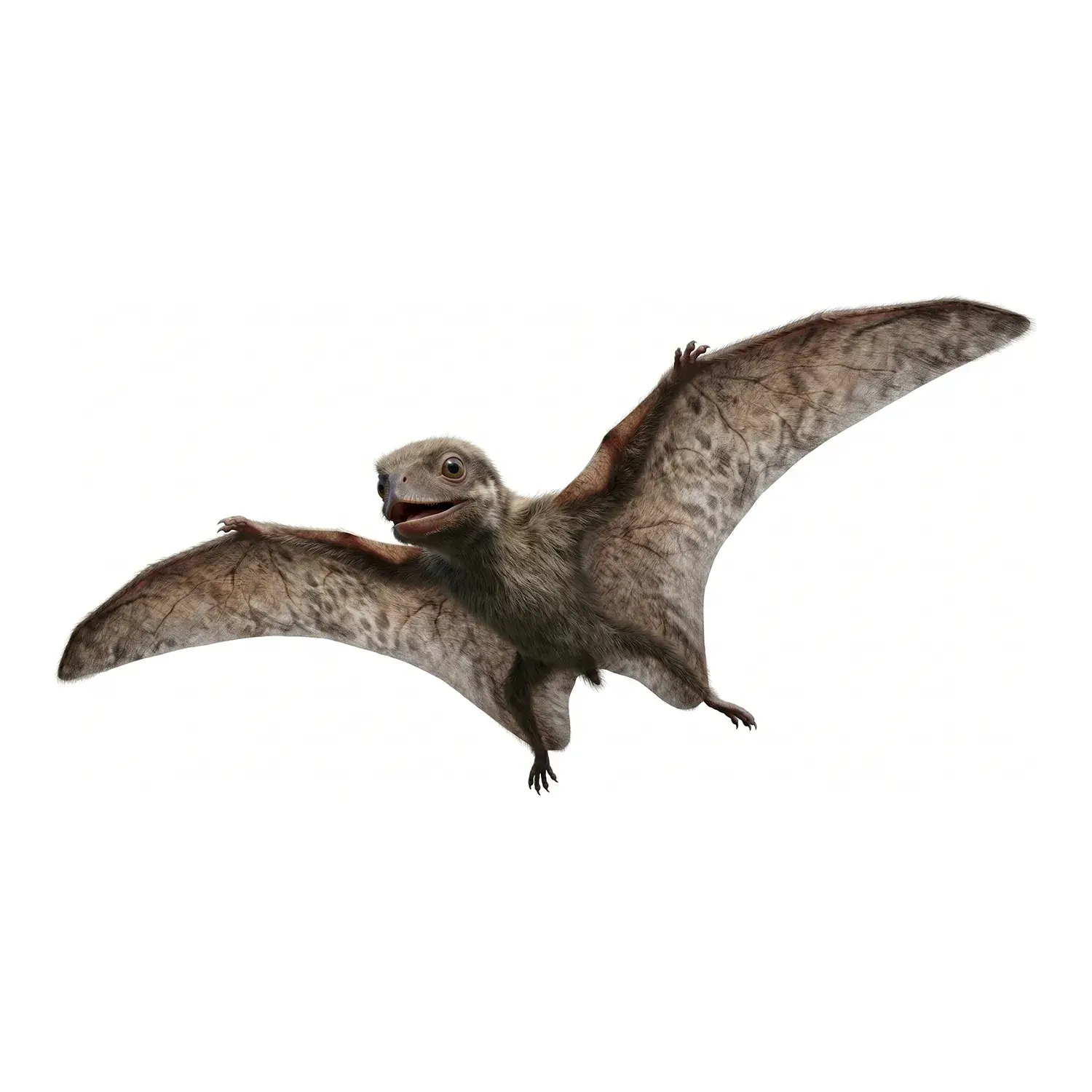
Anurognathus was a very small pterosaur.
It is said that its appearance was akin to that of a modern bat.
Size
Its body length was a mere 9 centimeters (3.5 inches), with a wingspan of about 0.5 meters (1.6 feet).
Head
Its skull was tall and short from front to back.
The snout was rounded.
Teeth
Inside its mouth, small, sharply pointed teeth grew straight up, structured to ensure prey could not escape.
Wings
Compared to its body length, its wings were elongated and well-developed, giving it excellent gliding capabilities.
Ecology as an Aerial Hunter
Preying on Insects Like a Nightjar
Given these physical characteristics, Anurognathus is believed to have been insectivorous.
Their hunting style is often compared to that of the modern bird, the “nightjar.”
Utilizing their excellent flight capabilities and agility, they swiftly flew through the air, snatching up flying insects one after another.
“Agility” Over Speed
While their flight capabilities may not have allowed for high maximum speeds, they seem to have been specialized for “agility.”
In addition to the gliding ability provided by their elongated wings, their short-tailed bodies allowed for tight turns in the air.
This ability would have been immensely helpful when hunting evasive insects like butterflies mid-air.
In the skies of Jurassic Germany, Anurognathus—with its adorable tiny body and peculiar “tailless” appearance—played a vital role in the ecosystem.