
Kerberosaurus
Name Origin
Cerberus Lizard (Hell's Watchdog)
Family
Hadrosauridae
Classification
Diapsida, Ornithischia, Ornithopoda
Habitat (Discovery Location)
Russia
Period
Approximately 66 million years ago (Late Cretaceous)
Length
Approximately 9 meters
Diet
Herbivore
You might also like... 

-
 Bambiraptor
- Classification
- Theropods
- Characteristics
- Carnivorous
- Feathered
- Era
- Cretaceous period
- Troodon
- Classification
- Theropods
- Characteristics
- Carnivorous
- Era
- Cretaceous period
- Moros
- Classification
- Theropods
- Characteristics
- Carnivorous
- Era
- Cretaceous period
- Huanansaurus
- Classification
- Theropods
- Era
- Cretaceous period
-
Sponsored Links
-
Sponsored Links




![[Latest Research] What Was the Function of Spinosaurus's Giant "Sail"? Exploring the Mysteries of Thermoregulation and Underwater Locomotion](https://dinosaurmuseum.jp/wp/wp-content/uploads/eyecatch_spinosaurus-sail-function_en-1024x512.webp)
![[Latest Discovery] A Third Type of Skin, Neither Scales Nor Feathers? Meet "Haolong dongi," a New Dinosaur Species Covered Entirely in Spikes](https://dinosaurmuseum.jp/wp/wp-content/uploads/eyecatch_dinosaur-spiky-skin-discovery_en-1024x512.webp)

Description
At the very end of the Cretaceous period (about 66 million years ago), which marked the finale of the dinosaur age.
In the vast lands of the Amur River basin in the present-day Russian Far East, there lived a dinosaur bearing the name of the “gatekeeper of hell” from Greek mythology.
Its name is “Kerberosaurus.”
Despite the terrifying ring of its name, derived from the hellhound Cerberus, it was in reality a gentle, herbivorous dinosaur that fed on plants near the water.
The True Identity of the “Hellhound”: A Gentle Herbivore Despite Its Scary Name
A 9-Meter Duck-Billed Dinosaur
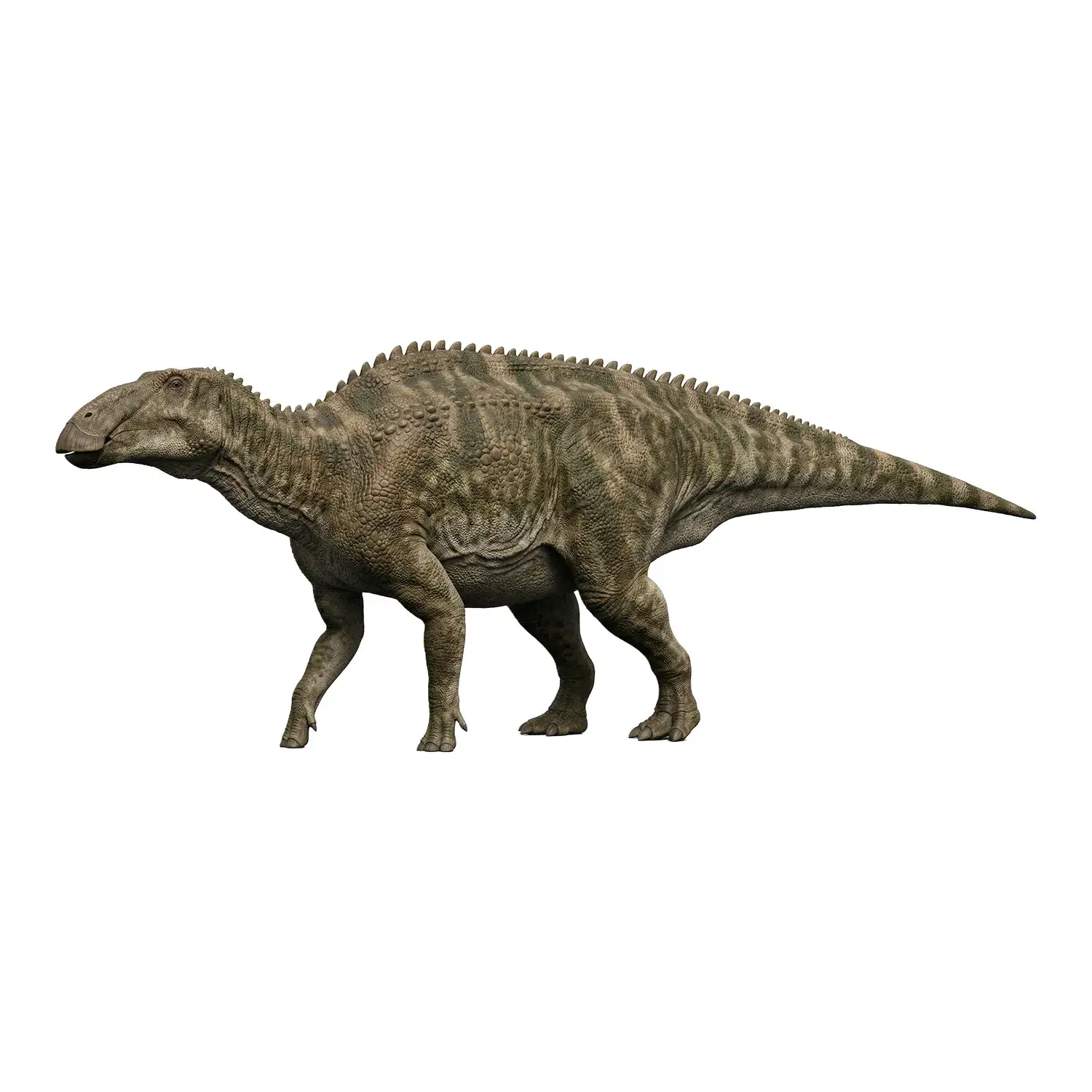
Kerberosaurus was a large herbivorous dinosaur reaching approximately 9 meters (29.5 feet) in length.
Classified under the family “Hadrosauridae,” it belonged to the so-called duck-billed dinosaurs and efficiently ate plants with its flat beak.
Currently, only fossilized skull bones have been discovered.
Why “Cerberus”?
There are various theories about this, but it is said the name implies that they were the gatekeepers standing at the entrance to the “hellish era” of the dinosaur extinction, as they lived at the very end of the Cretaceous period.
While the sound of the name evokes a ferocious monster, it was actually an important herbivorous dinosaur that supported the ecosystem right before the mass extinction.
From North America to Asia! The “Traveler” That Crossed Continents
The most important keyword when discussing Kerberosaurus is “intercontinental migration.”
Connected Continents
Fossil research has revealed that Kerberosaurus is a descendant of a group originating in North America.
At the time, Asia and North America were connected by land (such as the Bering land bridge).
Their ancestors evolved in North America and later became “travelers” who crossed overland into the Eurasian continent (Russia and East Asia).
This discovery is considered one of the definitive pieces of evidence showing that advanced hadrosaurs expanded their range from North America to Asia.
Shifting Classification: A Relative of Kamuysaurus (Mukawaryu)?
Kerberosaurus is also a dinosaur whose classification has seen changing perspectives over time.
Early Classification: Saurolophini Tribe
Initially, it was considered to belong to the tribe “Saurolophini,” possessing somewhat primitive characteristics similar to “Prosaurolophus” and others that lived in North America about 75 million years ago.
Recent Classification: Edmontosaurini Tribe
However, in recent studies, it is more often classified under the tribe “Edmontosaurini,” which includes the North American “Edmontosaurus” and “Kamuysaurus (Mukawaryu)” discovered in Hokkaido, Japan.
According to this new theory, Kerberosaurus is a close relative of Kamuysaurus.
A magnificent drama emerges of a group born in North America crossing over to Asia, with each lineage undergoing its own unique evolution in its respective region.
Coexistence on the Banks of the Amur River
Kerberosaurus was discovered in the “Tsagayan Formation” in Russia.
This area was once a floodplain of the Amur River.
In this same formation, another dinosaur of the Hadrosauridae family named “Amurosaurus” has also been found.
Amurosaurus was a type with a crest on its head (subfamily Lambeosaurinae), looking vastly different from the crestless Kerberosaurus.
During the twilight of the dinosaur age, the “hellhound” and the “crested dragon” likely coexisted peacefully on the Russian plains, quietly grazing on vegetation.