
Hatzegopteryx
Name Origin
Wing of Hatzeg
Family
Azhdarchidae
Classification
Diapsida, Pterosauria
Habitat (Discovery Location)
Romania
Period
Approximately 66 million years ago (Late Cretaceous)
Length
Approximately 11 to 12 meters (wingspan)
You might also like... 

-
 Dimorphodon
- Classification
- Flying reptiles
- Characteristics
- Carnivorous
- Era
- Jurassic period
- Elasmosaurus
- Classification
- Marine reptiles
- Characteristics
- Carnivorous
- Era
- Cretaceous period
- Peloroplites
- Classification
- Thyreophora
- Characteristics
- Herbivorous
- Era
- Cretaceous period
- Segisaurus
- Classification
- Theropods
- Characteristics
- Carnivorous
- Era
- Jurassic period
-
Sponsored Links
-
Sponsored Links







![[Latest Research] What Was the Function of Spinosaurus's Giant "Sail"? Exploring the Mysteries of Thermoregulation and Underwater Locomotion](https://dinosaurmuseum.jp/wp/wp-content/uploads/eyecatch_spinosaurus-sail-function_en-1024x512.webp)
![[Latest Discovery] A Third Type of Skin, Neither Scales Nor Feathers? Meet "Haolong dongi," a New Dinosaur Species Covered Entirely in Spikes](https://dinosaurmuseum.jp/wp/wp-content/uploads/eyecatch_dinosaur-spiky-skin-discovery_en-1024x512.webp)



Description
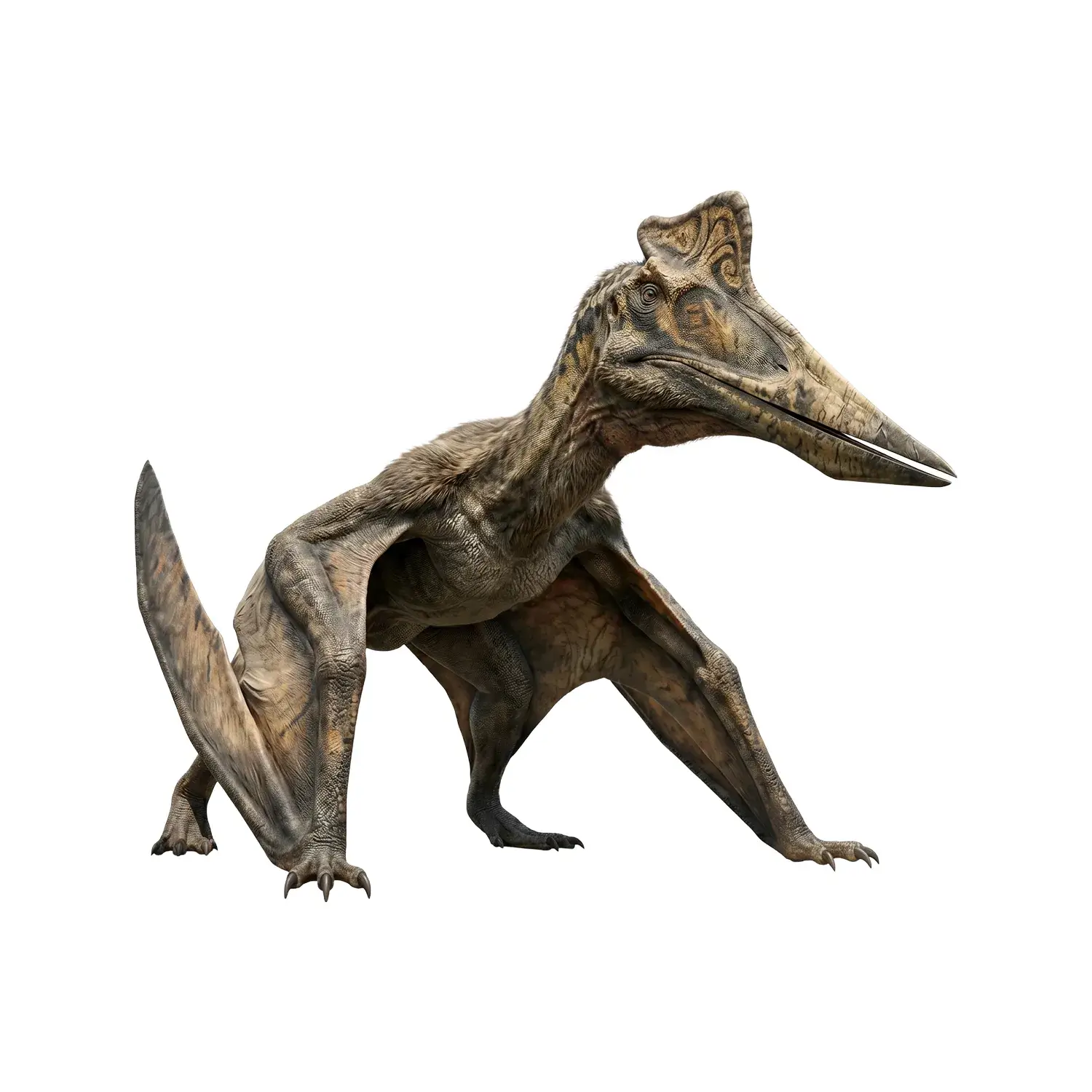
Around 66 million years ago, during the Late Cretaceous period, a massive flying monster reigned over Romania.
This is “Hatzegopteryx,” a pterosaur whose scientific name means the “Wing of Hatzeg.”
Classified in the family Azhdarchidae within the suborder Pterodactyloidea, it is known alongside its close relative Quetzalcoatlus as one of the largest flying creatures in history.
A Head the Size of a “Compact Car” and an Extraordinary Physique
The greatest characteristic of Hatzegopteryx lies in its overwhelming size and robust skeleton.
A Massive Skull Over 3 Meters Long
While the skulls of other pterosaurs were elongated and thin, the skull of Hatzegopteryx exceeded 3 meters (9.8 feet) in length and was incredibly robust.
This means it carried a massive, heavy head—comparable in size to a “compact car”—at the end of its neck.
A Thick, Short Neck and Heavy Body Weight
To support this massive head, its cervical vertebrae (neck bones) were distinctively shorter and thicker compared to other azhdarchids.
Furthermore, because its bones were less hollow and more densely packed, it is believed to have been much heavier than Quetzalcoatlus, which was of a comparable size.
An “Evolutionary Reversal” Born from an Island Environment
Why did a pterosaur, which should inherently become lighter to fly, evolve into such a massive and heavily built creature?
The answer lies in its habitat.
The Isolated “Hatzeg Island”
During that time, Europe was dotted with islands in a shallow sea known as the “Tethys Sea,” and the “Hatzeg Basin” in Romania, where the fossils were discovered, was also a small island back then.
Preying on “Dwarfed Dinosaurs”
Dinosaurs trapped on this island, such as Magyarosaurus and Telmatosaurus, had undergone “insular dwarfism,” shrinking in size to adapt to the limited food and environment.
Additionally, there were no large carnivorous dinosaurs like Tarascosaurus; only small carnivorous dinosaurs existed there.
The Path to Apex Predator
In this “environment devoid of powerful natural enemies,” Hatzegopteryx underwent gigantism—much like modern Komodo dragons or giant tortoises—rising to become the “apex predator of the island,” overpowering and feeding on the dwarfed dinosaurs.
Could It Actually “Fly” With Such a Heavy, Massive Body?
Due to its high bone density and heavy weight, some researchers believe that “it could not fly and merely roamed the ground,” or that “it only flew to escape enemies when it was a light, young individual, and stopped flying once fully grown.”
On the other hand, there is a strong viewpoint asserting that “it must have been able to fly.”
The Island-Hopping Theory
It would have been difficult for a pterosaur with a very high basal metabolic rate to consistently consume enough calories to maintain its massive body on a single small island.
It is speculated that, just as modern Komodo dragons swim across the sea, Hatzegopteryx flew from island to island in search of food.
Astonishing Takeoffs Powered by Muscle Strength
Another theory suggests that it had highly developed, robust muscles in its limbs, allowing it to leap from the ground into the air in mere seconds using sheer muscle strength, without needing updrafts or high ground (there is also an opinion that the high bone density was only present in certain parts of the discovered fossils).
Did this monster, standing as tall as a giraffe, soar freely through the skies, or was it a giant predator that stalked the earth?
The truth of Hatzegopteryx, which underwent its own unique evolution on an isolated island, will remain asleep within the strata of Hatzeg until a near-complete fossil is found.