
Carnotaurus
Name Origin
Meat-Eating Bull
Family
Abelisauridae
Classification
Diapsida, Saurischia, Theropoda
Habitat (Discovery Location)
Argentina
Period
Approximately 72 to 69.9 million years ago (Late Cretaceous)
Length
Approximately 7.5 to 9 meters
Weight
Approximately 1.35 to 2.1 tons
Diet
Carnivore (Meat-eater)
 Jurassic
Park / World Featured Dinosaur
Appearance in Jurassic World: Fallen Kingdom
This medium-sized carnivorous dinosaur made its long-awaited series debut in this film. Originally from the population on Isla Sorna, these individuals migrated to Isla Nublar, where they adapted to the wild and survived. Its appearance was highly anticipated before the movie's release and was celebrated by hardcore fans.
Two adults appear in the film, playing memorable—though somewhat unfortunate—roles in both the opening and closing acts.
The first individual appears during the volcanic eruption on Isla Nublar. Amidst the emergency where even Allosaurus and Rexy (Tyrannosaurus) were fleeing in panic, this individual—perhaps driven by hunger or a naturally belligerent nature—chose not to run but to confront a Sinoceratops.
Although it picked the fight, it was repelled by the Sinoceratops and switched its target to Owen's group. However, at that moment, the Tyrannosaurus barged in, knocking it out with a single blow and finishing it off by crushing its neck underfoot (a famous scene also used for the movie poster). Its hard-earned screen time ended up serving merely as a foil to highlight the strength of Rexy and the Sinoceratops.
The second individual was transported to the "Lockwood Estate" on the mainland and released along with the other dinosaurs at the end. Later, it approached the Tyrannosaurus after she had devoured Eli Mills to scavenge a severed leg that had fallen. However, it was headbutted away by the T-Rex and shown scrambling to escape.
In fact, the Carnotaurus had already appeared in Michael Crichton's original novel The Lost World (1995), where it was depicted with chameleon-like camouflage (active camouflage) capabilities. However, this trait was omitted in the film version, where it is portrayed as a standard carnivorous dinosaur.
Additionally, while it has served as a de facto "final boss" in related media (such as the Disney movie Dinosaur), within this franchise, it was listed as one of the genetic bases for the Indominus rex in the previous film, Jurassic World (implying that the Indoraptor likely contains Carnotaurus genes as well).Appearance in Jurassic World: Dominion
Although it appeared only briefly in the trailer and tended to be overshadowed by other dinosaurs in the main film, it certainly left its mark, particularly during the scenes on Malta.
In the film, both an adult and a juvenile appear in the fighting pit within Malta's black market.
Adult
It had a broken left horn and scarring from burns on its body, and was being held alongside an Allosaurus. It appears this wounded adult was originally intended to be "Toro," the individual from the animated series Camp Cretaceous.
Juvenile
It was also held captive in the black market.
Midway through the story, while being pursued by Owen, Rainn Delacourt—one of the series' villains—shoots the locks off the containers holding the Allosaurus and Carnotaurus, recklessly unleashing the two dinosaurs.
The released adult then joined the Allosaurus in attacking smugglers and locals in the square, instantly turning the streets of Malta into a living hell.
The juvenile also had its moment. When Rainn Delacourt was cornered by Owen and accidentally fell into the fighting pit for small dinosaurs, the juvenile bit into one of his arms. Assisted by a Lystrosaurus and a juvenile Baryonyx (which delivered the killing blow), it successfully helped take down the villain.
Additionally, according to posts on the official "Dinotracker" website, other individuals have been confirmed outside the United States. Sightings include one attacking llamas in Peru and traces of a destroyed shed in the UK, suggesting that the species is expanding its habitat across the globe.
TODAY'S QUIZ
Correct answer = 1 coin
What were the two horns above Carnotaurus’s eyes most likely used for?
Loading…
You might also like... 

-
 Pyroraptor
- Classification
- Theropods
- Characteristics
- Carnivorous
- Era
- Cretaceous period
- Majungasaurus
- Classification
- Theropods
- Characteristics
- Carnivorous
- Era
- Cretaceous period
- Anchisaurus
- Classification
- Sauropods
- Characteristics
- Herbivorous
- Era
- Jurassic period
- Acrocanthosaurus
- Classification
- Theropods
- Characteristics
- Carnivorous
- Era
- Cretaceous period
-
Sponsored Links
-
Sponsored Links









![[Latest Research] What Was the Function of Spinosaurus's Giant "Sail"? Exploring the Mysteries of Thermoregulation and Underwater Locomotion](https://dinosaurmuseum.jp/wp/wp-content/uploads/eyecatch_spinosaurus-sail-function_en-1024x512.webp)
![[Latest Discovery] A Third Type of Skin, Neither Scales Nor Feathers? Meet "Haolong dongi," a New Dinosaur Species Covered Entirely in Spikes](https://dinosaurmuseum.jp/wp/wp-content/uploads/eyecatch_dinosaur-spiky-skin-discovery_en-1024x512.webp)




Description
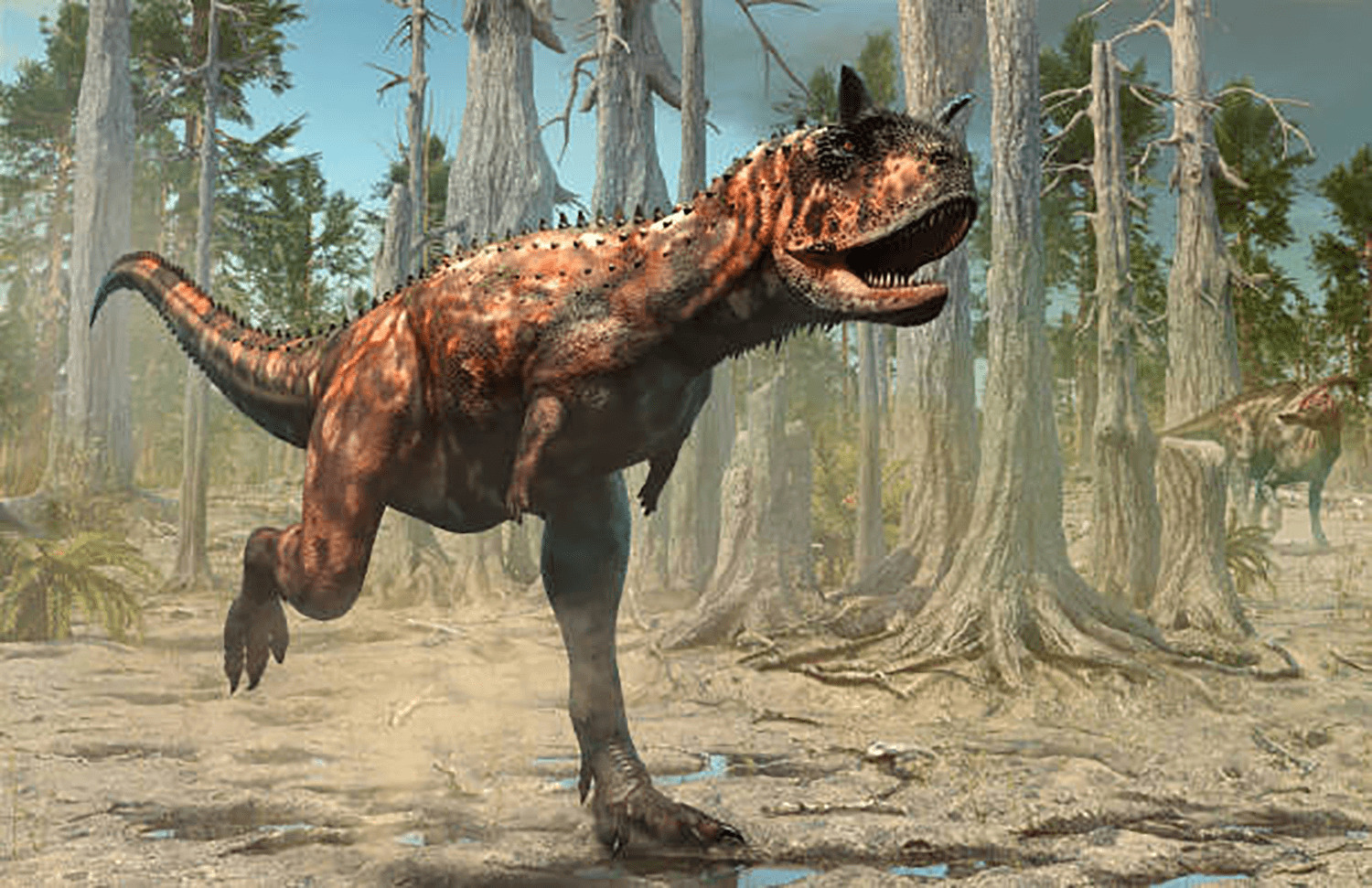
Carnotaurus was a carnivorous dinosaur that reigned in South America (present-day Argentina) during the Late Cretaceous period.
Possessing unique characteristics that set it apart from Tyrannosaurus and Allosaurus, it is known as the representative dinosaur of the Abelisauridae family, which evolved uniquely in the Southern Hemisphere.
We will thoroughly explain the surprising ecology and mysterious physical features of this “horned hunter,” which is also popular in movies and games.
The Origin of “Meat-Eating Bull” and the Mystery of Its Horns
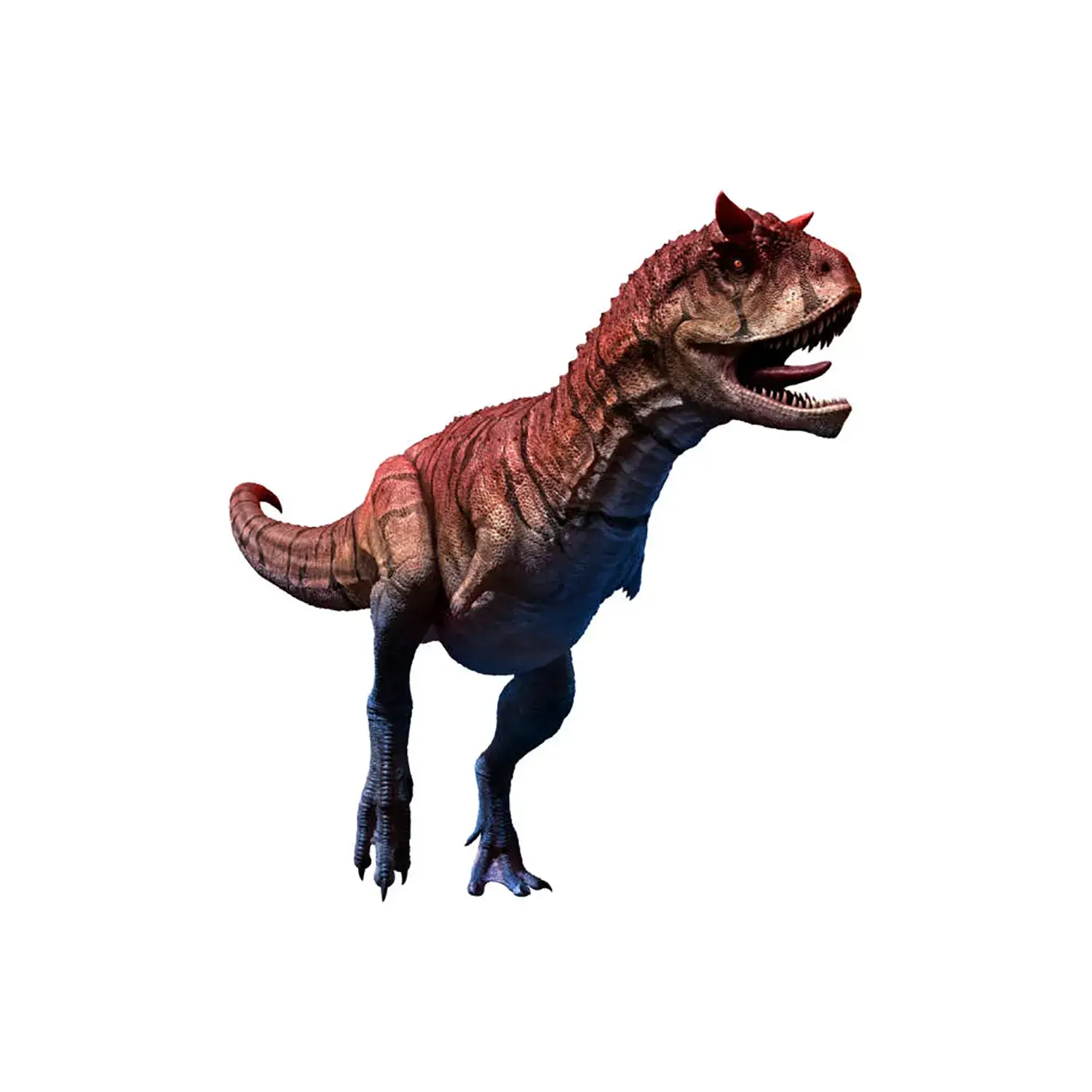
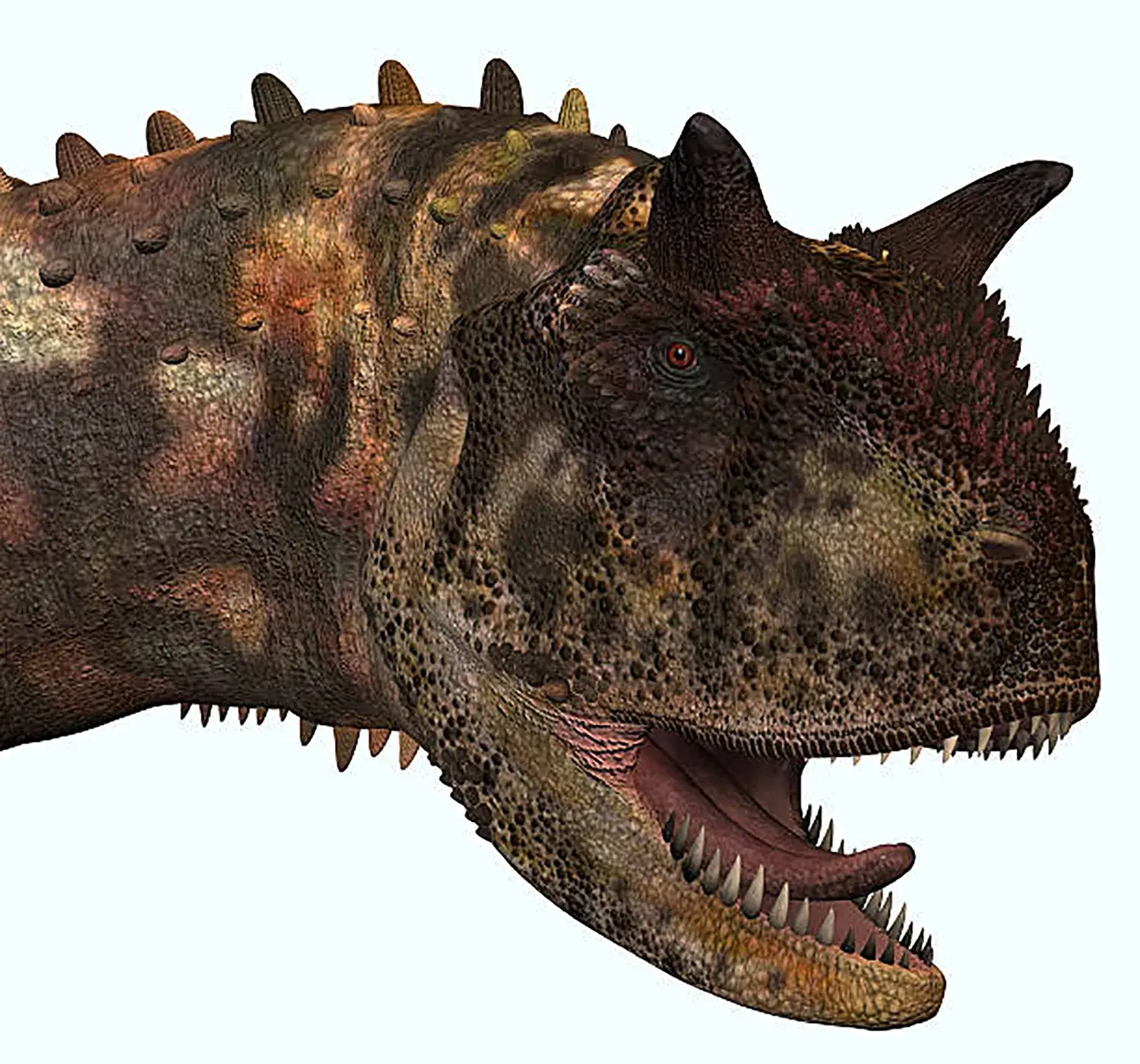
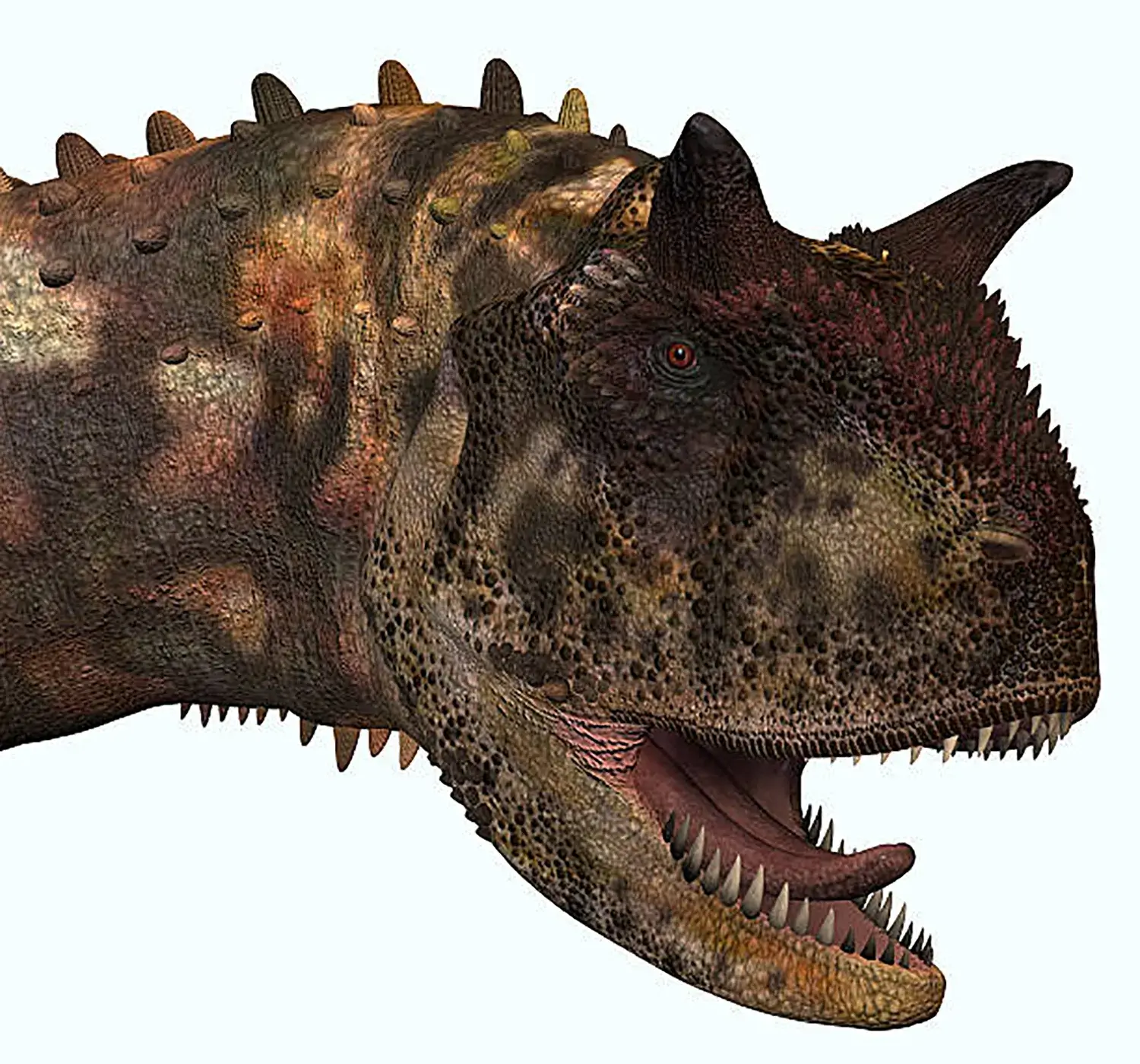
The scientific name Carnotaurus means “meat-eating bull” in Latin.
As the name suggests, their most distinctive feature is their head.
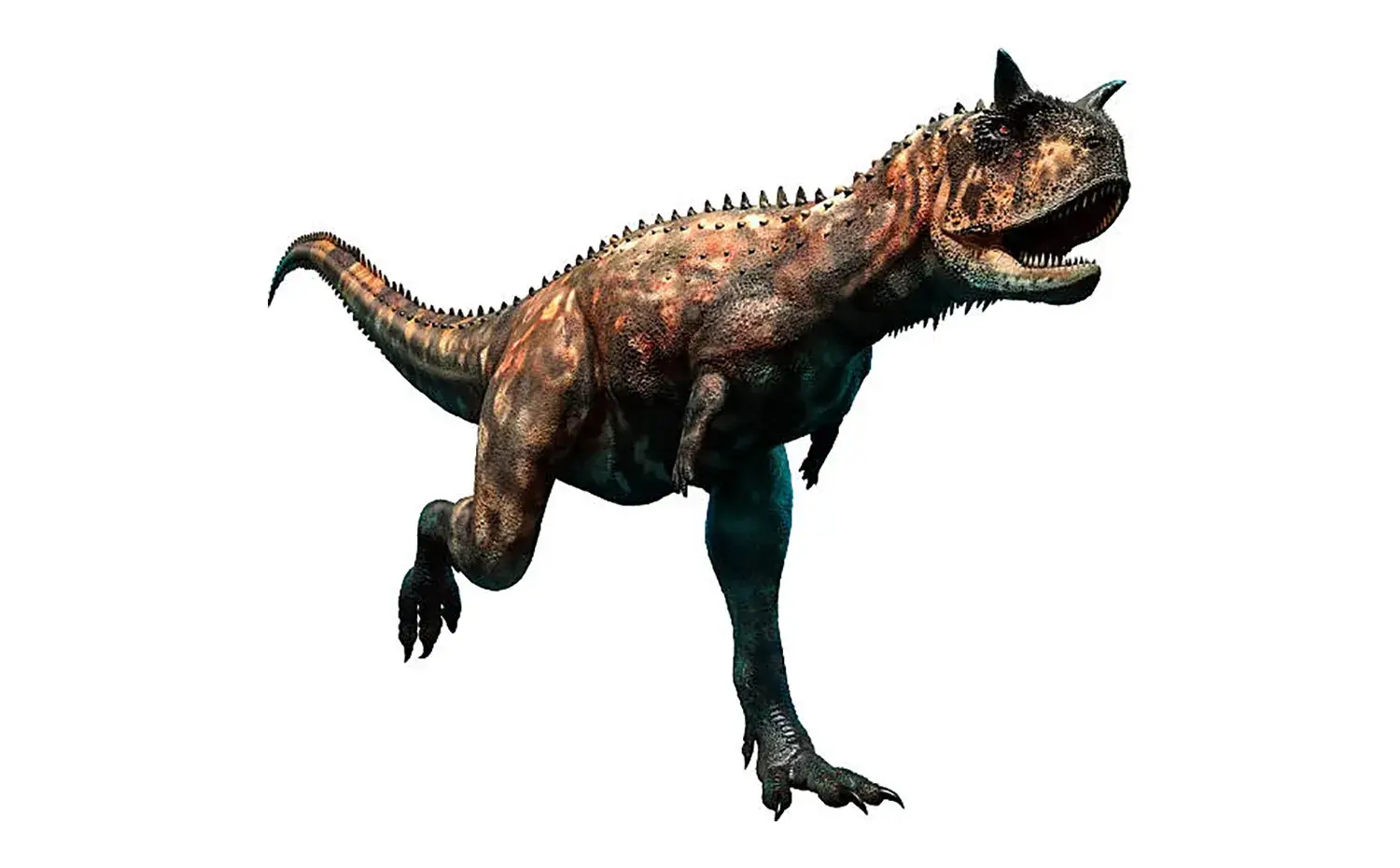
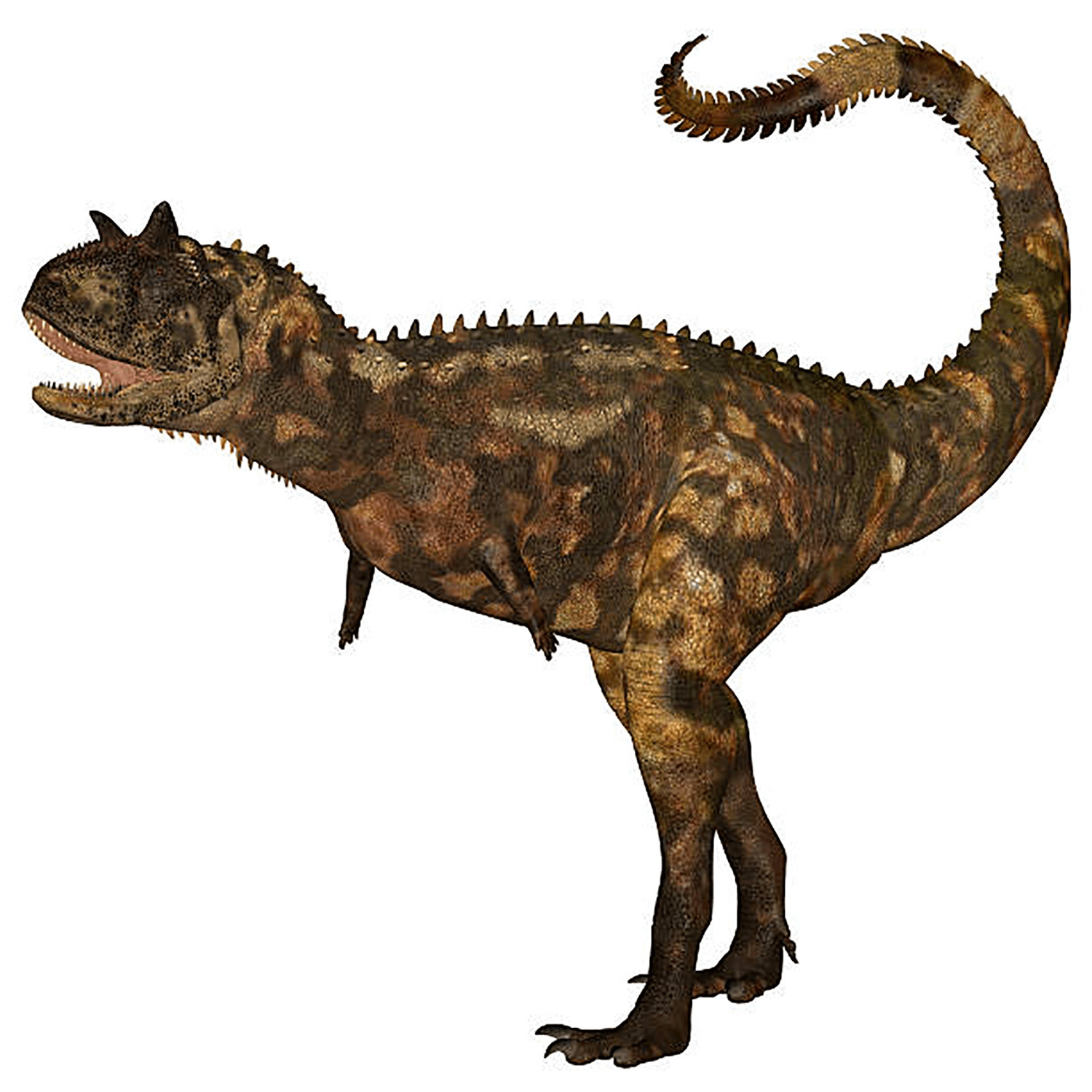
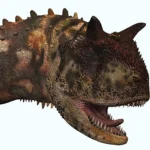
With a face reminiscent of a bulldog—tall vertically and compressed horizontally—it possessed two thick horns protruding sideways above its eyes.
Its appearance is truly that of a “bull in the shape of a lizard.”
It had two thick horns protruding sideways above its eyes.
It is extremely rare for carnivorous dinosaurs to have such horns, and their purpose has long been a mystery.
Since they lacked the strength to be used as weapons, the prevailing theory today is that they functioned as “intra-specific display.”
It is believed that the size of the horns was used as an appeal point to attract females or to intimidate rival males.
The “Ultimate Tiny Arms”: More Vestigial Than Tyrannosaurus
Essential to discussing Carnotaurus are its extremely vestigial forelimbs.
While Tyrannosaurus is famous for its small arms, Carnotaurus takes this to the extreme, with arms measuring only about 50 cm long.
Its forelimbs were only about 50 cm long.
The elbow and wrist joints were fused, making it look at first glance as if the hand grew directly from the upper arm.
However, they were not simply degenerate.
While many advanced theropods reduced their digit count, Carnotaurus retained a primitive “four fingers.”
Even more surprisingly, despite the arms being minuscule, the shoulder girdle was well-developed, revealing that the range of motion in the shoulder was remarkably wide.
The purpose of these bizarre forelimbs remains even more shrouded in mystery than the horns.
The Fastest Giant Hunter on Land? Astonishing Physical Abilities and the “Caudofemoralis”
Contrary to its strange appearance, recent research has revealed that Carnotaurus was likely a hunter possessing terrifying physical capabilities.
According to a 2011 study, Carnotaurus is considered one of the “fastest dinosaurs,” boasting top-class speed among all large theropods.
The basis for this is the size of the “caudofemoralis,” a muscle extending from the tail to the thigh.
Research suggests that the caudofemoralis of Carnotaurus was among the largest of any animal on Earth.
Its caudofemoralis muscle was among the largest of any animal on Earth.
It is believed that this robust muscle generated explosive propulsion, allowing for tremendous charging power like a bull.
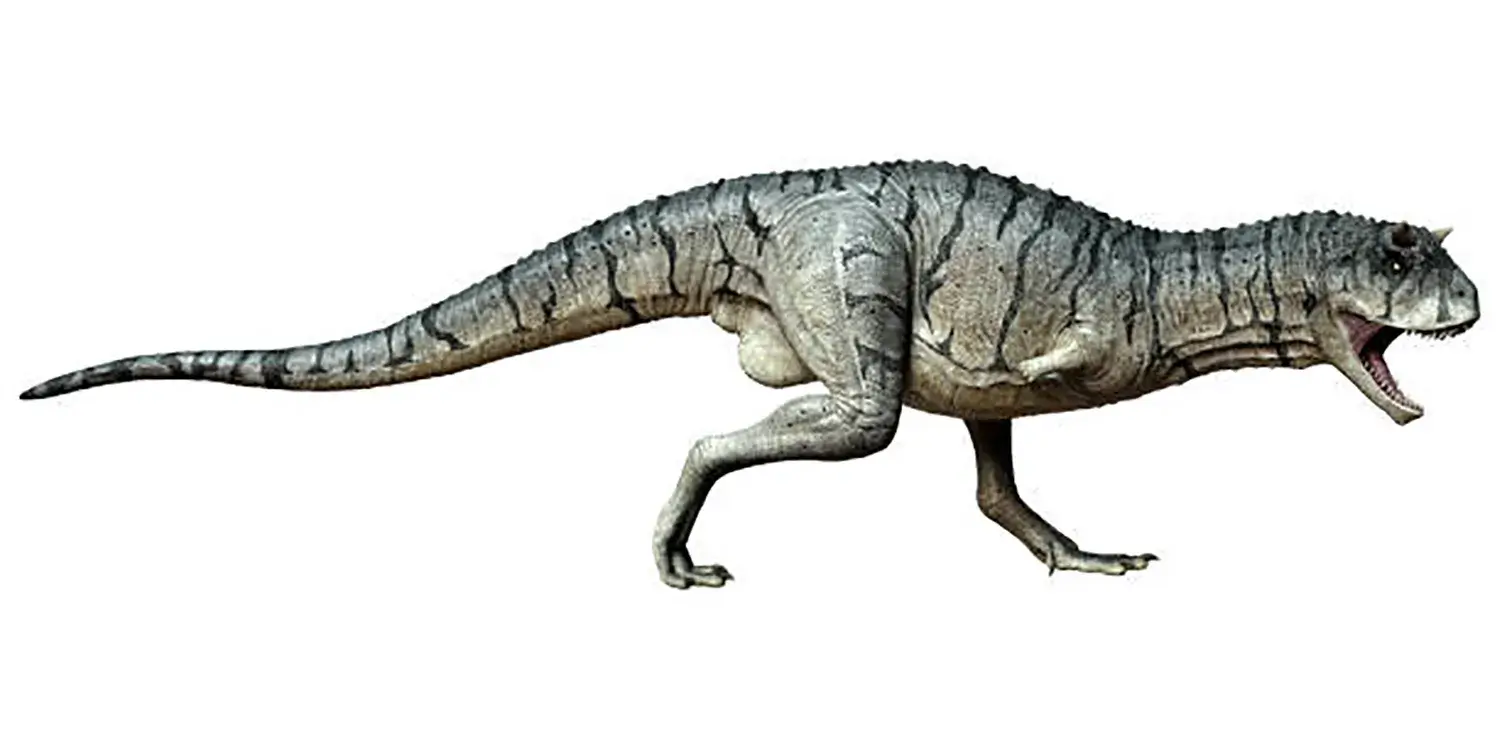
However, in exchange for this massive muscle, the tail had low flexibility, and it is presumed that it could not turn very tightly.
It may have specialized in a style of closing the distance instantly with overwhelming straight-line speed to deliver a powerful strike.
It boasted top-class speed among large theropods.
Proof of “Scales” in the Age of Feathers
In recent years, the theory that “carnivorous dinosaurs had feathers” has become common, but regarding Carnotaurus, it is asserted that it “almost certainly did not have feathers.”
This is due to the exceptionally good condition in which the Carnotaurus fossil was discovered.
Fossils discovered in Patagonia in 1985 preserved clear impressions (traces) of “scaly skin.”
This confirmed that Carnotaurus had reptile-like scale-covered skin, making it an extremely important resource in the study of the Abelisauridae family.
One of the Largest Species of Abelisauridae
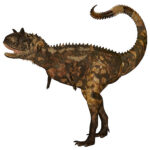
Carnotaurus is estimated to have been approximately 7.5 to 9 meters long and weighed 1.35 to 2.1 tons.
It was once considered the largest among abelisaurids, but in recent years, a species called Pycnonemosaurus has emerged as a rival.
Regardless, Carnotaurus undoubtedly possessed a massive body representing this group.
Thanks to the well-preserved complete skeleton and even skin traces, Carnotaurus is particularly well-studied among the Abelisauridae.
Its unique appearance and abilities tell the story of how diverse dinosaur evolution was, exceeding our imagination.