
Eocarcharia
Name Origin
Fierce-eyed Dawn Crocodile
Family
Carcharodontosauridae
Classification
Diapsida, Saurischia, Theropoda
Habitat (Discovery Location)
Niger
Period
Approximately 110 million years ago (Early Cretaceous)
Length
Approximately 6–8 meters
Diet
Carnivore (Meat-eater)
You might also like... 

-
 Irritator
- Classification
- Theropods
- Characteristics
- Carnivorous
- Era
- Cretaceous period
- Gargoyleosaurus
- Classification
- Thyreophora
- Characteristics
- Herbivorous
- Era
- Jurassic period
- Megapterygius
- Classification
- Marine reptiles
- Characteristics
- Carnivorous
- Era
- Cretaceous period
- Liliensternus
- Classification
- Theropods
- Characteristics
- Carnivorous
- Era
- Triassic period
-
Sponsored Links
-
Sponsored Links







![[Latest Research] What Was the Function of Spinosaurus's Giant "Sail"? Exploring the Mysteries of Thermoregulation and Underwater Locomotion](https://dinosaurmuseum.jp/wp/wp-content/uploads/eyecatch_spinosaurus-sail-function_en-1024x512.webp)
![[Latest Discovery] A Third Type of Skin, Neither Scales Nor Feathers? Meet "Haolong dongi," a New Dinosaur Species Covered Entirely in Spikes](https://dinosaurmuseum.jp/wp/wp-content/uploads/eyecatch_dinosaur-spiky-skin-discovery_en-1024x512.webp)

Description
The African continent during the Early Cretaceous period, approximately 110 million years ago.
The region that is now Niger (Elrhaz Formation) was a paradise for dinosaurs, blessed with abundant waters and greenery, but it was also the stage for a harsh struggle for survival.
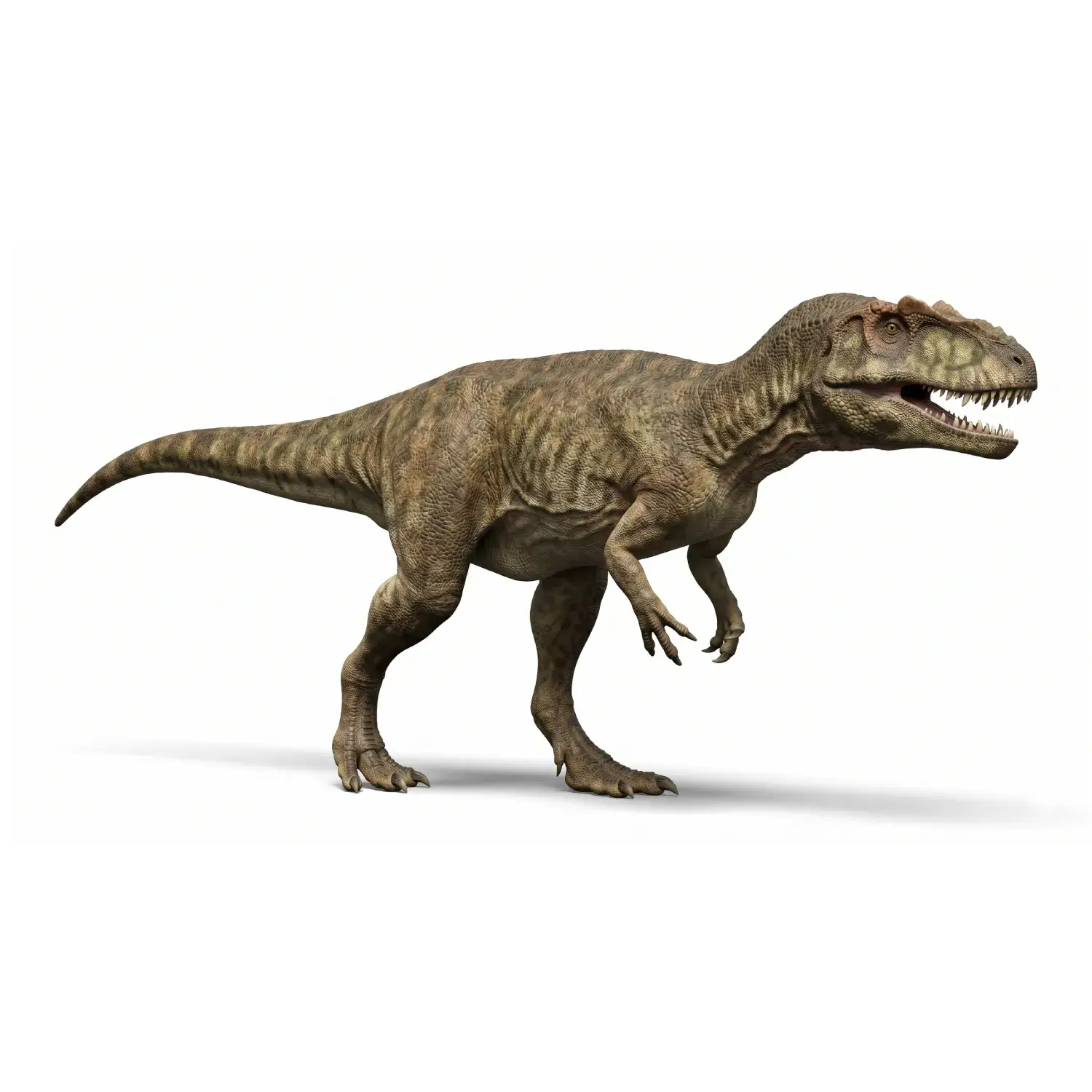
The carnivorous dinosaur that reigned at the apex of the ecosystem in this land, casting a piercing gaze, was “Eocarcharia”.
As a relative of the giant carnivorous dinosaur Carcharodontosaurus that would appear later, they established a solid position in the ecosystem of that time.
“Fierce-eyed Dawn Crocodile”: The Intimidating Face Indicated by its Scientific Name
The scientific name “Eocarcharia dinops” holds a very intense meaning that symbolizes the physical characteristics of this dinosaur.
Meaning of the Name
“Fierce-eyed Dawn Crocodile”
Supraorbital Ridges and Display
Why was it given such a name?
The reason lies in the shape of the skull around the eyes.
In the discovered fossils, the part protruding above both eyes like a visor (the brow area) rose significantly high with thicker bone than found in general theropods.
This is believed to have given it an intimidating and ferocious impression, as if it were constantly glaring at its opponents.
Paleontologists such as Paul Sereno and Stephen Brusatte have pointed out that this “supraorbital ridge” (brow ridge) was not merely a decoration but may have been used for combat between individuals of the same species or for courtship (display).
When males butted heads, this thick bone might have served as a weapon while simultaneously acting as a shield to protect their own eyes.
An “Active Hunter” with Shark-like Teeth
A Carnivorous Dinosaur 6 to 8 Meters Long
Eocarcharia was a carnivorous dinosaur with an estimated total length of 6 to 8 meters.
Although smaller compared to its relative Carcharodontosaurus that appeared later, it boasted sufficient size as a predator of its time and occupied a basal position within the family Carcharodontosauridae.
Sharp Teeth Designed to Tear Flesh
Its most defining feature was the “sharp, shark-like teeth” unique to its group.
Lined with thin, sharp teeth featuring serrations on the edges, this structure was suited not for crushing the bones of prey, but for tearing off flesh and causing massive blood loss.
This dental characteristic supports the theory that they were not scavengers feeding on carrion, but “active and powerful hunters” that attacked and brought down prey themselves.
Coexistence Through Skillful “Niche Partitioning” with Rivals
Other large carnivorous dinosaurs have also been found in the region where Eocarcharia lived.
They managed to coexist skillfully in the same environment by practicing “niche partitioning”—targeting different prey and occupying different spaces.
The Active Hunter “Eocarcharia”
An apex predator that utilized its sharp teeth and physical abilities to attack and prey on living herbivorous dinosaurs like Nigersaurus.
The Scavenger “Kryptops”
Abelisauridae.
It avoided competition by acting as a “scavenger,” eating leftovers and carcasses rather than hunting large prey itself.
The Fish-Eating Specialist “Suchomimus”
Spinosauridae.
By preying primarily on “fish” at the water’s edge, it established a status unrelated to the struggle for terrestrial prey.
The “Three-Way” Balance Inherited by the Next Generation
This magnificent division of roles was carried over to later eras (Late Cretaceous Africa).
Even as the actors became gigantic and were replaced, this tripartite balance of hunter, scavenger, and fish-eater continued to be maintained.
The Mystery of the “Chimera” Surrounding the Specimen
Was the “Fierce Eye” from Another Dinosaur?
Eocarcharia is also a dinosaur shrouded in mystery.
No new specimens have been found since its discovery in 2000.
Furthermore, in recent years, it has been identified that part of the skull (around the eye socket) previously considered a characteristic of Eocarcharia actually belonged to a member of the Spinosauridae (likely Suchomimus) living in the same era.
If this observation is correct, the skull information we have for Eocarcharia might be a “chimera”—a reconstruction mixing fossils from multiple dinosaurs.
Even the characteristic of the “fierce eye,” which inspired its scientific name, might have actually been a misidentification of parts from another dinosaur.
While its true form remains in the mist, the fact that they played an important role in Early Cretaceous Niger remains unchanged.
Eocarcharia is a valuable existence that teaches us both the complexity of ancient ecosystems and the difficulties of fossil research.