
Scelidosaurus
Name Origin
Limb Lizard
Family
Scelidosauridae
Classification
Diapsida, Ornithischia, Thyreophora
Habitat (Discovery Location)
United Kingdom
Period
Approximately 196–183 million years ago (Early Jurassic)
Length
Approximately 3–4 meters
Weight
Approximately 270 kg
Diet
Herbivore
You might also like... 

-
 Incisivosaurus
- Classification
- Theropods
- Characteristics
- Herbivorous
- Feathered
- Era
- Cretaceous period
- Majungasaurus
- Classification
- Theropods
- Characteristics
- Carnivorous
- Era
- Cretaceous period
- Diplodocus
- Classification
- Sauropods
- Characteristics
- Herbivorous
- Era
- Jurassic period
- Elaphrosaurus
- Classification
- Theropods
- Characteristics
- Carnivorous
- Era
- Jurassic period
-
Sponsored Links
-
Sponsored Links









![[Latest Research] What Was the Function of Spinosaurus's Giant "Sail"? Exploring the Mysteries of Thermoregulation and Underwater Locomotion](https://dinosaurmuseum.jp/wp/wp-content/uploads/eyecatch_spinosaurus-sail-function_en-1024x512.webp)
![[Latest Discovery] A Third Type of Skin, Neither Scales Nor Feathers? Meet "Haolong dongi," a New Dinosaur Species Covered Entirely in Spikes](https://dinosaurmuseum.jp/wp/wp-content/uploads/eyecatch_dinosaur-spiky-skin-discovery_en-1024x512.webp)

Description
The Early Jurassic period marks the initial stage of the dinosaur era.
In the present-day United Kingdom, an important dinosaur lived that holds the key to unlocking the secrets of the evolution of the later “Thyreophora” (armored dinosaurs).
Its name is “Scelidosaurus.”
Although it is a great ancestor of star dinosaurs like Stegosaurus and Ankylosaurus, this dinosaur remained dormant in a museum for over 150 years. Thanks to recent re-examination, it has received a dramatic re-evaluation as the “Rosetta Stone of dinosaur research.”
The “Blueprint” of Thyreophora: Ancestor of the Big Names
Scelidosaurus is the common ancestor, or an existence extremely close to it, before the divergence of “Stegosauria” (with plates on their backs) and “Ankylosauria” (armored with plates).
It is an important dinosaur standing at a branching point in evolution; without it, the later Stegosaurus and Ankylosaurus might not have existed.
Basic Specs and Origin of Name
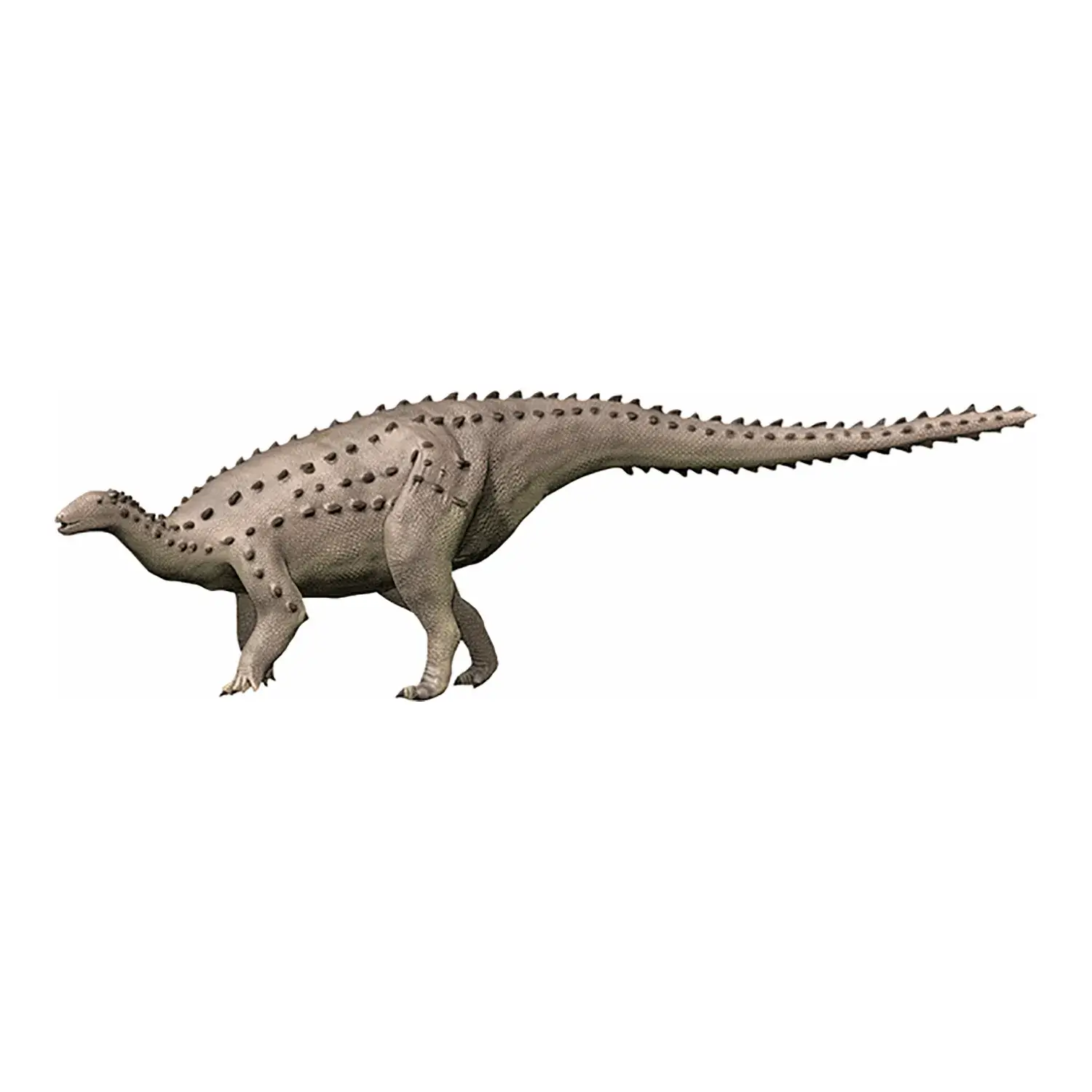
It is a medium-sized herbivorous dinosaur with a total length of 3 to 4 meters and a weight of approximately 270 kg.
It had a weight similar to a modern large cow or a small rhino.
The scientific name means “Limb Lizard.”
It was named by the renowned paleontologist Richard Owen.
Elaborate “Living Armor”
Its greatest feature is the elaborate armor of “osteoderms” covering its entire body.
Dorsal Armor
From the neck to the tail, bony plates with keels (ridges) were lined up in several rows.
Flank Spikes
On the flanks, there were sharp osteoderms curved like goat horns, blocking the approach of enemies.
Throat and Gaps
The throat was also firmly guarded, and small granular scales were densely embedded in the gaps of the armor.
Because these bones were not fused and remained independent, the armor combined mobility with defense.
Indeed, the “blueprint” for later heavily armored dinosaurs was completed here.
Evolutionary Missing Link: Transition to Quadrupedalism
Evolution from Scutellosaurus
While its ancestor “Scutellosaurus” was small and bipedal, Scelidosaurus had a large body and heavily developed armor.
To support this increased weight, they chose a sturdy “quadrupedal walk.”
This embodies the evolutionary process where Thyreophorans abandoned agility to become heavily armored.
The Oldest Ornithischian Dinosaur?
As of June 2025, it is considered one of the “oldest currently known ornithischian dinosaurs.”
It occupies an extremely important position in understanding the origin of the ornithischians, which had been shrouded in mystery.
150 Years of Sleep and the “Rosetta Stone”
“Rediscovery” via Acid
The fossil was discovered in 1858.
It is one of the first dinosaurs for which a “nearly complete skeleton” was found, but because it was buried in hard limestone, complete cleaning was impossible, and it slept in storage for over 150 years.
However, since 2020, Dr. David Norman succeeded in freeing the fossil from the rock using a method of dissolving the limestone with acid.
What appeared was an astonishing specimen with details ranging from the skull to traces of skin.
Because of this overwhelming amount of information, it came to be called the “Rosetta Stone of dinosaur research,” likened to the stone tablet used for deciphering ancient scripts.
Jurassic Life Scenery: Standing on Two Legs and Herds
Diet and Bipedal Stance
It was a herbivorous dinosaur that ate ferns and shrubs with its beak and leaf-shaped teeth.
Although basically quadrupedal, because its hind limbs were long and developed, it is speculated that it could “stand on two legs” when eating plants in high places or when alert.
Living in Herds
Having become slow due to heavy armor, it is considered highly likely that they moved in herds to protect themselves from carnivorous dinosaurs.
They likely traveled in groups to protect their young while seeking good feeding grounds.