
Talenkauen
Name Origin
Small Skull
Family
Iguanodontidae
Classification
Diapsida, Ornithischia, Ornithopoda
Habitat (Discovery Location)
Argentina
Period
Late Cretaceous
Length
Approximately 4 meters
Diet
Herbivore
You might also like... 

-
 Suchomimus
- Classification
- Theropods
- Characteristics
- Carnivorous
- Era
- Cretaceous period
- Tylosaurus
- Classification
- Marine reptiles
- Characteristics
- Carnivorous
- Era
- Cretaceous period
- Frenguellisaurus
- Classification
- Theropods
- Characteristics
- Carnivorous
- Era
- Triassic period
- Afrovenator
- Classification
- Theropods
- Characteristics
- Carnivorous
- Era
- Jurassic period
-
Sponsored Links
-
Sponsored Links











![[Latest Research] What Was the Function of Spinosaurus's Giant "Sail"? Exploring the Mysteries of Thermoregulation and Underwater Locomotion](https://dinosaurmuseum.jp/wp/wp-content/uploads/eyecatch_spinosaurus-sail-function_en-1024x512.webp)
![[Latest Discovery] A Third Type of Skin, Neither Scales Nor Feathers? Meet "Haolong dongi," a New Dinosaur Species Covered Entirely in Spikes](https://dinosaurmuseum.jp/wp/wp-content/uploads/eyecatch_dinosaur-spiky-skin-discovery_en-1024x512.webp)

Description
Argentina during the Late Cretaceous period.
In South America during this era, there lived an ornithopod that had undergone a mysterious evolution, possessing an appearance similar to dinosaurs that flourished in the distant Jurassic period.
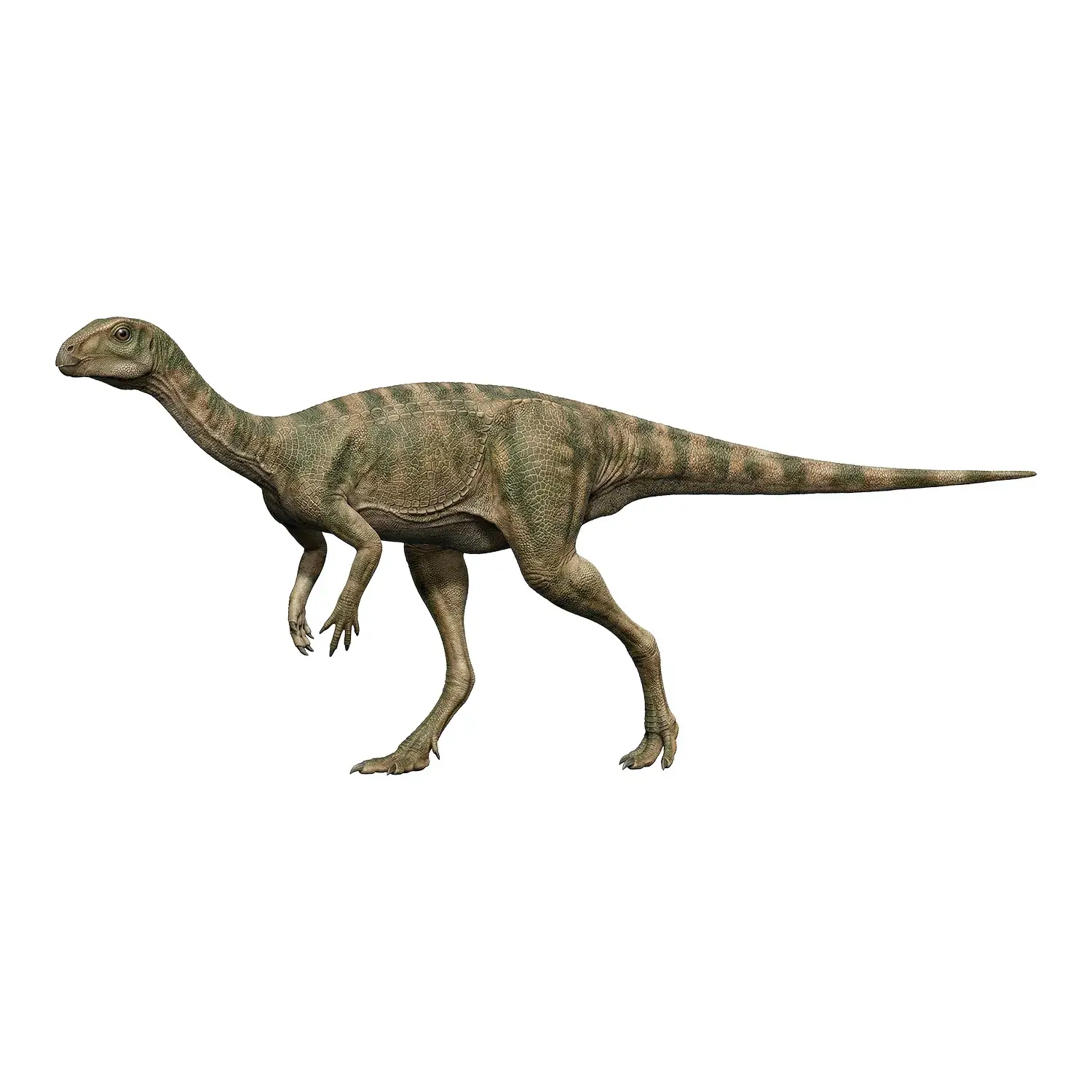
“Talenkauen,” described in 2004, is known for having armor plates on its flanks.
However, this armor was extremely thin and unreliable for protection against enemy attacks.
Meaning “Small Skull”: Appearance Similar to Dryosaurus
Origin of the Name and Size
The scientific name Talenkauen means “small skull.”
Its total length was approximately 4 meters.
Described in 2004, this dinosaur is one of the representative ornithopods of South America.
Retaining Traces of the Jurassic
Its appearance closely resembles “Dryosaurus,” which flourished in North America and Africa during the distant Jurassic period, but Talenkauen is characterized by a longer neck.
It is an intriguing specimen that sheds light on the evolutionary process these dinosaurs underwent in the Southern Hemisphere during the Late Cretaceous.
Only 3mm Thick! The Mystery of the “Too Thin Armor”
The most distinctive feature of Talenkauen is the “armor plates” that lined its flanks.
While one might imagine thick, sturdy armor like that of Ankylosaurus when thinking of armored dinosaurs, their armor was quite unique.
Unreliable Defense?
The plates were only about 3mm thick.
Compared to the heavy armor of stegosaurs (Stegosaurus family) and ankylosaurs (Ankylosaurus family), this was excessively thin, and its physical defensive capability against the fangs and claws of carnivorous dinosaurs was likely quite unreliable.
Flight Over Defense? The “Run Away” Survival Strategy
Why, then, did they possess such thin armor?
While its full function remains a mystery, their primary means of defense was not to withstand attacks using this armor.
Lightweight Body and Long Legs
Talenkauen possessed a lightweight body and long hind limbs.
Its greatest weapon was this physical ability; when attacked by predators, it is believed to have protected itself by using its speed to “run away.”
The thin armor may have played merely an auxiliary role, or perhaps it served a different purpose entirely (such as display).