[Dinosaur History] What Era Did They Live In? A Complete Breakdown of the Timeline from Dawn to Extinction
Dinosaurs are perhaps the most dramatic and imagination-capturing creatures in Earth’s history.
Striding across the land with their massive bodies and reigning at the top of the ecosystem, when did they first appear, what environmental changes did they survive, and why did they suddenly vanish?
Learning about the era in which dinosaurs lived is an epic journey to unravel the “dynamic history of Earth,” including continental drift, drastic climate changes, and threats from outer space.
What is the “Geological Time Scale” That Marks the History of Dinosaurs?
To understand the history of dinosaurs, we must first look at the “geological time scale,” which divides Earth’s 4.6 billion-year history into segments based on milestones in biological evolution and crustal movements.
Geological time is broadly divided into the Precambrian and the Phanerozoic Eon, a period rich in fossils.
The Phanerozoic is further divided from oldest to youngest into three eras: the Paleozoic, Mesozoic, and Cenozoic.
It was during the Mesozoic Era that dinosaurs first appeared and massively thrived.
The Mesozoic Era is further subdivided into the following three periods:
The Triassic Period
The era when dinosaurs first “emerged” in the world.
The Jurassic Period
The golden age when dinosaurs truly became gigantic and enjoyed “massive prosperity.”
The ancestors of birds also appeared during this time.
The Cretaceous Period
The era when dinosaurs like Tyrannosaurus appeared, marking the peak of their diversity.
This is also the era when all non-avian dinosaurs faced “extinction.”
The Eve of the Dinosaurs: A Harsh Earth and the Largest “Mass Extinction” in History
Long before dinosaurs appeared, during the Paleozoic Era (Mid-Carboniferous to Late Permian: roughly 320 to 260 million years ago), the Earth was cold and covered by vast glaciers.
The Formation of the Supercontinent Pangea
At the end of the Permian period (about 250 million years ago), the world’s continents collided and merged to form a single giant landmass known as the “Supercontinent Pangea.”
Vast deserts spread across the deep interior far from the ocean, creating a harsh climate with extreme temperature differences—scorching hot summers and freezing cold winters.
A Crisis for Life on Earth: “The Permian-Triassic (P-T) Mass Extinction”
Around the same time as the formation of the supercontinent, the greatest catastrophe in history occurred, wiping out over 90% of all species on Earth.
The cause was a combination of the following factors:
Massive Volcanic Activity
Rapid cooling caused by volcanic ash and dust, followed by extreme global warming due to greenhouse gases.
Lethal Oxygen Depletion
Volcanic gases consumed oxygen, causing atmospheric oxygen levels to plummet from around 30% to roughly 12%.
Due to this unprecedented mass extinction, creatures that once dominated the seas, such as trilobites, completely disappeared.
The few surviving organisms were forced to find new evolutionary paths in this extremely dry, low-oxygen world.
The Triassic Period: The “First Dinosaurs” Born in a Low-Oxygen Wasteland
The Triassic Period, the dawn of the Mesozoic Era, is further divided into specific epochs and ages.
| Triassic | Early | Induan Age |
|---|---|---|
| Olenekian Age | ||
| Middle | Anisian Age | |
| Ladinian Age | ||
| Late | Carnian Age | |
| Norian Age | ||
| Rhaetian Age |
The Era of “Underdogs” Hidden in the Shadows of Giant Crocodiles
Approximately 230 million years ago (Late Triassic), “dinosaurs” finally made their appearance on the Pangean supercontinent, where oxygen levels were a mere 12%.
At the time, the true rulers of the land were “giant crocodilian reptiles” like the Rauisuchians, which grew to over 8 meters long.
In contrast, the very first dinosaurs, such as Eoraptor and Eodromaeus, were small creatures measuring only about 1 meter in length.
They lived as “underdogs,” scurrying out of sight of the giant crocodiles, but by acquiring “bipedalism”—the ability to stand and walk on their hind legs—they enabled highly efficient movement, marking the first step toward their future massive success.
The End-Triassic Mass Extinction and a Shift in Power
Around 208 million years ago (Rhaetian age), a combination of falling “comet fragments” from space and massive volcanic activity triggered another mass extinction.
The giant crocodilian reptiles could not withstand the drastic environmental changes and went extinct, but the dinosaurs survived.
Ironically, the reason for this was “because they were small.”
- Highly fuel-efficient (they required less food and energy)
- Fast generation turnover (they could rapidly recover their population when environmental conditions improved)
With the crocodilian reptiles gone, dinosaurs leaped onto the stage of the Jurassic Period as the true leading stars.
The Jurassic Period: The Breakup of Pangea and the Golden Age of Giant Dinosaurs
The chronological divisions of the Jurassic Period, when dinosaurs evolved their bodies to ultimate gigantic proportions, are as follows:
| Jurassic | Early | Hettangian Age |
|---|---|---|
| Sinemurian Age | ||
| Pliensbachian Age | ||
| Toarcian Age | ||
| Middle | Aalenian Age | |
| Bajocian Age | ||
| Bathonian Age | ||
| Callovian Age | ||
| Late | Oxfordian Age | |
| Kimmeridgian Age | ||
| Tithonian Age |
A Lush “Greenhouse Earth” and the Gigantism of Dinosaurs
Entering the Jurassic, the supercontinent Pangea began to break apart, and ocean currents started circulating the Earth’s heat, changing the extreme weather into a mild and humid climate.
Carbon dioxide levels in the atmosphere reached about ten times current levels, and the strong greenhouse effect created a lush paradise of vegetation.
With an inexhaustible food supply, dinosaurs dramatically “increased in size,” and species like Stegosaurus, Diplodocus, and Allosaurus reached the peak of their evolution in these rich forests.
Furthermore, during the Middle Jurassic (about 150 million years ago), a primitive bird called Archaeopteryx emerged from a group of theropods, acquiring the ability to fly and expanding the stage of evolution into the sky.
The Cretaceous Period: An Explosion of Diversity and Ultimate Dinosaur Evolution
The subdivisions of the Cretaceous Period, which produced the most diverse forms of dinosaur evolution, are as follows:
| Cretaceous | Early | Berriasian Age |
|---|---|---|
| Valanginian Age | ||
| Hauterivian Age | ||
| Barremian Age | ||
| Aptian Age | ||
| Albian Age | ||
| Late | Cenomanian Age | |
| Turonian Age | ||
| Coniacian Age | ||
| Santonian Age | ||
| Campanian Age | ||
| Maastrichtian Age |
The Appearance of “Fruiting Plants” and the Co-starring of Star Dinosaurs
During the Cretaceous Period (from about 145 million years ago), the continents became further fragmented, allowing isolated dinosaurs to undergo unique evolution in different regions.
The catalyst for this evolution was the emergence of “angiosperms (fruiting and flowering plants),” which had significantly higher nutritional value (calories).
Able to consume energy far more efficiently, dinosaurs advanced their evolution, developing armor and horns, and building complex social structures.
Star dinosaurs that remain incredibly popular today, such as Triceratops, Ankylosaurus, Spinosaurus, and the absolute king, Tyrannosaurus Rex, emerged one after another.
*Oceanic Anoxic Event (about 120 million years ago)
In the marine world, massive submarine volcanic eruptions caused a depletion of oxygen, leading to the extinction of ichthyosaurs.
Afterwards, plesiosaurs (like Plesiosaurus) and Mosasaurus-type marine reptiles became the new rulers of the oceans.
A Sudden End: The Giant Asteroid Impact and the “Impact Winter”
The age of dinosaurs came to a close at the “K-Pg boundary,” which marks the divide between the Mesozoic and Cenozoic Eras.
According to the latest precise measurements (Professor Paul Renne, 2015), this event is now confirmed to have occurred “about 66 million years ago” (the previous accepted theory was about 65.5 million years ago).
A Cascading Hell and the Complete Collapse of the Food Chain
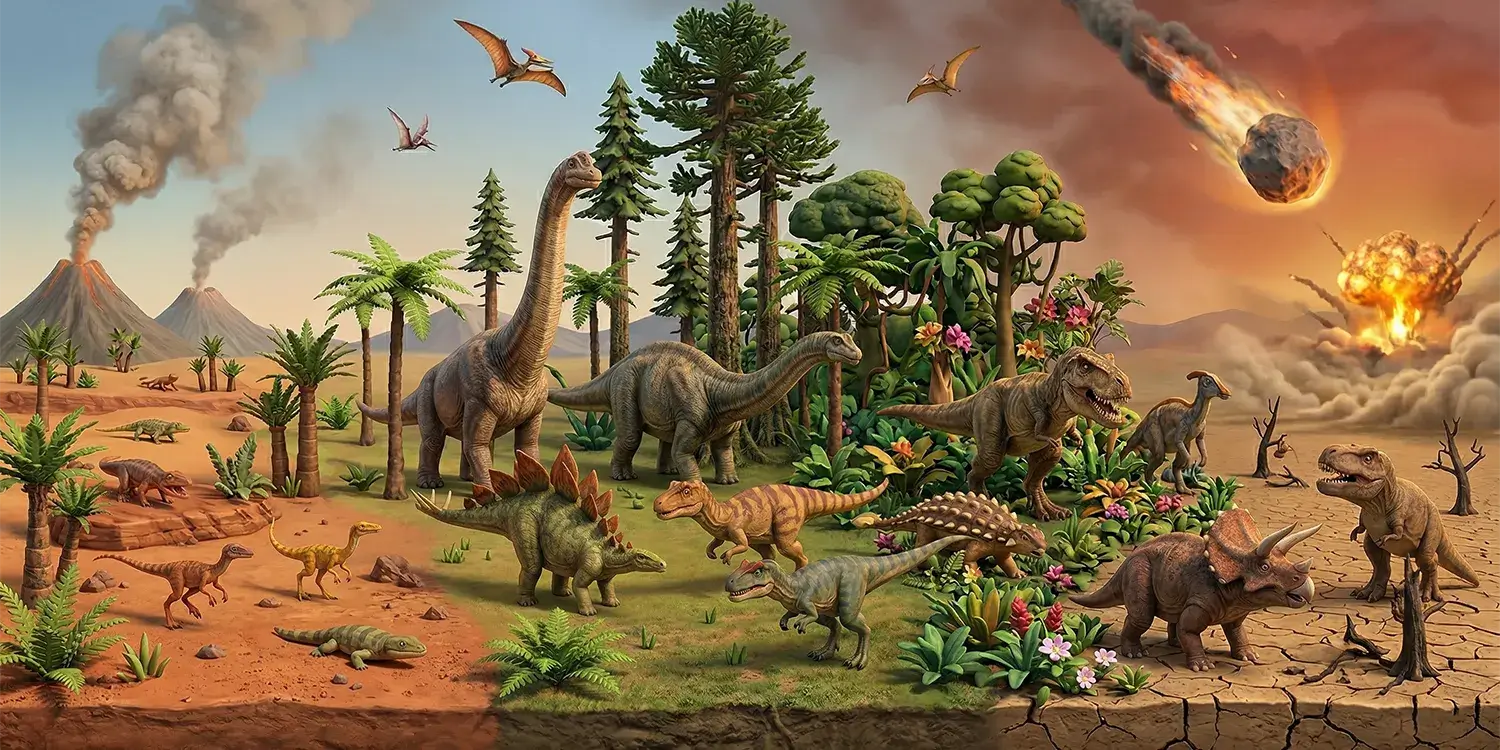
A massive asteroid approximately 10 km in diameter slammed into the Earth at tremendous speed off the coast of the present-day Yucatán Peninsula in Mexico (the Chicxulub Crater).
Direct Destruction
A horrific shockwave, extreme heat, and mega-tsunamis reaching up to 300 meters high were generated.
Massive Wildfires
Fragments of rock re-entering the atmosphere created frictional heat, igniting global forest fires.
Impact Winter
Enormous amounts of dust kicked into the atmosphere completely blocked out the sunlight.
The Earth was plunged into prolonged darkness and rapid cooling.
As sunlight failed to penetrate, plants died off, causing herbivorous dinosaurs to starve, which in turn brought down the carnivorous dinosaurs. This “complete collapse of the food chain” is believed to have severed the glory of the dinosaurs that had lasted for approximately 160 million years.
The Dinosaur Story is Not Over
The only ones that went extinct at the end of the Cretaceous Period were “non-avian dinosaurs.”
A portion of small theropods—which continued to evolve from Archaeopteryx born in the Jurassic, possessing feathers and the ability to fly—managed to beautifully survive the devastating extinction event.
They explosively diversified during the Cenozoic Era and evolved into the “birds” that rule the skies of our Earth today.
Sparrows, crows, and even penguins are, taxonomically speaking, perfectly classified as “surviving dinosaurs.”
The tale of life for the dinosaurs, having slipped through the flames of the asteroid and the rigors of extreme environmental change, did not end in extinction. It continues to be powerfully spun, right by our side, even today.









![[Latest Research] What Was the Function of Spinosaurus's Giant "Sail"? Exploring the Mysteries of Thermoregulation and Underwater Locomotion](https://dinosaurmuseum.jp/wp/wp-content/uploads/eyecatch_spinosaurus-sail-function_en-1024x512.webp)
![[Latest Discovery] A Third Type of Skin, Neither Scales Nor Feathers? Meet "Haolong dongi," a New Dinosaur Species Covered Entirely in Spikes](https://dinosaurmuseum.jp/wp/wp-content/uploads/eyecatch_dinosaur-spiky-skin-discovery_en-1024x512.webp)