
Anchiornis
Name Origin
Almost bird
Classification
Diapsida, Saurischia, Theropoda
Habitat (Discovery Location)
China
Period
Approximately 161 to 151 million years ago (Late Jurassic)
Length
Approximately 34 to 40 centimeters
Weight
Approximately 110 to 250 grams
Diet
Carnivore (Meat-eater)
You might also like... 

-
 Imperobator
- Classification
- Theropods
- Characteristics
- Carnivorous
- Era
- Cretaceous period
- Nigersaurus
- Classification
- Sauropods
- Characteristics
- Herbivorous
- Era
- Cretaceous period
- Pycnonemosaurus
- Classification
- Theropods
- Characteristics
- Carnivorous
- Era
- Cretaceous period
- Kronosaurus
- Classification
- Marine reptiles
- Characteristics
- Carnivorous
- Era
- Cretaceous period
-
Sponsored Links
-
Sponsored Links









![[Latest Research] What Was the Function of Spinosaurus's Giant "Sail"? Exploring the Mysteries of Thermoregulation and Underwater Locomotion](https://dinosaurmuseum.jp/wp/wp-content/uploads/eyecatch_spinosaurus-sail-function_en-1024x512.webp)
![[Latest Discovery] A Third Type of Skin, Neither Scales Nor Feathers? Meet "Haolong dongi," a New Dinosaur Species Covered Entirely in Spikes](https://dinosaurmuseum.jp/wp/wp-content/uploads/eyecatch_dinosaur-spiky-skin-discovery_en-1024x512.webp)





Description
When you think of the age of dinosaurs, you might imagine reptiles with drab colors like brown or gray.
However, modern paleontology is dramatically rewriting that common perception.
The key player in this shift is Anchiornis, an incredibly important dinosaur that astonished researchers worldwide.
Anchiornis stands as a monumental landmark in the history of dinosaur research.
Since its initial discovery in 2009, hundreds of exceptionally well-preserved fossil specimens have been confirmed, making it the most completely preserved feathered dinosaur from the Jurassic period.
Resolving the Evolutionary Contradiction: The “Temporal Paradox”
The discovery of Anchiornis solved a major contradiction within the scientific community.
This was the resolution of the “temporal paradox.”
In the past, Archaeopteryx, considered the oldest known bird, lived about 150 million years ago. However, many of the feathered dinosaurs thought to be its ancestors had only been found in newer rock layers from the Cretaceous period.
The Past Contradiction
Why did the ancestors only exist in a newer era than their descendant (Archaeopteryx)?
The Discovery of Anchiornis
It was discovered in Jurassic strata approximately 10 million years older than Archaeopteryx.
This proved that dinosaurs with bird-like features already existed before the appearance of Archaeopteryx, making the theory of evolution from dinosaurs to birds even more solid.
A Historical First! “Dinosaur Colors” Restored with Scientific Evidence
The biggest reason Anchiornis is world-famous is that it became the “first dinosaur in history to have its entire body coloration scientifically restored.”
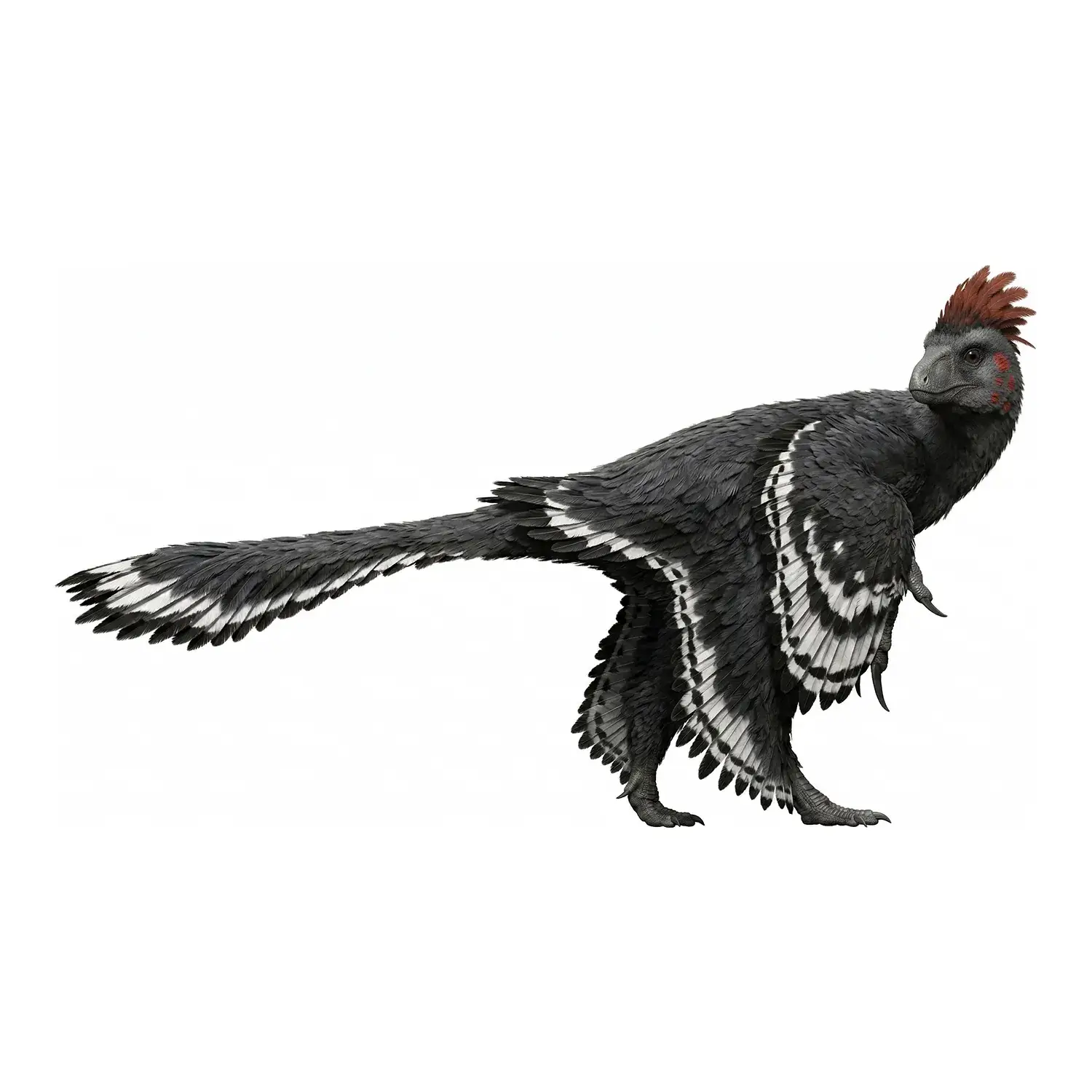
In 2010, a research team analyzed traces of feathers preserved in the fossils using an electron microscope and discovered microscopic pigment cells called “melanosomes.”
By comparing their shape and density to those of modern birds, the team successfully identified the dinosaur’s body colors.
The Restored Stylish Colors
This discovery strongly suggests that dinosaurs utilized advanced coloration for communication with peers and visual appeals (displays) to attract mates.
The “Glider” Dancing Through the Forest on Four Wings
A major feature of Anchiornis is that it was in a “four-winged” state, possessing well-developed flight feathers not only on its forelimbs but also on its hindlimbs.
While it is believed that they could not achieve powered flight by flapping their wings like modern birds, it is speculated that they skillfully used their hind limb wings for the following purposes:
This discovery supports the evolutionary scenario in which dinosaurs went through a “four-winged gliding stage” before their hind limb wings eventually regressed, transitioning into the “two-winged flight” seen in modern birds.
The Discovery of “Pellets” Revealing Realistic Ecology
Among the hundreds of fossils, there were also fossils of “pellets” (regurgitated masses) that reveal what they ate while alive.
A pellet is a mass of indigestible bones and scales that is regurgitated from the mouth after swallowing prey whole.
Bones of lizards and fish have been found in the pellets of Anchiornis, revealing that they preyed on these creatures near the water or up in the trees.
Furthermore, the behavior of regurgitating unnecessary matter is an adaptive trait to lighten the body and make flying or gliding easier. From this perspective as well, we can see that they were incredibly close to birds.
A Fluctuating Classification: Dinosaur or Bird?
Passionate debates continue among paleontologists today regarding the exact classification of Anchiornis.
The Troodontidae Theory
A common theory suggesting they are phylogenetically close.
The Archaeopterygidae Theory
A leading theory arguing that they should be included in this family because they are extremely close to birds.
The Anchiornithidae Theory
A theory that establishes a new family grouping to include closely related species (such as Caihong).
The sheer number of these debates, with even encyclopedias differing in their classifications depending on the publisher, shows that this creature truly sits on the “boundary line between dinosaurs and birds.”
Anchiornis, whose name means “almost bird,” has helped unravel the mystery of bird origins and showed us the “true colors of a dinosaur” for the first time.
With its four wings spread and its reddish-brown crest fluttering as it glided through the Jurassic forests, this creature can truly be called a “miraculous bridge” connecting dinosaurs and birds.