
Angaturama
Name Origin
Brave one (from the language of the indigenous Tupi people of Brazil)
Family
Spinosauridae
Classification
Diapsida, Saurischia, Theropoda
Habitat (Discovery Location)
Brazil
Period
Approximately 110 million years ago (Early Cretaceous)
Length
Approximately 7 to 8 meters
Diet
Piscivore (Fish-eater)
You might also like... 

-
 Pyroraptor
- Classification
- Theropods
- Characteristics
- Carnivorous
- Era
- Cretaceous period
- Aquilops
- Classification
- Marginocephalia
- Characteristics
- Herbivorous
- Era
- Cretaceous period
- Pteranodon
- Classification
- Flying reptiles
- Characteristics
- Carnivorous
- Era
- Cretaceous period
- Nigersaurus
- Classification
- Sauropods
- Characteristics
- Herbivorous
- Era
- Cretaceous period
-
Sponsored Links
-
Sponsored Links










![[Latest Research] What Was the Function of Spinosaurus's Giant "Sail"? Exploring the Mysteries of Thermoregulation and Underwater Locomotion](https://dinosaurmuseum.jp/wp/wp-content/uploads/eyecatch_spinosaurus-sail-function_en-1024x512.webp)
![[Latest Discovery] A Third Type of Skin, Neither Scales Nor Feathers? Meet "Haolong dongi," a New Dinosaur Species Covered Entirely in Spikes](https://dinosaurmuseum.jp/wp/wp-content/uploads/eyecatch_dinosaur-spiky-skin-discovery_en-1024x512.webp)



Description
Approximately 110 million years ago, during the Early Cretaceous period of the Mesozoic Era.
In the vast wetlands of what is now northeastern Brazil, there lived a uniquely shaped carnivorous dinosaur adapted to both aquatic and terrestrial environments.
This was Angaturama, a member of the spinosaurid family.
Meaning “brave one” in the language of Brazil’s indigenous people, this dinosaur holds its own unique evolutionary history and the “greatest mystery” among the immensely popular spinosaurids.
The Discovery of the “Brave One” and Exceptionally Well-Preserved Fossils
The fossils of Angaturama were discovered in the world-renowned Santana Formation (specifically the Romualdo Formation) in Brazil, a geological site that has also yielded numerous pterosaur and fish fossils.
In February 1996, it was officially described and published by paleontologist Dr. Alexander Kellner and his team, based on the excavated front half of a skull (the snout).
It was given a proud name fitting for a predator that dominated the water’s edge with its imposing physique.
A Crocodile-Like Head and Specialization for a “Piscivorous” Diet
Angaturama underwent a unique evolutionary path that set it apart from typical carnivorous dinosaurs like Tyrannosaurus.
A Narrow Snout to Minimize Water Resistance
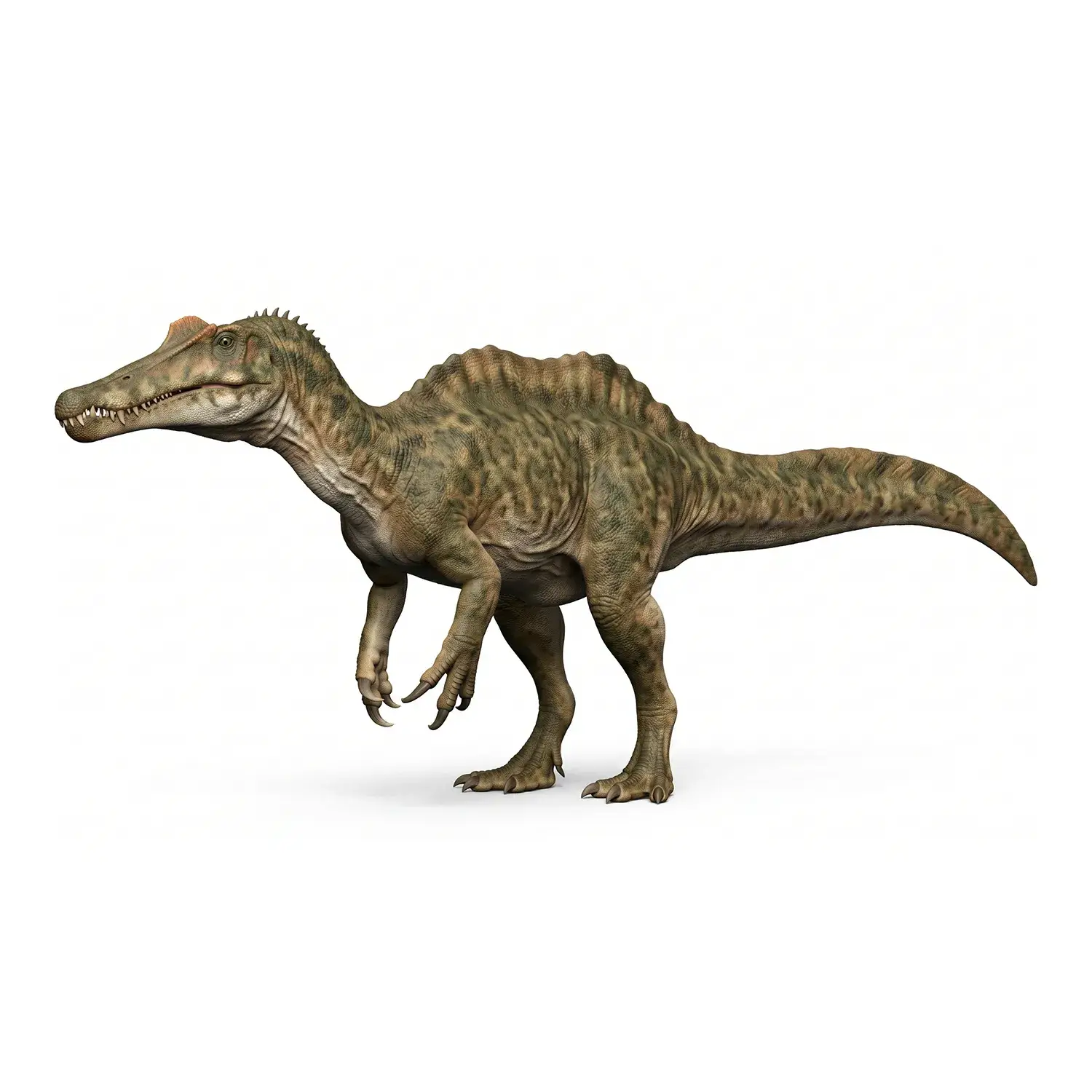
Its most prominent feature was its long, slender snout (the area from the tip of the nose to the mouth), which was extremely narrow in width, much like that of a crocodile.
“Conical Teeth” Lacking Serrations
While typical carnivorous dinosaurs had serrations (jagged edges) for tearing flesh, the teeth of Angaturama lacked serrations and were “conical” with vertical ridges on the surface.
This structure closely resembles that of modern fish-eating crocodiles and is specialized for firmly “gripping and piercing” thrashing, slippery fish.
Based on these characteristics, it is speculated that rather than chasing prey on land, they lived a “semi-aquatic” lifestyle, using their swimming abilities to prey primarily on fish near the water, much like modern crocodiles.
The Role of the Back Sail and Head Crest
On its head, it had a crest-like structure known as a “sagittal crest.”
Furthermore, based on the skeletons of closely related species, it is believed to have had a “sail” on its back formed by highly developed neural spines.
Two main theories have been proposed regarding its purpose:
The Thermoregulation (Radiator) Theory
The sail was laced with numerous blood vessels, allowing the dinosaur to raise its body temperature by basking in the sun or lower it by catching the wind.
The Display Function Theory
It was used as a flashy visual display to make the dinosaur appear larger and more attractive during territorial disputes or courtship behaviors.
Paleontology’s Greatest Mystery: The Relationship With “Irritator”
The greatest mystery that cannot be ignored when discussing Angaturama is its relationship with “Irritator,” a very similar dinosaur named in 1996 from the same Romualdo Formation.
Because their era, discovery location, and classification match perfectly, it has long been suggested that “these two might be the exact same dinosaur (the same species).”
However, there is a major dilemma preventing physical proof.
Angaturama
Only the “front half” of the skull has been found.
Irritator
Only the “back half” of the skull has been found.
Because there are no overlapping parts, a direct physical comparison is impossible. Arguing that they would fit together like a puzzle to form a single skull, many suggest treating Angaturama as a “junior synonym” (an invalid alternate name given later) and integrating it into Irritator in encyclopedias and other texts.
On the other hand, a detailed analytical study in 2017 concluded that “these did not come from the same individual,” based on differences in fossil preservation, color, and structure.
In particular, it was pointed out that the snout of Angaturama clearly belonged to a slightly larger individual.
Were Angaturama and Irritator the exact same dinosaur, or were they separate, closely related species coexisting while dividing ecological niches near the water?
A definitive conclusion has yet to be reached.
Precisely because a complete skeleton has not been found, it stirs our imagination, leaving us waiting eagerly for the full picture of this fascinating “brave one” of the wetlands to be revealed.