
Kamuysaurus
Name Origin
Deity lizard
Family
Hadrosauridae
Classification
Diapsida, Ornithischia, Ornithopoda
Habitat (Discovery Location)
Japan
Period
Approximately 72 million years ago (Late Cretaceous)
Length
Approximately 8 meters
Weight
Approximately 4 to 5.3 metric tons
Diet
Herbivore (Plant-eater)
You might also like... 

-
 Byronosaurus
- Classification
- Theropods
- Characteristics
- Carnivorous
- Era
- Cretaceous period
- Pelecanimimus
- Classification
- Theropods
- Characteristics
- Carnivorous
- Era
- Cretaceous period
- Diplodocus
- Classification
- Sauropods
- Characteristics
- Herbivorous
- Era
- Jurassic period
- Corythoraptor
- Classification
- Theropods
- Characteristics
- Herbivorous
- Omnivorous
- Era
- Cretaceous period
-
Sponsored Links
-
Sponsored Links









![[Latest Research] What Was the Function of Spinosaurus's Giant "Sail"? Exploring the Mysteries of Thermoregulation and Underwater Locomotion](https://dinosaurmuseum.jp/wp/wp-content/uploads/eyecatch_spinosaurus-sail-function_en-1024x512.webp)
![[Latest Discovery] A Third Type of Skin, Neither Scales Nor Feathers? Meet "Haolong dongi," a New Dinosaur Species Covered Entirely in Spikes](https://dinosaurmuseum.jp/wp/wp-content/uploads/eyecatch_dinosaur-spiky-skin-discovery_en-1024x512.webp)



Description
During the 186-million-year reign of the dinosaurs, the Japanese archipelago was largely submerged at the bottom of the deep sea. Because of this, it was long considered “common sense” that finding fossils of terrestrial dinosaurs in Japan was extremely difficult.
However, a major discovery in Mukawa Town (the former Hobetsu Town district) in Hokkaido completely overturned this conventional wisdom.
This discovery was “Kamuysaurus japonicus” (commonly known as the Mukawaryu, or Mukawa dragon), unearthed from Late Cretaceous marine strata.
From Slumber in a Storage Room to a Global Discovery! A Miraculous Story
The journey leading up to the unveiling of Kamuysaurus was nothing short of a continuous drama.
2003–2004: Seven Years of Slumber
A fossil enthusiast discovered an unusual fossil and donated it to the Hobetsu Museum.
Initially identified as belonging to a crocodile or perhaps a “plesiosaur,” it ended up sleeping in the museum’s storage room for seven years without ever being displayed.
2011: An Expert’s Insight and Prophecy
While preparing the fossil, Associate Professor Tamaki Sato, a plesiosaur expert, realized that “this is not a plesiosaur bone.”
She contacted Associate Professor (now Professor) Yoshitsugu Kobayashi of Hokkaido University, who definitively identified it as a “dinosaur tail.”
He made a bold prediction: “There is a high probability it was washed out to sea by a tsunami or similar event, and buried in the seafloor mud before scavengers could consume it. If we keep digging, we should find an entire skeleton.”
2013–2014: Excavation of a Complete Skeleton
Betting on this historic possibility, Mukawa Town secured a total of 60 million yen for excavation costs.
The excavation team, led by Professor Kobayashi, saw his prediction brilliantly fulfilled. They unearthed a nearly complete skeleton comprising about 80% of the dinosaur’s total bone volume—the most complete dinosaur skeleton ever found in Japanese history.
The True Face and Ecology of the “Duck-Billed Dinosaur” Revealed by Fossils
The detailed appearance of Kamuysaurus has become clear thanks to the discovered complete skeleton.
A Slender Build and Walking Style
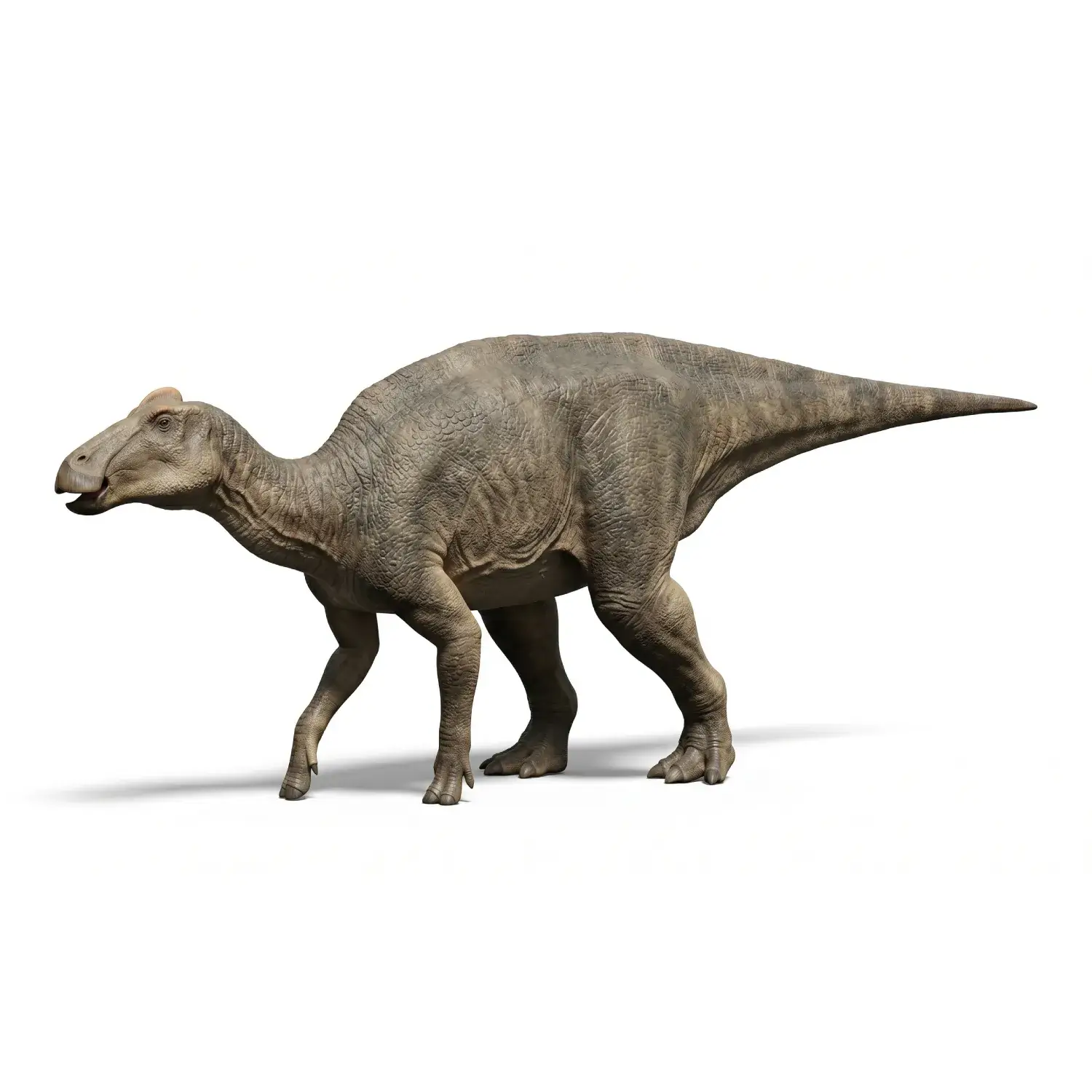
At approximately 8 meters (26.2 feet) in length, it is about average size for the Hadrosauridae family, but it features a notably slender body overall.
Equipped with a sturdy neck and torso, it primarily moved on all fours while using its long tail for balance (though it was also capable of bipedal walking).
A Flat Mouth Suited for a Herbivorous Diet
Possessing the “flat, beak-like mouth” characteristic of duck-billed dinosaurs, it efficiently gathered and consumed vegetation near the water’s edge.
Unique Skeletal Structure
Despite being an adult, its skull was relatively tall, suggesting it may have had a flat “crest” atop its head.
Additionally, it possessed slender forelimbs and a highly unique skeletal feature where the neural spines of its 6th and 12th dorsal vertebrae tilted “forward.”
The Life of the “Mukawa Dragon” Revealed by Bone “Tree Rings”
Amazingly, paleontologists have been able to decipher this individual’s entire life from the internal structure of its bones.
By examining a cross-section of its tibia (shin bone), researchers identified nine “lines of arrested growth” (LAGs) that resemble the rings of a tree.
When calculating to account for lines that had been remodeled and lost over time, its age at death was estimated to be 12 to 13 years old.
Furthermore, the bones revealed that it underwent a rapid growth spurt around 3 to 4 years of age, and its growth slowed down as it reached adulthood around 7 to 8 years old.
The Origin of the Name “Japanese Dragon God” and Local Sentiments
In September 2019, incorporating “Kamuy”—which means god or deity in the language of Hokkaido’s indigenous Ainu people—it was officially named “Kamuysaurus japonicus (Japanese dragon god).”
On the other hand, the common name “Mukawaryu” sparked complex discussions. For instance, an association of residents from the former Hobetsu Town (the actual excavation site) submitted a petition with 3,029 signatures arguing that “it should be renamed after the former town name.”
Ultimately, the mayor of Mukawa decided to continue using the name “Mukawaryu.”
The town completed trademark registration and experimented with an ordinance to collect usage fees, illustrating just what a massive asset this great discovery is to the local community.
How It Changed the History of Dinosaur Research in Japan
The discovery of the complete skeleton of Kamuysaurus completely shattered the established theory that “finding a complete dinosaur skeleton in Japan is nearly impossible.”
The fact that a terrestrial dinosaur was found in marine strata provides clear evidence for the “possibility of dinosaur carcasses washing out to sea and fossilizing.”
The life of a single dinosaur, swept away by the waves and sunk to the ocean floor over 70 million years ago, now speaks powerfully to the potential for more discoveries of the century awaiting us in Japan.