
Erlikosaurus
Name Origin
Erlik's Lizard
Family
Therizinosauridae
Classification
Diapsida, Saurischia, Theropoda
Habitat (Discovery Location)
Mongolia
Period
Approximately 90 million years ago (Late Cretaceous)
Length
Approximately 4.5 - 6 meters
Weight
Approximately 500 kilograms
Diet
Herbivore (Plant-eater)
TODAY'S QUIZ
Correct answer = 1 coin
What is one reason why Enigmosaurus and Erlikosaurus are generally classified as separate genera today?
Loading…
You might also like... 

-
 Rapator
- Classification
- Theropods
- Characteristics
- Carnivorous
- Era
- Cretaceous period
- Fukuiraptor
- Classification
- Theropods
- Characteristics
- Carnivorous
- Era
- Cretaceous period
- Tsintaosaurus
- Classification
- Ornithopoda
- Characteristics
- Herbivorous
- Era
- Cretaceous period
- Futalongkosaurus
- Classification
- Sauropods
- Characteristics
- Herbivorous
- Era
- Cretaceous period
-
Sponsored Links
-
Sponsored Links











Description
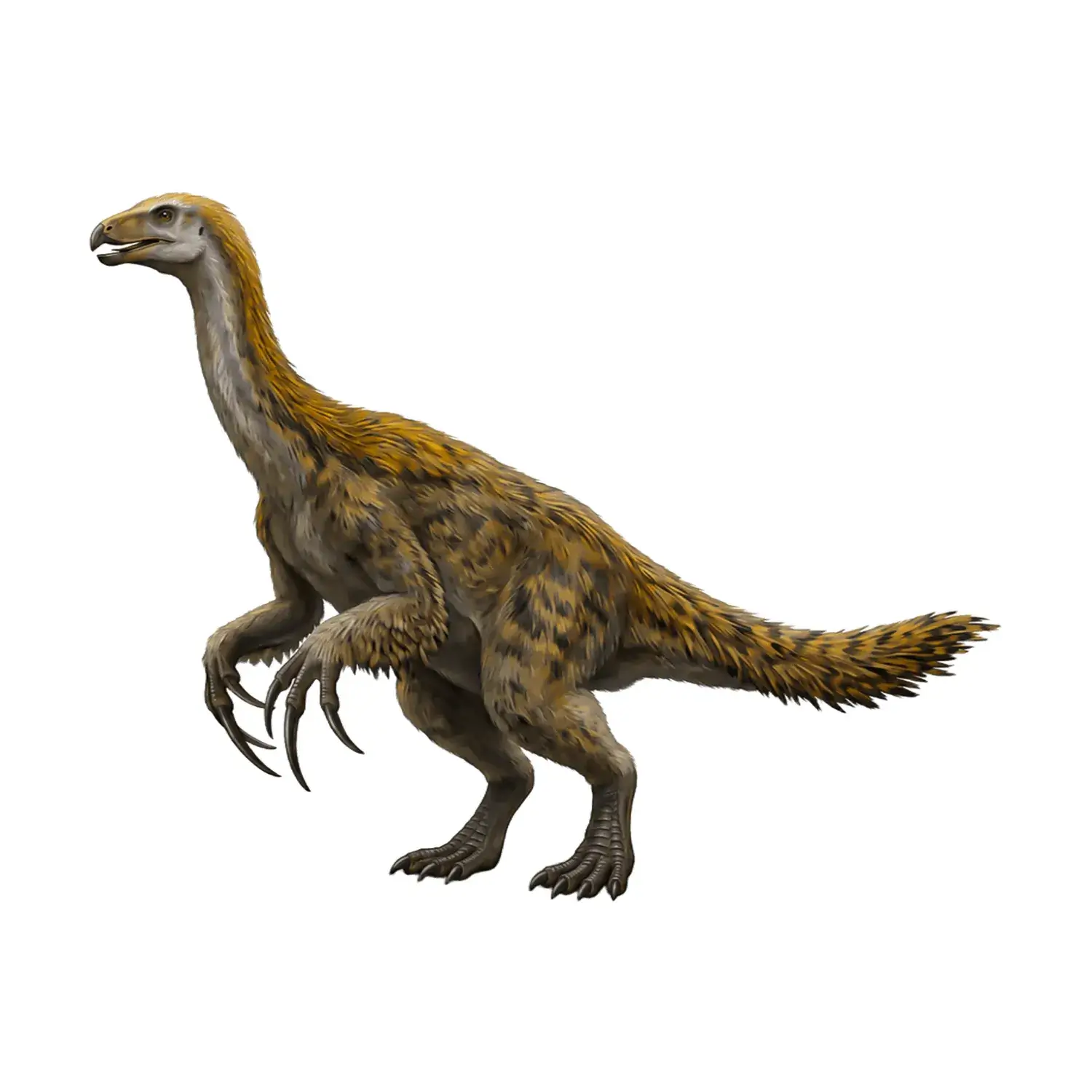
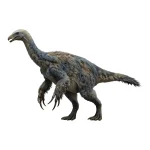
Erlikosaurus was a theropod dinosaur that lived in what is now Mongolia during the Late Cretaceous, approximately 90 million years ago.
It belonged to the family Therizinosauridae and is estimated to have been approximately 4.5 – 6 meters long.
When people think of theropods, they may picture carnivorous dinosaurs such as Tyrannosaurus or Allosaurus.
However, Erlikosaurus is thought to have fed primarily on plants.
It was a dinosaur with unique evolutionary adaptations, including a beak for eating vegetation and pelvic features associated with the development of its digestive system.
Furthermore, studies examining the interior of its skull have revealed that brain regions associated with hearing, smell, and balance were well developed.
Research into its fossil characteristics and brain structure has helped scientists learn more about the body structure and lifestyle of Erlikosaurus.
Fossils Discovered in Mongolia and a Name Derived from Erlik
Erlikosaurus fossils were discovered in 1972 during a joint Soviet-Mongolian expedition in Umnugovi Province, southern Mongolia.
The fossils were found at Baisiin Tsav, within the Bayan Shireh Formation, which is estimated to date back approximately 90 million years.
In 1980, Mongolian paleontologist Altangerel Perle described it as a new genus and species, naming it Erlikosaurus andrewsi, the type species of the genus.
The genus name is derived from Erlik, a demon king appearing in Turkic and Mongolian mythology.
The name means “Erlik’s lizard.”
The species name “andrewsi” was given in honor of American paleontologist Roy Chapman Andrews.
In 1981, Perle redescribed the genus using the spelling “Erlicosaurus,” but the original name “Erlikosaurus” is now recognized as the valid genus name.
A Well-Preserved Skull and a Body Approximately 4.5 – 6 Meters Long
Erlikosaurus is known from a partial skeleton, primarily consisting of a skull.
Representative fossils include a skull with the lower jaw, some cervical vertebrae, the left humerus, and a right foot.
The skull was approximately 25 centimeters long, and the humerus was approximately 30 centimeters long. Its skull is known as one of the better-preserved specimens among therizinosaurs.
Because a complete skeleton has not been found, determining its exact body length is difficult.
Based on the size of the skull, humerus, and other bones, its total length is estimated to have been approximately 4.5 – 6 meters.
These estimates vary, and compared with its close relative Segnosaurus, Erlikosaurus may have had a relatively lighter build.
In an estimate published by Gregory Paul in 2010, Erlikosaurus was approximately 4.5 meters long and weighed approximately 500 kilograms.
A Beak and a Mouth with Approximately 108 Teeth
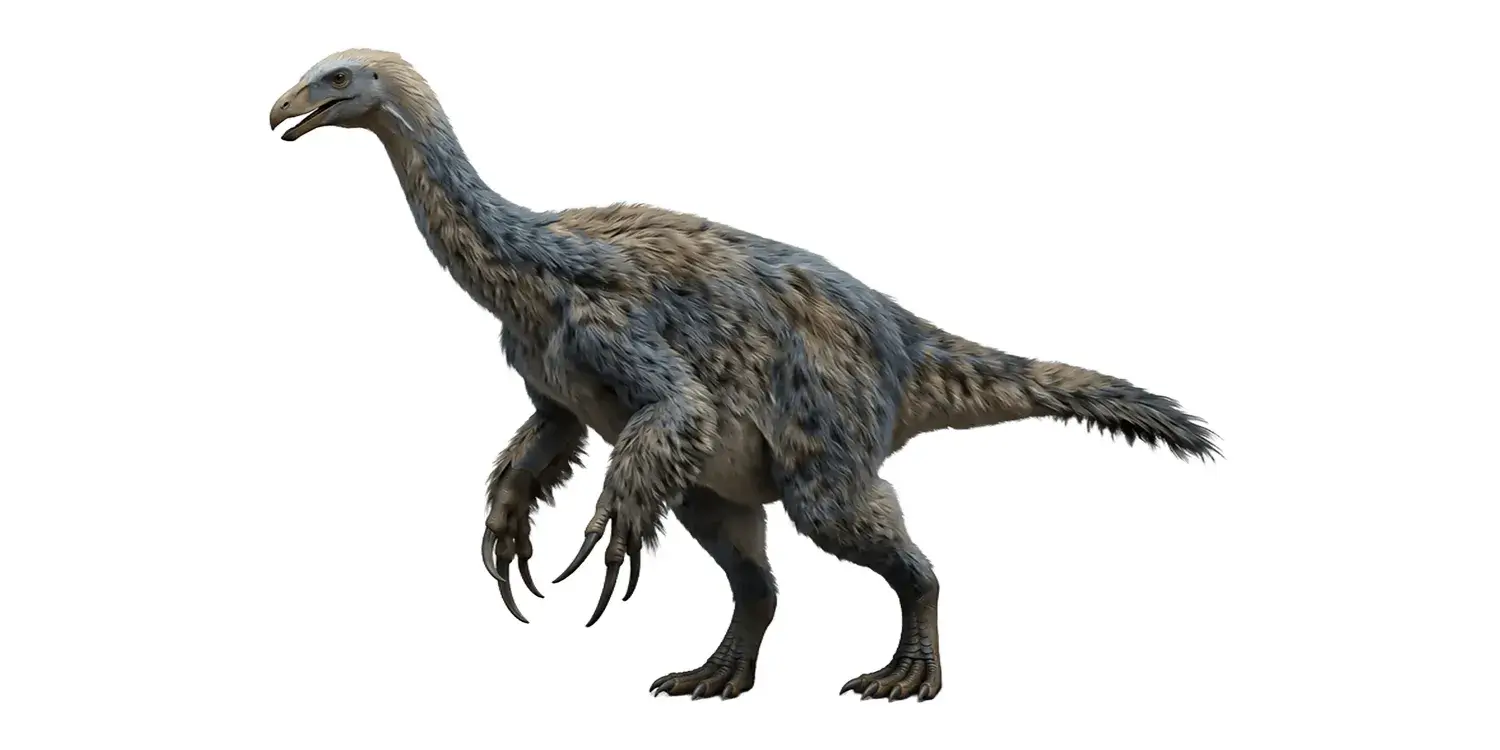
Erlikosaurus had a bony beak at the tip of its snout for picking vegetation.
However, numerous teeth were present behind the beak, so it did not have a completely toothless mouth.
It is believed to have had 23 teeth on each side of the upper jaw and 31 teeth on each side of the lower jaw, for a total of approximately 108 teeth.
The edges of its teeth had fine serrations.
This combination of a beak and teeth is thought to have helped it cut vegetation and manipulate plant material in its mouth.
Distinctive Features Including Elongated Nostrils and Claws
The nostrils of Erlikosaurus were large and elongated, while the rear portion of its braincase was expanded by bones containing internal cavities.
Since therizinosaurs are known to have had feathers, Erlikosaurus may also have been covered in feathers.
Its feet had elongated claws that measured approximately 10 centimeters in length even when measured by the bony core alone.
However, their specific function remains unknown.
Related species had long claws on their forelimbs, which may have been used to pull vegetation closer or for defense.
Therizinosaurs: Theropods That Evolved Toward Herbivory
Although theropods include many carnivorous dinosaurs such as Tyrannosaurus and Allosaurus, therizinosaurs were a group that evolved specialized adaptations for eating plants.
One of their adaptations for feeding on plants was a broad beak at the tip of the snout.
It was suited for cutting vegetation, and their teeth are also thought to have helped process plant material.
Furthermore, therizinosaurs had a distinctive pelvic feature in which the pubis pointed backward.
This structure is also seen in ornithischian dinosaurs and may have been related to accommodating a large digestive system adapted for processing plant matter.
Although the pelvis of Erlikosaurus itself has not been discovered, these features are known from fossils of closely related therizinosaurs.
Because Erlikosaurus belonged to the same group, it is also thought to have fed primarily on plants.
Brain Studies Using CT Scans Revealed Its Sensory Abilities
Research on Erlikosaurus has focused not only on the shape of its skull but also on the structure of the brain housed inside it.
In 2012, a research team led by Stephen Lautenschlager examined the interior of its skull using CT scans.
The results revealed well-developed brain regions associated with smell, hearing, and balance.
Similar features are also found in birds and some carnivorous theropods.
Its forebrain was also considered relatively large and well developed, suggesting that it may have been capable of interpreting its surroundings and performing complex behaviors.
Researchers have suggested that these sensory abilities and brain structures may have helped it engage in social behavior with other individuals and evade predators.
However, specific behaviors cannot be determined from brain shape alone.
Possibly the Same Dinosaur as Enigmosaurus
Enigmosaurus, another therizinosaur, was also discovered in the same Bayan Shireh Formation as Erlikosaurus.
Enigmosaurus was named based on a partial pelvis, and some researchers have suggested that it may have been the same animal as Erlikosaurus.
Since the pelvis of Erlikosaurus has not been found, it is difficult to directly compare the two.
Meanwhile, the pelvis of Enigmosaurus shows differences in features and size from that of its close relative Segnosaurus.
For this reason, some researchers disagree with the idea that the two belonged to the same dinosaur.
As a result, Erlikosaurus and Enigmosaurus are generally still treated as separate genera.